Showing posts with label the damnwriting. Show all posts

Thursday, May 09, 2013

Battling the Blank Page

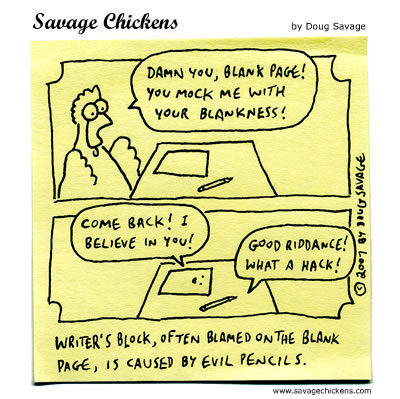
A blank page is daunting. It's a fact. It's a totally illogical fact, but it's a fact.

Sometimes the vast possibilities presented by that which is unwritten can stymie a writer. Sometimes the idea of modifying a pristine white field (whether paper or word processor) with your inadequate first draft is demoralizing. Yet it's completely illogical: possibilities thwarted by the presence of possibilities? An empty sheet of wood pulp seeming more worthy than words representing your unbridled imagination? It's totally illogical -- and yet totally true.

So true, in fact, that I've been given advice my entire life of how to combat it:

In undergrad my creative writing adviser suggested we all draft in pencil because it would feel less permanent than pen therefore allowing us the ability to put mistakes on the page without fear of ruination.

A middle school English teacher forbade our class from writing in pencil because we were too tempted to erase our good ideas along with our bad -- pen only! Mistakes were to be crossed out, but kept. And when we got our writing back from her we saw why: she nurtured all those aborted thoughts of ours and helped us see that we could stretch beyond the safe answers we thought where the "right" answers.

I've known people who type only with their eyes closed. Or who write at night, turn off their desk lamp and pitch the background color of their word processor black so that they can lose awareness of the screen's harsh, mechanical glare. (This does provide sort of an ethereal state, especially if you alter the text color to something whimsical.)

For as many people who swear by ornate "writer helping" software like scrivner, I've heard from just as many who just want a basic word processor -- cut, paste, spellcheck -- because the additional bells and whistles of "writing helping" software can provide as much distraction as assistance.

Lately, even the word processor has become too fancy for me.

Monday, January 28, 2013

Real Conversations Between Writers

Jenny: Got any plans?

Me: Tonight, we edit! ... but say it like "At dawn, we ride!"

Jenny: or "Tonight we dine in HELL!"

Me: ...

Jenny: Well maybe that's a bit too much.

Thursday, January 24, 2013

The Forgetful Kimchi Hypothesis

Last week, I gathered up some hope from the rubble, and took to heart a suggestion from a magazine that I "send again" by embarking on the final edits of a short story I'd left unfinished for months. It only took me one evening of work to come to the hypothesis that good stories are kimchi.

Kimchi is a spicy Korean food which, while different from sauerkraut in taste, is not so different in production: at its heart, Kimchi is just fermented cabbage. I know, who doesn't see decaying cabbage and think, now there's a metaphor for fiction writing, right? But I hold to my hypothesis: stories are kimchi.

Making kimchi involves chopping and combining raw ingredients including the all important napa cabbage. You combine it with other stuff. Then you wait. You don't touch the kimchi. You don't poke at it or check in on it daily. Traditionally, you put the kimchi in an earthenware jar and bury it in the backyard for months, if not a year, depending on the recipe and the seasonal temperature. The burying is to help provide consistency in temperature, although such jars often are stored above ground in courtyards. Most recipes you'll find on the internet suggest that refrigeration is probably the way to go, yet in Korea "you will still see rows of kimchi jars on top of the flat roofs of apartment buildings in the big cities." [source]

Is my hypothesis that writing is nothing more than a slow fermentation process? That's too simplistic a comparison for what I have in mind.

The drafting of a piece fiction does not need to be slow. The current editing project is a short story I dashed off in an evening because of a looming 8:00 AM workshop deadline. But following that quick trot, gathering ingredients, preparing, chopping, mixing, I received thoughtful feedback, and then I stuck it all in an earthenware jar and buried it in the backyard for about eight months.

The story didn't need months to complete its drafting, but for me to go from the piece's writer to its editor I needed that time. It wasn't about the story, it was about me processing the feedback I'd been given and -- more importantly -- it was about me forgetting the process of writing it.

Forgetting is the most important part. When I take an idea from concept to plot to details to words on a page, I am wrapped up in all of it. I know what I meant to write even if it's not what I actually wrote. At the time of creation, I read what I've written and I anticipate my own next moves. I'm unsurprised. I'm unenthusiastic. I'm too in touch with the process of creation. So I have to take the time to forget everything save the vaguest sense of what the story was about.

Eight months after writing the short story, I hauled the jar back inside and revised. I got more feedback. I was much, much closer to being happy with the story. I'd resolved some of my own craft short comings. I'd figured out which parts of the story were too light, and which too weighty. Then I put it back in an earthenware jar and buried it in the backyard for eighteen months. Eighteen.

This is not to say that I did not write during that year and a half. I just wrote other things. I filled other earthenware jars until my folder of Word Docs looked like a Korean courtyard. And on the eighteenth month when I opened this particular jar, I'd forgotten everything about drafting the piece. Finally I could read it as a reader would, as an editor would. Things which the creator in me thought were "necessary" to describe the world were readily apparent as flotsam to be skimmed off. The story found a new opening place. The first five pages were cut and the information therein condensed into a paragraph. The dispersal of information regarding the character's motivation was restructured. The main speculative element was previously nebulous to the reader -- as the writer I'd understood how it worked just fine -- so its description was reworked, condensed. Would you like some kimchi? It's ready.

I understand writing quickly. I think that deadline driven writing is superb, but then again, deadlines are my main source of inspiration. My advice -- if we must boil this down to advice -- is to write fast and edit slow. Give yourself time to forget so that you can meet your story again as a stranger. Play that game TV couples like to engage in, the let's-put-the-past-behind-us-and-pretend-this-is-the-first-time-we-ever-met game. You know the one, where they smile bittersweet smiles at each other and attempt to pick each other up for the first time in spite of their insider information.

Of course, no advice should be treated as sacrosanct. All writers write differently. Yet I am always astounded by those who begin rewriting a piece almost as soon as they've drafted it, those who can go from workshop to second draft within a week, if not a day. Not astounded because they're "doing it wrong" but that they're able to do so all. My memory is by no means a steel trap, but it needs a stretch of time before it can forget a story well enough to allow me to read it afresh, read it like a reader and not like its creator.

---

More thoughts from other people: "Do You Practice Creative Contemplation?" an interesting essay on patience and listening, and while it poo-poos on NaNoWriMo, the mother of all deadlines, I believe that a NaNoWriMo draft, taken with a kimchi recipe approach, is potentially quite serviceable, so I'll cut the essayist a break.

Thursday, June 07, 2012

How to avoid sleep

How to avoid sleep: At Midnight, start working on editing your own short story.

Think, I'll just quickly read through and cut 850 words.

End up adding 100 words.

At 3:00 AM consider going to sleep. But you're so close! Just a few more pages! And you know if you stop now you'll only have to start from the beginning when you pick it up tomorrow.

Continue reading and editing. Tinker with emphasis of theme. 5:00 AM and the story's complete.

Format to market's guidelines.

Mail.

Congratulations, it's now 5:30 AM. Dawn is doing that rosy finger thing that poets write about.

Consider whether it's better to sleep til late afternoon or put on a pot of coffee and work through it.

You're wide awake and you make your own hours, so why not?

Besides, early-early morning is great for getting work done! No one bothers you because no one's awake! And those who are awake don't bother you because they don't think anyone else is awake.

Thursday, November 03, 2011

NaNoWriMo: Dangerous Decisions

I've made what may amount to a dangerous NaNoWriMo decision: the three day writing week.

I have a semi-traditional schedule in that I work 40 hours or more per week, but I work most of that over just four days (with occasional exceptions). This means that I spend a chunk of the week wearing myself thin, then a chunk being cranky, and a third chunk recovering from the wear and crankiness. The end result is that I've decided to write my NaNoWriMo novel over only the three days each week when I am in my non-work-for-paycheck recovery mode.

Or, in lay terms, I've not yet started writing.

This could be brilliant -- a clear cut separation between work and play that doesn't muddy the waters or attempt to spread out the pain.  Or it could be a death knell -- an insurmountable task to write 50,000 words in fourteen days instead of thirty days. (Isn't it nifty how Thanksgiving added in all those non-working days for me? Nifty nifty nif -- yeah, I really should think of a different word but can't.)

How's progress?

Saturday, April 16, 2011

Motivation, Making it happen, and Me

Three M concepts for today.  Let's start with "me":  my crusader challenge interview is up on Cerebral Lunchbox today.  Check it out here.

Motivation is one of those tricky, intangible forces of the universe.  If I push on a block of wood, that's a force that can be seen.  But like gravity and centripetal force, motivation can't be seen.  But it can be felt and measured.

Okay, so there is no standardized means of measuring motivation, but I'm certain you could make a personal scale if you wanted to.  You know when the force of motivation is affecting you and you know when it's absolutely not part of the picture.  The question is, can a body at rest perform work without the influence of motivation?

Did I just make the part of your brain that vaguely remembers high school physics freak out? Because I definitely have a little part of my brain spazzing out right now.

There's so much involved to go from body at rest, to applying motivational force, to making it happen -- whatever "it" is.  Take for instance the garbage disposal.

Several months ago -- yes, months -- I convinced my garbage disposal to stop working when I stuck a lemon half down it and the disposal protested by stopping and not starting.  I thought I'd burned out the motor.  I thought I needed to go put in a work order with the apartment office idiots (oh, I have reason to think very little of my on-site staff, like when they said they were taking me to court for over a thousand dollars of unpaid rent and then it turned out they owed me $70).  And then wait for lord knows how long for a repair man to show up for my not-very-urgent repair.  And I, of course, would want to be home for this so that my cats would not dart off into the wide yonder when the repair guy came into the place if I wasn't here.

So I put it off.  And put it off.  There was no motivation to get it fixed.  I had another sink I could use, so I did.  I had a working dishwasher I could use, so I did.  It wasn't convenient, but it was manageable, therefore cancelling out any force that might have become motivation to fix the situation.

And this is where "what I've learned from the TV show Dexter" comes into play.  Srsly.

Then, during my marathoning of four seasons of Dexter, I watched the character Dexter "break" a garbage disposal, take it apart to look for evidence, and flip a switch to get it going again.  And I was like, wtf? there's a switch down there? So I wondered over to my garbage disposal, looked underneath, and sure enough, there's a reset button down there.  Ten seconds later: working garbage disposal.

I learned a lifeskill from watching Dexter -- how many people can say that?
 

Monday, February 14, 2011

Wash, rinse, repeat: how novels are born

This morning, theLiz was telling me that she got a brill idea while in the shower.  She practically wrote the whole opening chapter and figured out how to reframe the novel/story so that it would be less work to develop and write!  Ah! Ray-of-light-shining-down-on-the-hilltop moment!

"Why," she said, "do I always get great ideas in the shower?"

"It's the only time you're not multitasking and overworked," I said.  "Wash, rinse, repeat, doesn't require higher brain function, so your subconscious shows up and says by the way, I've found a solution for that problem you were working on, I just didn't want to bother you while you were busy earlier."

She's not the only writerly friend of mine who does some of her best plotting in the shower.  Me? I'm not a shower-plotter.  In the shower I rehearse lectures I'm thinking of giving in the classes I teach.  Or I rehash conversations that I wish had gone differently -- the real life kind not the fictional ones.

My best accidental writing zone is the time before bed.  It has the same conditions as the shower: you're not busy, not working on anything else, you're not able to do another task with those spare minutes because you're supposed to be falling asleep (or all ready asleep).  That's when I start writing scenes in my head and planning out conversations (the fictional kind this time),  It's also the time when I'm most likely to lose my utterly brilliant ideas.

I'll repeat a scene or line again and again, telling myself I WILL remember this in the morning, and then I don't.  Whammie.

My solution?  No, I refuse to get out of bed and write it down -- warm, comfortable, possibly with a cat asleep on my leg. not. getting. up.  No, I refuse to put a pen and paper beside my bed b/c that will mean turning on a light -- gah! harsh light! oh and I upset the cat, damn.  My solution: iPod touch.

Hello, my name is Eileen, and I sleep with my iPod touch.

Now when these ideas strike I grab the ipod, open the notepad application, type until my thumbs/wrists hurt and the auto-spell has fucked up half my words but I'm too sleepy to care, and then email it to myself.  The next morning, coffee in hand, I open my email to -- huh? whaz dat? it's ... oh. OH! Story!!!!!

And all is well with the world.

Where or when is your epiphany place/time?

Photo credit: Rock&Ice

Tuesday, January 25, 2011

Getting my mind around getting it done

I am a slow writer.  At least, I think I am.

I can write quickly if I must.  I usually write 20 page research papers in under 36 hours.  Okay, sometimes I go over deadline and it's 72 hours.  Someone once told me that a good formula was an hour a page plus one to proof read at the end.  Though that formula wasn't true when I was in college, it has been for the master's program.

But for fiction?  I churned out a story, 3000 words, start to finish in about seven hours one night at Odyssey last summer.  It had some problems, but it also had a beginning, middle, and end.  Then I let my subconcious tackle the edits and problems of that story for six months, finally sitting down to redraft.  I've been redrafting for the past 30 days.

I'll get stuck.  I'll take a bunch of notes.  I'll find something else to do (most likely not writing). Then the perfect phrasing or situation to get me unstuck bubbles up in my mind the next day.

It's taking forever.

And I'm looking for ways to make it happen quicker.  There has to be something better than a sentence or single idea bubbling up per day.  Come on, lots of bubbles.  Let's think carbonation here.

Eat That Frog!: 21 Great Ways to Stop Procrastinating and Get More Done in Less TimeIt's not just the revisions (although they're worse than anything else).  I've been putting off first drafts as well.  So I started reading Eat That Frog! a self-help book about time management.  Although, as theLiz told me, reading a book about how to not procrastinate sounds like a great form of procrastination.

Just read this interview with Julie Duffy of StoryADay.  It is indeed a month long write-a-story-each-day challenge.  Sounds intense.  Sounds like the pulp writers of yesteryear (but hold that though, it's tomorrow's post).  Sounds like something I'd really like to do.  Sounds like my sloooooooowness would either get kicked out or get me kicked out.  Hmm.

Duffy's advice:
Finish. Finish every story. Even if it's dragging and you hate it, learning how to work through that and get to to the good bit is all part of the craft. Just starting stories will never get you anywhere. Learning how to craft your ideas into finished stories is what it's all about.
I need to get over the starting and get on to the doing and the sticking.  Sticking with the doing.

Bestselling author Jenny Crusie writes:
There is a time before I begin a book that I panic. I can’t remember how I did it before, the first fifteen books must have been flukes, I don’t know everything that’s going to happen in the story, I don’t understand the characters, I’m a fake, the book is going to be a disaster, and my career is over. The fact that I do this before every book is not a comfort.
Then she found god collaging.

Hmm. Thanks -- tempting -- but no.  I'm already waist-deep in unfinished arts-n-crafts projects, I really don't need another excuse to buy and/or collect more of that stuff.  Although the whole panic notion does put me in mind of this absolutely spot on cartoon.

Is it really as simple as Ann Aguirre makes it out to be?  Find a group of people who want to write five thousand words a day and then you all write five thousand words a day?  She makes caveats that finding the right group of people is important -- and lordy do I know that: those groups where we all slacked off and secretly rejoiced that we'd failed together instead of failed alone, yeah, those groups weren't very helpful.  But she's big on there being no magic in the system.  There's no magic time, no magic aura, the stars do not align.  She just goes.  Does.  Is.

I guess I just need to go. Do. Be.  Get off my stupid starting block and keep going without tripping on it.  Of course, Aguirre's method is for the first draft, not the revisions.

Does your style slant toward slow or fast?  Slow and steady or (worse) slow and sporadic?

What processes and advice have worked for you?

Tuesday, January 04, 2011

New Year, New Frenzy

I'm the kind of person who's never happy with just one project. So it's not just at New Year's that I feel overwhelmed with a slew of things I want to do and want to do now.  Yesterday, it was novels.  Writing them.  Today it's academic papers for conferences.  Because I just got word that my portrayals of little red riding hood proposal was accepted for a conference on heroines in science fiction and fantasy conference.

I just need to get something finished.  I'll be very excited if I do.


Finishing means that all the piecemeal work I've been doing here at my desk, goes off into the world and interacts with people as it was intended to do, instead of growing the mountain here.  I should explain the "growing the mountain" reference.

I multi-task like a computer does. Say you ask your computer to perform five tasks at once: playing music, opening a file, IMing online, downloading something and you've also got a spreadsheet open.  The computer does not perform all those tasks at once.  It instead puts them into a cycle, performing a small bit of music playing, then a small bit of opening the file, a small bit of your chat conversation, a small bit of the download and a small bit of spreadsheet whatnot.  Then it cycles back.  It performs the bits so quickly that you (usually) don't notice when it's off performing another task.  However, when you have the computer doing five tasks and you ask it to open a file, that file is going to take longer than if you had the computer performing no tasks. I work like this too--except not as fast.

I'm always working on ten projects.  I think that's a conservative yet realistic number for what I'm doing.  I have four novel projects on the "this year" list. Ha. Other novel projects are chillin in the bread box.  I'm writing one academic paper, editing another.  I'm actively editing two short stories, and I've got another few who are patiently waiting their turn.  And then there's the teaching projects.  So ten seems about right.

The end result is that it seems like nothing gets done.  I work bit by bit, accomplishing a little bit more on each task daily.  But then I get frustrated for not finishing--much like I get frustrated when I over task my computer and slow it down.  (This was more of a problem on computers a few years back, but it's still been known to happen, especially when I'm in the Mac labs on campus.)

I'm beginning to think I need to streamline my process more.  Multi-task less.  Produce more finished items rather than switching projects.  Though I'm afraid this may not happen unless I re-wire my brain.  Hmm.

Non sequitur: And then I had store bought perogies for lunch. Which are never as good as homemade perogies. Of course, the only perogie recipe I have could feed an army or a small polish family.  Guess it's a good thing I had awesome Thai food for dinner.

Tuesday, December 07, 2010

BIC HOK

BIC HOK = Butt in chair, hands on keyboard

It's a mantra I keep chanting to myself tonight.  I desperately want to go to sleep.  Then again, I've wanted to go to sleep since about 8:00 PM because I didn't get enough sleep last night (oh prepping for student conferences, the havoc you wreak on my sleep).  It's two hours later as I write this.  I've had to constantly remind myself that what I really need to do is keep working on my story.

The story desperately needs to be done.

That whole pesky wants vs needs thing appears to be getting in the way of my shut eye.

Ten more days of semester.  Ten more days of semester.  Ten more days of ...

Thursday, October 28, 2010

Grab bag

Suggested by Michael, 50 Strategies for Making Yourself Work and getting the damnwriting done.

Nathan Norton, a Third Coast Magazine intern, posted a great article on the Third Coast blog about why your story's title is important and ways to think of making it better. He had me laughing several times along the way.

The principles of physics meet real life in Unpopular Science, a comic from NYTimes. I find most of them amusing, but you'll probably get a real kick out of them if you have kids.

Here's some practical magic for writers: a blog post from Writer Unboxed which inspired me to get a copy of this book. The book hasn't arrived yet (no bookstores still stock it), so I'll let you know in a week (or month) how it is.

Speaking of magic and the fact that it's almost Halloween, how annoying is it that you can't get your hands on a Halloween movie from Netflix for the past ten days? You must have to plan all your Halloween orders ahead, submit them at the beginning of them month and then hang on to them all Smog-like until the actual holiday. Bummer. Guess I won't be listening to Thackery Binx tell me how to defeat a trio of witches this weekend.

When I was a teenager I thought Thackery Binx--though human only for 20 minutes of the entire movie--was oh-so-cute.  But it wasn't until I saw a Thackery Binx photo today that I realized that actor is the same one who is now McGee on NCIS.  Ha. Crazy.

Monday, May 24, 2010

The journals are ready to go to their new home

Congratulations wrtsmith, you're the owner/adopter of a rather large bundle of literary journals and magazines! Contact me and I'll box and ship you the book-booty.

Yesterday evening, as I (unsuccessfully) trolled the internet for inspiration for my next speculative short story, I realized that not all questions can be answered with a Google-search. Shocking, but true.

That's when I broke down and bought the art book I blogged about on Sunday. I doubt it'll arrive in time to give me an idea before my next self-imposed short story deadline but it will arrive before I go to "camp."

Is it odd [bad] that I'm thinking of this six week summer workshop as camp? Summer camp for writers. Trekking off into the wilderness (or neatly kept university grounds) of New Hampshire, it'll be just like when you were a kid, except much more exhausting and without the arts and crafts made of Popsicle sticks (I hope).

So, in an attempt to get a spark of an idea to catch into a short story to have ready before camp starts (and with my inspirational art-book not set to arrive for 5-9 days), I decided to try the opposite tack:  boil down a full sized idea into a tasty reduction sauce.  Hey, it works for making a nice sauce-glaze-type-thing to go with steak, why not on a story?  (And I just realized I never posted for Jud the incredibly-tasty-and-not-too-involved steak recipe of my father's.)

I don't know if I'll be able to create a story line that's short enough (and complete in 6000 words) out of the opening of the novel I started writing in December/January (and then gave up on when semester started). But, if nothing else, the exercise is making my prose much more concise.

I'm finding that when I think I have all the time and space in the world (a 80,000 word novel) I write way too much.  Maybe I should attempt to turn everything into something smaller than it really is.

Monday, April 19, 2010

Don't be so "serious"

Laura Miller addresses why writers shouldn't strive to be "serious," and makes other helpful noises from one reader to all those writers out there.

In another essay, I found out that the phrase "Writing is rewriting" is apparently an "old saying." While I agree with the sentiment, I can't say I've ever heard the phrase before, new, old or otherwise. Otherwise, this essay is full of good stuff to think about when editing. I know I mentioned recently that the "literary types" are horrible at teaching novel writing (they're more of if you build it, they will come which is fine when you're Kevin Costner, but when you're me? Not so much).  So I've been hunting down novel writing instruction from the genre people, which is better but not as good as what you'll find at the bottom of the article on editing.  Screenwriters.  I should have already known that screenwriters-turned-novelists are the gold standard for teaching structure in long-form storytelling.  Because they are.  And the only teacher I've ever had who was willing to tackle teaching novel writing was a screenwriter-turned-novelist.

But before the writer gets to that, she stars off the essay by listing all the things she was "before she was a writer," which makes me sad and frustrated. Lately I've been thinking about my own "before I was a writer" list of jobs and, honestly, I'd rather just get to the damn writing part. I'm coming up on some "free time" between semesters. I could spend it visiting friends and family, or I could get the damnwriting done.

I recently had an acquaintance who took a week off of work and in ten days she kicked out a 50,000 word first draft of the novel she's been toying with for months. It's ... well, it's many things, including crazy, but it's also inspiring.

I too have notes and notes and notes drafted for two different popular novel projects. Two weeks, fourteen days, 70,000 words between the end of April and the middle part of May.  I'd be crazy to do it. I'd be crazy not to do it. Better to do the damnwriting than keep adding bizarre jobs to my "before I was a writer" list.

Highly Recommended