Showing posts with label writing advice. Show all posts

Monday, March 14, 2016

Writing What You Know and Researching What You Don't

Clips
Beginning writers are often given the advice "write what you know." It's not a rule, not by a long shot. It's advice.

And it's not even advice that applies  long-term.

It's training wheels.

When you're starting to write, you have a lot of brand new considerations to make. You're learning to balance craft -- storytelling, grammar, narrative, pacing, character, dialog -- and the best way to do that is to do. That is, write. And if you're spending the majority of your time researching, then you're not writing.

Further, it can become hard to parse if your story isn't working because of craft issues or because you're writing about something you clearly have no experience with. It's best to eliminate variables to help diagnose the problem. In this case, eliminating places, careers, time periods, situations, etc., that you're unfamiliar with, means that the problems that are left are probably craft problems.

So once a writer reaches the stage where her writing feels solid enough to take on research . . . well, that's a brand new, fabulous can of worms.


Research: it's like spinach for writers

You need to know what you're talking about. There it is. The reason we say "write what you know." You need to know what you're talking about. If you've experienced it, all the better. If you haven't, then you need to research it to make it something you know.

And there are three layers of knowing to consider: details/mechanics, emotions, and cultural/social structures.

Details and mechanics can always be researched. Start with a Google search. Read articles on the topic. Read books on the top (or the relevant parts of books on the topic). Visit the location. Visit museums or reenactments of the time period. Watch/read fiction with a similar setting.

You can find Writer's Police Academy events put on around the country -- very popular with mystery writers for obvious reasons. They walk writers through some routine procedures, let them learn what it feels like to be handcuffed, answer questions, and the like.

Of course, technical details can be gleaned from reading-research or watching-research, but nothing beats the real thing for the sensory experience. The smell, sound, taste, and feel of the thing/place can instantly make fiction real, regardless of how well we can "see" it.

Emotions. The way people react in certain situations and the ways they process information, grief, etc. -- those are much harder to do direct research on. The best research on this count is life experience. The more situations you've encountered in your life, the more you know about your own reactions and the reactions of others. Some can be discerned through people-watching, and some through really engaging with fiction, but nothing beats life experience.

Have you ever read something where the character's emotion seems totally off base and you just have to wonder, has the writer ever actually experienced the death of someone close to them? or falling in love? had their heart broken? been cheated on? lost a job? been told they had a life-changing diagnosis? been in combat? or whatever the situation is. Research/experience is important here too.

Not to mention social structures. Different social groups have different structures and rules that determine how people act. Be aware that characters from different backgrounds will act differently, whether it's a cultural, generational, or linguistic difference. I've seen good writers fail miserably while attempting space-based military science fiction. They love the genre and have a grasp of the science, but absolutely no experience with the military, and it killed the realism of the character interactions in that particular setting. Can someone who's never served write good military SF? Probably, but it'll take a lot of research and the help of experts.

Research makes writing stronger. Like spinach.

But like Popeye, you don't apply the spinach directly to the problem, you ingest it and let it work through you. Don't dump research directly into the writing, let it work through you. Let it become part of your character building and creative process. Let it become part of your body and brain until you use it unconciously.

And beware the infodump-disguised-as-dialog route. That's a bit like swaping coats and expecting facial recognition software not to find you. Savvy readers will be able to see right through that disguised research dump.

But research that's well incorporated can heighten the reader's sensory experience. Do you know what a morgue smells like? I don't. Not from personal experience. But a well-written scene could transport me there even if it's not an experience I really want to have firsthand.

Research: it's like entering the Fire Swamp

Do you know someone who's been "doing research" on their novel for years? When you ask how the writing's going, they tell you about this or that resource they've found and how it's inspiring them, but updates on the actual writing of the story are much more sparse.

Research, as wonderful and necessary as it may be, can become a Fire Swamp for writers that prevents them from reaching their ultimate goal: the writing.  Patches of lightning sand to suck you in and suffocate you. Spouts of flame. R.O.U.S.s that creep along in the shadows, tailing you, wiggling their ugly noses to stay on your scent.

The Fire Swamp is absolutely not someplace you'd like to build a summer home, but it is a place you could live quite happily for a while . . . so long as you get out before one of the three great dangers of the Fire Swamp does you in. Or rather, kills your chances of completing a project.

It's the twists and turns of research that suck you in so that you never feel like you've reached the bottom, that you know enough, and can stop researching. It's the spurt of flame that destroys one idea, so you move your feet quickly and start down a new path of research you didn't expect to go down in order to flesh out a second idea. It's the creeping doubt that you're not getting it right, you need to know more before you can proceed or the critics and experts are going to eat you alive.

You may have to traverse the Fire Swamp of research. Just remember, once you go in you can make it out.

But why bother doing deep research at all? Because Wikipedia is a wonderful place to start research but a horrible place to end it.

Moving beyond Wikipedia

Wikipedia, a horrible place for your research to end. Yep, it's worth repeating.

Wikipedia can't tell you what a morgue smells like. It can't express to you on a scale of 1-10 how itchy and uncomfortable a Civil War uniform is. It can show you pictures of the coast of Ireland or the Amazon rain forest or the Southwest, but it can't tell you how the air feels on your skin in those places or the wuzziness of altitude sickness in a desert is like. Nor is it going to differentiate between technical detail and day-to-day details of certain occupations.

Consider Wikipedia on par with asking your spouse or neighbor or co-worker, hey, have you ever heard of such-n-such, and then discovering that they have a good passing knowledge of the thing. Conversational knowledge. They can give you keywords and point you in the right direction as you continue to research and read things by actual experts that is more in depth than a Wikipedia article could ever be (and eventually you can contact those experts, more on that later). Whether those are news articles, journal articles, or books.

And no, not all those resources are going to be free.

Well, not free on the internet. But if you have a library card, you can bet your ass they're still free. You just have to do some work and carry your butt down to your library.

Only have a popular library in your town? No access to a research library (usually a university library)? Actually, you do have access to huge libraries even through a tiny little small town library. Most public libraries are connected to a state-wide network that connects both city and university collections. In Michigan it's called MeL Cat, the Michigan eLibrary Catalog. What you can do with that website catalog is take your library card, the one from Podunk Town, and use it to check out books from the University of Michigan or Michigan State University or whoever has the book you want. And best of all, those libraries will deliver the book to your local library for free. You pick it up and check it out using your regular old library card.

If you have access to a system like this (and again, in Michigan you almost always can get access and I have to imagine other states have similar systems), you can get access to serious, vetted, in depth resources, some of which would be expensive -- or impossible, if they're out of print -- to purchase on your own.

All you have to do is be patient and wait for them to be delivered. Use that time to write the next scene. You know, avoid feeling like you're building a summer cottage in the fire swamp.

When/how to consult an expert

In the Roundtable Podcast interview "20 (more) minutes with Jeanne Cavelos, the host remarked that Jeanne Cavelos had several appeals for help listed on her website's front page. One of which was for experts in scientific fields she was not herself well versed in, and another appeal states, "My main character is bipolar (manic-depressive). If you are bipolar and don't mind sharing some of your experiences..."

I agree with the Roundtable Podcast host Dave Robison about the absolute remarkableness of reaching out. As writers who are creating whole worlds in our minds or who are perhaps hard pressed to carve out time alone to do the writing, the idea that we then need to reach out to others is . . . tough sometimes. Such an easier route is to just jump on Wikipedia and call it done.

Jeanne Cavelos urged writers to do research, "whether to make the setting more real, the science more real, or the magic more real." And divulged that when she started writing she didn't want to ask for expert help because she felt embarrassed to not know.

She also shared what she's found to be the best way to approach an expert: gather as much information about the subject as you can before you approach the expert -- asking them to give you a crash course in the topic isn't useful or polite -- so that by the time you're reaching out to them they know you "just have some questions that only a person can answer." Even mentioning the time she contacted an expert in manhole covers after reading the book the expert had written.

Yes, an expert in manhole covers. There are all sorts of people out there with specialized knowledge.

It reminds me of an Anne Lamott essay in Bird by Bird where she recounts becoming obsessed with figuring out the word for the wire thingy on top of a champagne bottle. It's called a wire hood, by the way, but gaining that knowledge led her down a path that eventually had her on the phone with a monk who worked in a vineyard. Her point in the essay was that researching by reaching out to speak to experts makes writing more communal (which Wikipedia cannot do -- although  admittedly, she was penning the essay before the rise of Wikipedia).

"Sometimes I think I know the answer and I just want to confirm it," Jeanne Cavelos says in her podcast interview. "And many times they [the experts] volunteer details that are incredible that I want to incorporate in some way into the book. That's one way primary sources and experts can really help you, providing these details that you can't imagine and you can't find in a book. As writers, we tend to believe we have pretty good imaginations, but really the truth is often way stranger and more interesting than we can imagine."

I once heard from a paramedic who said he'd been prepared to see weird stuff when he'd worked in New York City, but hadn't truly seen weird shit until he started working the same job in Cleveland. And no, I couldn't imagine the details. Not without asking someone who'd actually been there.

Saturday, March 05, 2016

Should You Kill Off Your Characters? (And When)

Not long ago, I was ask to participate as a panelist in the day-long event "Get Published! 2016" at the Herrick District Library in Holland, Michigan. The event was put on by MiFiWriters and was the first such event they've hosted. I spoke as editor of a small press alongside the editors of MiFiWriters and Caffeinated Press -- all Michigan-based small presses. I'm hopeful it was of use to those attending -- I know I was tickled to talk to a near-full room -- and I'm certain it will only become a better and stronger event if MiFiWriters choose to run another one in 2017.

The programming mainly focused on the mechanics of publication, so that's what I'd prepped for. But there were a couple of questions that arose from the interests of the audience that I hadn't prepped for and, consequently, really got me thinking.

One such was about killing off characters. Should you kill off characters or should you avoid it?

We live in a post-Game-of-Thrones world.

The immediate response from the panelists showed me one thing: We live in a post-GoT world.

We welcome Game of Thrones (GoT) being Game of Thrones, but anything else that's as savagely death-happy we're . . . well, we're over it. Which is funny when you consider that in Dexter (the TV show not the books) you had at least one murder per episode carried out by the protagonist and frequently another murder occurring under other circumstances. What Dexter didn't have was the continual, perpetual killing off of primary characters, characters we'd grown to care about, although many did eventually get the ax, it wasn't constant. That's pure GoT.

One panelist even said that he'd been all murdered out by GoT. So many interesting characters had been killed off on GoT that he'd lost the ability to bond with or care about any new character he met in that world. A perfectly normal coping reaction. If you're constantly being tragically abandoned, sooner or later you develop a defense mechanism and assume it's better to not get invested in anyone, because if you do, they're only going to leave you and hurt you in the process. Even if they're just a character in a book.

On the other end of the spectrum, there are the sort of stories where everyone lives no matter what.

Stories where, as ridiculous and implausible as it might be for a person to live through Situation X, the characters miraculously do. Further, they tend to survive these scrapes without a scratch on them, certainly not without the months or years of medical treatment normally associated with living through a physically brutal event. So much so that by the next episode they don't even have a limp or a sling or a residual pain that leads them to a pill addiction. Nope. Everybody lives. Everybody's healthy. No need for "scraped and bruised" makeup in the next episode even though it's supposed to just happen a few days later.

Dude. Let me just say, I've had bruises from running into the coffee table that have lasted longer than most lived-through-a-car-accident-on-a-TV-show bruises.

If the above examples represent the two ends of the spectrum, where should a writer try to fit his or her story? 

The simplest answer I can give is: Probably somewhere in between the two extremes.

Of course, the nuanced answer is . . . well, nuanced.

It depends on your plot, world building, and character development. Don't kill off characters willy-nilly just because you can, or because you don't know what else to do with an extraneous character.

True story: I had a friend in high school who, whenever we were asked to write a creative story in English class, would kill off every single character by the end of the story. She wasn't a terribly macabre person -- actually, she was quite bubbly and cheerful -- she just didn't know how to end stories, and admitted as much. If everyone died, then the story had to be over, so everyone died. Honestly, next to her, GRRM looks like a spring pansy.

If a character dies in a story, it needs to serve the story. Or -- what I probably said at the conference this past weekend -- the death needs to serve the plot. 

Then -- boom! -- the following infographic appeared in one of my social media feeds a day or so after the conference. (Or maybe it wasn't serendipity, maybe it came to my attention because I was looking for it, consciously or subconsciously. Or is that in and of itself a precondition of serendipity? But I digress.)
Nifty infographic from helpingwritersbecomeauthors.com on what's a good or bad reason for killing off a character.
The infographic comes from the K.M. Weiland article "How to Successfully Kill a Character," and opens with the utterly provcative statement, "I love killing people."

On the panel we discussed how a character's death can re-frame a narrative. [Hunger Games spoilers, this paragraph only.] How nearly reaching the end of Hunger Games only to have Prim die -- when avoiding Prim's death was more or less the inciting incident of the trilogy -- helps solidify the ultimate narrative outcome as not one of triumph or accomplishment but one of futility and the cyclical nature of human greed and suffering, power and rebellion.

Proving you've got the chops to mete out death.

In a podcast, Carrie Vaughn has described her killing off of a character in Kitty and the Midnight Hour as an act of proving it wasn't another happy-go-lucky world where everybody lived. Indeed, it was more serious than that, more deadly, more dangerous. Like some sort of literary hazing ritual, killing off a character can be a moment when a writer decides they want to prove themselves as someone not to be taken lightly.

But tread cautiously. Carrie Vaughn was still using the character's death in service of the plot. She could have reworked the plot to not need that death. It would have been a different book if everybody lived. And what she's talking about is making that choice to not be the book where everybody lives . . . [read the full blog post on eileenwiedbrauk.com]

Saturday, July 25, 2015

Cat and the Internet

You know how there's software that can block your access to the internet for a fixed amount of time, supposedly to increase your productivity by keeping you off Facebook or other time-suck sites? Well, this is what I have: She may not be software, but she is soft. And she does keep me off the internet, but I don't think she's increasing productivity.

  Cat and the Internet (productivity?)

But this whole train of thought has gotten me looking into RescueTime and WriteRoom/DarkRoom programs. Although to be completely honest, I'm going to start with this writer's-hack of Microsoft Word (because why should I give up the word processing features when I don't have to?) I've followed the instructions and for my experience, it turns Word into a notebook. No, not a computer-notebook, but it tricks my brain into thinking it's writing in an honest to goodness notebook-notebook. As long as I don't over-analyze the fact that I'm typing not writing by hand, I can forget for a time that I'm on a computer.

Now. If I can just wrangle the cat.

Thursday, May 09, 2013

Battling the Blank Page

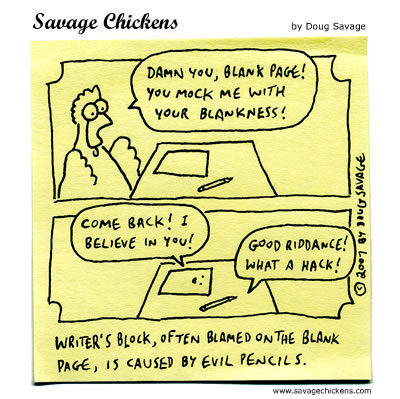
A blank page is daunting. It's a fact. It's a totally illogical fact, but it's a fact.

Sometimes the vast possibilities presented by that which is unwritten can stymie a writer. Sometimes the idea of modifying a pristine white field (whether paper or word processor) with your inadequate first draft is demoralizing. Yet it's completely illogical: possibilities thwarted by the presence of possibilities? An empty sheet of wood pulp seeming more worthy than words representing your unbridled imagination? It's totally illogical -- and yet totally true.

So true, in fact, that I've been given advice my entire life of how to combat it:

In undergrad my creative writing adviser suggested we all draft in pencil because it would feel less permanent than pen therefore allowing us the ability to put mistakes on the page without fear of ruination.

A middle school English teacher forbade our class from writing in pencil because we were too tempted to erase our good ideas along with our bad -- pen only! Mistakes were to be crossed out, but kept. And when we got our writing back from her we saw why: she nurtured all those aborted thoughts of ours and helped us see that we could stretch beyond the safe answers we thought where the "right" answers.

I've known people who type only with their eyes closed. Or who write at night, turn off their desk lamp and pitch the background color of their word processor black so that they can lose awareness of the screen's harsh, mechanical glare. (This does provide sort of an ethereal state, especially if you alter the text color to something whimsical.)

For as many people who swear by ornate "writer helping" software like scrivner, I've heard from just as many who just want a basic word processor -- cut, paste, spellcheck -- because the additional bells and whistles of "writing helping" software can provide as much distraction as assistance.

Lately, even the word processor has become too fancy for me.

Tuesday, April 23, 2013

Grimm, Once Upon a Time & Story Structure

I'm blogging as part of World Weaver Press's Fairy Tale Festival today about the throughlines / story structure of the first seasons of GRIMM and ONCE UPON A TIME. Catch the whole article here.

Monday, April 08, 2013

Don't Play It Safe

[Image/quote via Advice to Writers]
As a writer, you should fall in love with your characters at some point, even the dastardly ones. Perhaps the dastardly ones most of all because when else in life is it safe to love a psychopath? But what I often see is the more a writer writes about a set of characters, the less she is able to torture them. She cares about them now and wants to give them a happy life / happy ending.

But creating meaningful ways to torture your characters is important to the narrative. Extremely important.

It's easy to set up a character with a conflict when you haven't yet gotten to know them, but as you come to understand their complexities, you -- like a good parent -- want to smooth the road ahead of them instead of throwing giant obstacles in their way.

Think of the movie Twister. A simple enough plot: chase a series of tornadoes trying to get close enough to put a scientific instrument inside a twister, all while grappling with daddy-issues and a marriage that's fallen apart. I'm not saying that Twister is the perfect narrative -- I'm saying that as your characters drive down the country road of the plot, you need to throw stuff at them. Throw a crazed rival scientist at them. Throw a new fiancée at them. Throw a cow at them. Roll a runaway house directly into their path. And if driving through a tumbling house wasn't enough -- throw an oil tanker at them and make it explode.

Keep throwing stuff at your characters -- physical obstacles and emotional ones. Give 'em both barrels. Inflict pain and suffering. Make it hurt so good.

Because we love to read it when it hurts so good.

Thursday, January 24, 2013

The Forgetful Kimchi Hypothesis

Last week, I gathered up some hope from the rubble, and took to heart a suggestion from a magazine that I "send again" by embarking on the final edits of a short story I'd left unfinished for months. It only took me one evening of work to come to the hypothesis that good stories are kimchi.

Kimchi is a spicy Korean food which, while different from sauerkraut in taste, is not so different in production: at its heart, Kimchi is just fermented cabbage. I know, who doesn't see decaying cabbage and think, now there's a metaphor for fiction writing, right? But I hold to my hypothesis: stories are kimchi.

Making kimchi involves chopping and combining raw ingredients including the all important napa cabbage. You combine it with other stuff. Then you wait. You don't touch the kimchi. You don't poke at it or check in on it daily. Traditionally, you put the kimchi in an earthenware jar and bury it in the backyard for months, if not a year, depending on the recipe and the seasonal temperature. The burying is to help provide consistency in temperature, although such jars often are stored above ground in courtyards. Most recipes you'll find on the internet suggest that refrigeration is probably the way to go, yet in Korea "you will still see rows of kimchi jars on top of the flat roofs of apartment buildings in the big cities." [source]

Is my hypothesis that writing is nothing more than a slow fermentation process? That's too simplistic a comparison for what I have in mind.

The drafting of a piece fiction does not need to be slow. The current editing project is a short story I dashed off in an evening because of a looming 8:00 AM workshop deadline. But following that quick trot, gathering ingredients, preparing, chopping, mixing, I received thoughtful feedback, and then I stuck it all in an earthenware jar and buried it in the backyard for about eight months.

The story didn't need months to complete its drafting, but for me to go from the piece's writer to its editor I needed that time. It wasn't about the story, it was about me processing the feedback I'd been given and -- more importantly -- it was about me forgetting the process of writing it.

Forgetting is the most important part. When I take an idea from concept to plot to details to words on a page, I am wrapped up in all of it. I know what I meant to write even if it's not what I actually wrote. At the time of creation, I read what I've written and I anticipate my own next moves. I'm unsurprised. I'm unenthusiastic. I'm too in touch with the process of creation. So I have to take the time to forget everything save the vaguest sense of what the story was about.

Eight months after writing the short story, I hauled the jar back inside and revised. I got more feedback. I was much, much closer to being happy with the story. I'd resolved some of my own craft short comings. I'd figured out which parts of the story were too light, and which too weighty. Then I put it back in an earthenware jar and buried it in the backyard for eighteen months. Eighteen.

This is not to say that I did not write during that year and a half. I just wrote other things. I filled other earthenware jars until my folder of Word Docs looked like a Korean courtyard. And on the eighteenth month when I opened this particular jar, I'd forgotten everything about drafting the piece. Finally I could read it as a reader would, as an editor would. Things which the creator in me thought were "necessary" to describe the world were readily apparent as flotsam to be skimmed off. The story found a new opening place. The first five pages were cut and the information therein condensed into a paragraph. The dispersal of information regarding the character's motivation was restructured. The main speculative element was previously nebulous to the reader -- as the writer I'd understood how it worked just fine -- so its description was reworked, condensed. Would you like some kimchi? It's ready.

I understand writing quickly. I think that deadline driven writing is superb, but then again, deadlines are my main source of inspiration. My advice -- if we must boil this down to advice -- is to write fast and edit slow. Give yourself time to forget so that you can meet your story again as a stranger. Play that game TV couples like to engage in, the let's-put-the-past-behind-us-and-pretend-this-is-the-first-time-we-ever-met game. You know the one, where they smile bittersweet smiles at each other and attempt to pick each other up for the first time in spite of their insider information.

Of course, no advice should be treated as sacrosanct. All writers write differently. Yet I am always astounded by those who begin rewriting a piece almost as soon as they've drafted it, those who can go from workshop to second draft within a week, if not a day. Not astounded because they're "doing it wrong" but that they're able to do so all. My memory is by no means a steel trap, but it needs a stretch of time before it can forget a story well enough to allow me to read it afresh, read it like a reader and not like its creator.

---

More thoughts from other people: "Do You Practice Creative Contemplation?" an interesting essay on patience and listening, and while it poo-poos on NaNoWriMo, the mother of all deadlines, I believe that a NaNoWriMo draft, taken with a kimchi recipe approach, is potentially quite serviceable, so I'll cut the essayist a break.

Tuesday, January 08, 2013

Odyssey Writing Workshop Application Time

It's that time of year again! Odyssey Writing Workshop (which I continue to highly recommend) is accepting applications for the summer 2013 workshop session. They take only 16 students per summer for a six week, five-day-a-week workshop, lecture, and writing experience that's unlike any other. I'm both an Odyssey graduate and an MFA grad; and in many ways, Odyssey was a more useful experience in regard to my writing -- it was definitely more personalized, more intense, more ripe for having personal breakthroughs, and understanding my genre.

This year there's even some full and partial scholarships to be scored for the program.

Odyssey 2013 announcement:
Make a quantum leap in your writing this summer! The Odyssey Writing Workshop for fantasy, science fiction, and horror writers will run from June 10 to July 19 in Manchester, NH. Participate in the program that has led 58% of graduates to professional publication, with their work appearing in top magazines and published by major publishing houses. Challenge yourself and pack two years of learning into six weeks of intense work. Four-hour classes five days a week, an advanced curriculum, daily writing and critiquing assignments, weekly stories/chapters due, in-depth feedback on your work, personal guidance from Jeanne Cavelos, former senior editor at Bantam Doubleday Dell and winner of the World Fantasy Award, and guests Nancy Holder, Holly Black, Adam-Troy Castro, Jack Ketchum, Patricia Bray, and Sheila Williams. The early action application deadline is January 31, and regular application deadline is April 8. Four scholarships and one work/study position are available. Read more here: http://www.sff.net/odyssey/workshop.html

Thursday, May 17, 2012

Creating the lie

I love this writing concept!  Outlined in this article, "creating the lie" is all about that thing that your character believes at the start of the story which isn't true. And, in essence, the entire story is about them going through whatever it is they need to go through so that they no longer believe the lie by the end of the story.

Why do I love this concept? Because it's a great way of tying together the action aspects of the story with the psychological aspects of the story. I often find myself writing critiques to other writers about how their climaxes have become all action and no emotion. Now it's true that I've come to agree to disagree about the amount of description that should be on the page concerning emotional reaction / character feelings / character's internal reaction to stimuli.(I'm a big fan of more! so long as it's engaging, because I want to feel as they feel, agonize as they agonize, pump my fist in the air as they rejoice.) But thinking of your character as "caught in a lie they must overcome" forces you to not let the climax be about action alone.

Yes, the climax is tense. Yes, the climax is action filled.  Yes, you're speeding up the pacing by trimming down exposition. But trimming exposition doesn't mean  you have to trim emotion. Actually, Monica Wood's book on writing called Description has absolutely awesome discussion and examples of just this, so let me say it again: amping up the pacing and cutting exposition does not mean you have to cut character emotion -- it just means delivering it in short bursts relative to the pacing of the action surrounding it.

Friday, February 10, 2012

Bits and pieces

It's Friday and I'm scatterbrained. This semester (most semesters) Fridays mark the end of the regular work week and the beginning of my writerly work week. Or, erm, work weekend. Trying to get my brain around the shift and my body -- namely my fingers -- into gear, always poses a bit of a struggle. So I compensate by hanging out on social media for a while. Twitter, I've discovered, is either a pit of human mind barf, or a trove of sparkling little jewels. Today, thankfully, it's a bit more on the sparkly side, though not all of these gems were garnered from Twitter.

The Sci Your Fi Team starts off by amusing me with this notion:
Ever seen an intelligent troll? Ever seen a lumbering fairy? They’re all out there somewhere.
They have to be, right? Now I've got a half-baked idea about a fat fairy rolling around in my head. Hmm. (SYF Team Twitter and Blog)

DigiReader has up two new books as part of their Free Friday Romance eBooks promotion. I don't know much about either book, but you can check them out for yourself here.

Robyn at Seven Sassy Sisters discusses how bribery is the key to success and even provides a recipe. Saddest part of this blog post: she suggests inflicting the chocolate bribery on your family, not yourself.

Allison of Allison Writes discusses Annie Dillard's craft book The Writing Life. Which reminds me that I have a copy of Ursula Le Guin's Steering the Craft that I got as a Christmas gift sitting here on my coffee table that I really want to read but for some reason haven't gotten past the introduction. Perhaps because Le Guin is very strident about you taking her lessons seriously and spacing them out.

Book Ends (a blog and a literary agency) has posted an updated publishing dictionary -- frankly, knowing these terms is a must if you intend to write and publish whether with a traditional publisher, non-traditional publisher, or self-publish.

Linda at Visiting Reality takes the cake, literally. Oh those sprinkles are something else!

And lastly, agent Kristin Nelson who has been blogging for years at Pub Rants (which is a fab resource if you've not seen it), has started a new feature of Friday vlogs where she discusses questions she commonly receives at conferences. Below is her second episode which is about the difference between young adult and middle grade literature. I really liked this vlog because I honestly had no idea how to go about making that distinction but her theory works for me. The first episode was about how one might become a literary agent and (if she sticks to the schedule) there should be another video out today, but at the time of this posting, it hasn't yet hit the web.

Friday, December 02, 2011

Grab bag of life presents this week's findings ...

Catherynne M. Valente demands better vampires.  Vampires that have actual angst, not black pudding enthusiasts.

Two lesbians raised a baby and this is what they got.

Writer Zoe Winters and the theory of the 10,000 word day.  Winters says she started writing fanfic before she started writing her own worlds -- and that writes faster and easier because you eliminate the time spent on invention. But then she did it: she set out to have a 10,000 word day, and eight hours later accomplished it.

This chick in Manhattan made $1200 a month in free food off of Match.com.  It's pretty amazing, but the through of doing that is utterly exhausting. I think that sooner rather than later I'd be like screw it, I'm not putting on another pair of heels, I'm just going to eat ramen.

A really fabulous (and interestingly difficult) holiday writing prompt from Professor Ogden -- open to students and non-students alike.

This week provided my area of the country with some crazy-pants weather. Warm rain, then ice, then ten inches of snow all within 48 hours. Now, pay mind that the ten inches of snow did not fall where I live, or where I work ... it fell on the city I must drive through to get from where I live to where I work. Crazy-pants snow fell all Tuesday afternoon. It fell all evening. It fell during my drive home. It fell during the time I gratefully drove twenty miles per hour down a major highway just to stay behind the safety of the plow. Crazy-pants snow fell as the plow decided it had gone far enough in my direction, made a quick U-turn and started plowing the other of the highway. Crazy-pants snow fell as I blindly groped to stay in my lane and praised whomever came up with the concept of rumble strips. It fell as I neared the bright road-illuminating lights of civilization ... then left civilization and plunged back into the dark. Crazy-pants snow fell as I contemplated what it would be like to spend the night in a hotel, at a roadside rest stop, in the ditch. Crazy-pants snow fell as I finally reached town, got off an exit early and discovered that the city streets were pristine -- it was just the highway that was a death-trap-waiting-to-be-sprung.  Just pants. Lots and lots of pants.

But I survived. And as this fabulous Oscar the Grouch (non-disney endorsed) image tells us: Shit could be worse.

Friday, November 18, 2011

Odyssey writing workshops charitable trust announces winter 2012 online classes

The following is the press release I'm passing on from the Odyssey writing workshops charitable trust. And to be totally honest, I'm more than half interested in the "Secrets of Literary Agents" class.  The following was sent by Jeanne Cavelos and all the "I" references should be attributed to her, not me here on Speak Coffee:

Last winter, we had a huge response to the three online courses we offered.  Writers from all over the world applied; only fourteen were admitted to each course.  Using the latest technology, we were able to interact with each other in live class meetings and exchange homework and critiques.  Students were committed and enthusiastic and worked hard, taking their writing to the next level.

For seventeen years, Odyssey has pursued its mission to help developing writers of fantasy, science fiction, and horror improve their work by holding its annual six-week, in-person workshop in Manchester, New Hampshire.  But two years ago we expanded our mission, taking the teaching techniques that are so effective at the workshop and adapting them to create online classes.  We have worked very hard to ensure that our online classes are of the same quality and caliber as our in-person workshop and that they deserve to carry the name of Odyssey.  Courses provide a supportive yet challenging, energizing atmosphere, with class size limited to fourteen students.

This year, I'm excited to announce that we are again offering three different online courses covering some of the most critical issues for developing writers:

Showing versus Telling in Fantastic FictionCourse Meets:  January 4 - February 1, 2012
Instructor:  Jeanne Cavelos
Application Deadline:  December 8, 2011

Perhaps the first rule most writers hear is "Show, don't tell."  Yet in my experience, few writers actually understand the difference between showing and telling.  Even fewer understand that showing and telling are not two opposing possibilities, but two ends of a spectrum offering a range of subtle gradations.  To write with power, a writer must know where on that spectrum he should be at every moment, and he must be able to control the levels of showing and telling.  The skillful manipulation of showing and telling can make settings vivid, bring characters to life, put the reader in the middle of the action, and convey powerful emotions.  We will study examples of the successful and unsuccessful use of showing and telling.  We'll also discuss the special necessity of showing in fantastic fiction, and the challenges of doing so.

Secrets of Literary AgentsCourse Meets:  January 9 - 23, 2012
Instructor:  Lindsay Ribar
Application Deadline:  December 13, 2011

The best chance a developing writer has of getting an agent is to query someone who has become an agent only in the last few years.  Such an agent is still developing her list of writers and is actively looking for new writers to represent.  Because of this, I felt the best teacher for a course on getting a literary agent would be just such an up-and-coming agent.

In Secrets of Literary Agents, junior agent and author Lindsay Ribar reveals everything authors need to know about getting and working with an agent.  The right literary agent can help shape and build an author's career.  The wrong one can sink it.  In this course, Lindsay will explain why you need an agent in today's market and what an agent can do for you.  She will show you how to identify qualified agents appropriate for your work, and how to figure out which of those are the best candidates to approach.  You'll learn what agents are looking for in a query, a synopsis, and a novel opening, and how many submissions yours must compete against to get an agent's attention.  Lindsay will take you inside the minds of agents to reveal how they evaluate projects.

Lindsay will also prepare you for working with an agent.  She'll explain the contracts between agents and authors:  clauses to avoid, clauses to insist on.  You'll learn how many authors an agent represents and what an average day is like.  She'll let you know what is reasonable for an author to expect of an agent, and what is unreasonable, and how to build a positive, long-term relationship with an agent.  Lindsay will also discuss changes and trends in the publishing industry, particularly those involving fantasy, science fiction, and young adult literature.  Which sub-genres, publishers, and editors provide the best opportunities for new writers?  What is the role of e-publishing from an agent's perspective?  And how are these changes affecting literary agents?

Narrative Structures in Fantastic FictionCourse Meets:  January 25 - February 22, 2012
Instructor:  Bruce Holland Rogers
Application Deadline:  December 29, 2011

Award-winning author Bruce Holland Rogers finds structure one of the most useful guides when writing a story.  Often he will start a story with no more than a subject and a structure, and it will take him to fascinating places and leave him with a satisfying, unified story.
Structure can provide a story with unity, and it can give an author direction. If you ever get lost in the middle of writing a story, or you can't find the right climax, this course is for you.  Bruce will teach you how to identify and use powerful strategies, modes, and structures.  While most writers have a strong sense of what genre or sub-genre they're writing in, they have little sense of what type of structure they are using, if any.  This leads to muddled, dissatisfying plots.  Bruce will lay out a fascinating array of various structures, beginning with flash fiction structures, moving on to short story structures, and finally covering structures for long narratives.  Bruce will discuss the requirements and goals of these various structures, and how they can be developed with originality and emotion.

More information about our online classes can be found here:  http://www.sff.net/odyssey/online.html
If you've visited the Odyssey site recently, you may need to click REFRESH on your browser to see the new content.

PLEASE NOTE:  Those application deadlines are coming up soon!  If you would like to apply for more than one course, you must apply separately for each one.

If you're ready to hear about the weaknesses in your writing and ready to work to overcome them, you'd be welcome to apply to our online classes and learn the tools and techniques to take your writing to the next level.

Sunday, September 18, 2011

Low-residency MFAs

Judging from some of the comments I've gotten when I started blogging about good reasons to get an MFA and poor reasons to get an MFA, it sounds like a lot of low-residency MFA programs are being overlooked. Don't! These programs provide solid education and great flexibility for many individuals.



A definition: A "low-residency" MFA program is a program where much of the work is done remotely and interaction is primarily through correspondence and a minimum of 14 days of residential study each year. The MFA program will often break this up into two separate visits of 7-10 days. All other study is done from the student's home wherever that is in the country or world.

The AWP (Association of Writers and Writing Programs) says this by way of introduction to low-residency MFA programs in its Directors Handbook:
Since the first low-residency MFA program in creative writing was developed in the 1970s, higher education has established over thirty such programs.  With various combinations of residencies, workshops, lectures, online workshops and classes, study abroad, correspondence, and  one-on-one mentoring, low-residency programs vary; however, their chief attributes are individualized instruction and structural flexibility for students.  Low-residency programs require at least two years of study.  Students study literature and craft by writing original fiction, creative nonfiction, poetry, translations, screenplays, or plays; by analyzing contemporary and canonical works of literature; and by writing critical papers.  Programs also require culminating projects focused on the craft of writing—an extended craft essay, a lecture, or the teaching of a seminar.  The centerpiece of the course of study is a creative thesis, an original literary work in the student’s chosen genre(s). 

With its mentoring relationships involving one teacher and one student, or with small online workshops and seminars, the low-residency program excels in expediting the development of a writer.  Students in low-residency programs tend to be older than traditional graduate students.  Many students enter these programs intending to continue in their already established careers; these students find that their professional work is often improved by the skills they acquire in their artistic avocations.  Low-residency programs have a strong record of preparing graduates for careers in teaching, editing, publishing, public affairs, advertising, and administration. 

Lifestyle favorable: Low-residency MFAs are good choices if you aren't within driving distance of the school you want to go to and have a life you can't easily move. Great for people with kids in school, or a spouse that needs to stay put for work or family reasons, if you have a house you can't sell, or if you have a job. Yep, you don't have to quit your job to get an MFA if that's what you want to do. It'll be tough to juggle it all -- going to night school always is -- but it can be done.

Another perk is that low-residency MFAs do not (usually) come with teaching obligations to round out your funding. Although, if your post-MFA goal is to teach then this may be more of a con than a pro as the during-grad-school teaching obligations are also a form of getting experience. But if you know you don't want to teach -- ever -- then hey, bonus!

But remember that even though you get to keep your current normal life/job/living situation,  it is a form of "going back to school." Even though you meet in person only once or twice a year, you still have weekly homework, workshop deadlines, and scheduled internet chats/emails/etc. with faculty.

I've been told that to be a successful low-res MFA instructor you need to be good at expressing yourself in email -- that is, expressing yourself thoroughly and without confusion. So I'd assume that the flip side of that is that if you're a low-res student, you shouldn't be afraid of extremely long emails from your faculty; you should be willing and able to plow through those and learn whatever you can; you should be able to then express yourself succinctly through reply emails. Regardless of how well you can write a story, some people just can't email worth a damn -- odd, but true -- find out if this is you before you apply so that you can have a strategy for success or choose another route.

Niche and genre-favorable programs: If the classics aren't your thing and say, mystery writing is your thing, then odds are that there's a low-residency MFA program with a niche program for mystery writers. Same goes for screen writers, YA writers, science fiction, fantasy, romance, crime, and other forms of "commercial fiction," "popular fiction," or "genre fiction" (all three terms refer to the same thing and are used interchangeably). It's my experience that it's much harder to find programs that specialize in any of those things among traditional (high residency) MFAs, but there are quite a few now in the low-res world. The University of Southern Main, Seton Hill University, and Western Colorado are just a few I know off the top of my head. It's my opinion that more programs should be more open to training writers of popular fiction.

Non-MFA granting training programs: There are also non-MFA programs which are great.  Some of them, like the Odyssey Fantasy Writing Workshop, are potentially better than MFA programs in terms of how much you grow as a writer. If you're a sci-fi/fantasy/horror writer, consider Odyssey Fantasy Writing Workshop, Clarion, Clarion West, and others. For romance writers, join the RWA -- I don't know how much of an education the local chapters will give you, but I know that they often run bootcamps for members nationwide which you can attend (which anyone can attend but by joining the RWA you actually get notified of the upcoming event). I have little doubt that there are similar workshops and bootcamps for mystery writers and others interested in commercial genres check them out. They may be the alternative to a high residency MFA which is perfect for you.

Resources: While a google serach for "Low-residency MFA" will bring back oodles of results, there's also a handbook you can get in paper or Kindle format. It appears to be made by the same people who made the Creative Writing MFA handbook, which presumably didn't have an in-depth enough section on low-residency programs and thus the low-res volume. I've not taken a look at either -- they were either not in print yet or had gone out of print when I was applying to programs.

What I recommend is checking out the Portable MFA in Creative Writing (a $10-17 book) before you begin. If the book puzzles you, presents items you never thought of, makes you feel in over your head (ever so slightly) or tantilizes you to learn more, then getting an MFA may be just the thing to do. I remember looking at A Portable MFA before starting my program, and everything that I read sounded vaguely familiar. At the time, my vocabulary wasn't up to snuff (particularly the vocabulary I use to talk about writing) so it presented a challenge when the authors were talking about writing. But mostly I remember reading that book and agreeing with them on the lessons and the theory ... and then putting down the book and having no idea how to apply that to my own work.

And that is precisely what a good teacher/mentor can do for you: teach you how to take what works theoretically and make it work for you.

Forthcoming MFA posts: 
  • How to find a program
  • Why you should pay no attention to "rankings" for any school or program


Wednesday, September 14, 2011

Reasons to get an MFA in creative writing

Here's my big question -- before we even get into the "are you ready for an MFA?" and "where should you apply/go?" -- why do you want to get an MFA, and are your reasons strong enough to hold you through 2-3 years of graduate study?

Good reasons to get an MFA:
  • You want to work on improving your craft.
  • You are encouraged by having deadlines for your writing.
  • You want funded time to write (assuming you get funding).
  • You'd like to teach writing at the college level including composition.
  • You learn well in a school-setting.
  • You have a high threshold for pain when it comes to people critiquing your writing.
  • You enjoy classic and contemporary "literature."
  • You want to push yourself.


Poor reasons to get an MFA:

  • You got a BA in English and don't know what to do next.
  • You hate the thought of teaching freshmen to write essays and only want to be an artist.
  • You want to be an artiste.
  • Your writing doesn't need any work, you just need to network.
  • You believe that once you're in an MFA program, you need only stay long enough to network your way to an agent/editor/publication.
  • It will look good on your submission cover letters. 
  • You think a masters degree in creative writing will make you employable.

An MFA, in theory, is the terminal degree for a creative (or artistic) form.  There are creative writing PhD programs out there, but for the moment both a PhD and an MFA are considered "terminal."  As a creative discipline, the Fine Arts part of your Master of Fine Arts degree makes you not terribly employable.  There are no ready jobs for MFA holders they way there are ready jobs for holders of JDs.  (Although lately there's no ready jobs for them either.)

With an MFA in creative writing you can teach college level writing classes -- most of these openings will be college level composition classes not college level creative writing classes. With an MFA in creative writing a couple publications, you can also teach community ed. classes in creative writing. You must have substantial publications in your creative field and substantial previous teaching experience to land a decent job teaching creative writing full time.  Know this ahead of time if it's what you want.

The time spent getting the MFA is a time to learn, but it's also a time to write.  That is the most valuable part of the MFA for any funded student: funding to write.  The most valuable part for the unfunded student: a chance to learn craft from people who (usually) are good teachers.

MFAs are horrible places to network your way to publication. Unless you make it into Iowa.  If you make it into Iowa and convince them to give you a degree, it will be easier (eventually) to get a teaching position and/or your first book contract. But every other MFA in the country is not Iowa.  Only Iowa is the Iowa of writing programs. No other MFA holds that clout -- no matter its "ranking."  More on that ranking nonsense tomorrow.

The MFA community can sniff out those who are there to network not learn. And it takes them about as long to find the fakes as it does the new family on the block to figure out if their neighbor is bringing them a casserole to welcome them in and save them from ordering pizza while unpacking, or it the goo and noodles in the corning wear is really just an excuse to get in the house and snoop. And those who are identified as using the program to network, don't ever integrate fully into the community. Although I will say that most of my faculty are the biggest name droppers I've ever met ... but that doesn't mean they'll introduce you, the student, just because you're there.  If you're looking to network, then go to local readings. Find out about readings, get on email listserves.  The university, library, or community group in your area likely brings writers and editors to town to talk and you don't even know it. Ask to be included on those email list serves and then, you know, attend readings -- it's one of the best ways to meet writers. And it'll generally cost you the price of their book (to get it signed) and not the few grand it would cost per semester of MFA.

Wednesday, August 31, 2011

1st vs 3rd -- when POV becomes a storytelling issue

When I think about writing and craft, I break it down into sub parts.

There are grammar and punctuation rules -- important, but a low order concern in comparison.

There are style and clarity issues -- things like keeping it all in a consistent point of view and paying attention to the order of words in a sentence so that they are as precise in meaning as possible, often like cutting the fat.

Then there are what I think of as storytelling concerns -- these are the items that would be the same for an oral storyteller as they would for the writer: pacing, voice, use of description, and the awareness of how all of those things make the reader feel at any given moment in the story.

Recently, I've found myself in a situation where the choice between first person and third person point of view is no longer a style choice; it's become a storytelling issue.

I used to write everything in first person when I was a college student because -- duh -- I thought in first person. So writing first person was the moy easy choice. I suppose it helped that in college all of my narrators were spunky, eccentric, feminist, twenty-year-old women with a bit of a cruel streak when it came to sticking it to their ex-boyfriends. I suppose.

These pieces ended up being all about voice: how quirky could I make her voice? how intriguingly awful could I make her thoughts? (Because everyone loves to read about characters thinking the things we all think but are  too polite to say.) And I started to think of writing in the first person as easy because I just settled my writing-self right down in my stream of consciousness and typed away ... ahem, I meant the character's stream of consciousness.

But eventually, I got bored writing that same character and I wanted to branch out. But I still thought first person was the easiest, or at least the quickest means of pounding out a story. So when faced with a looming 8:00AM deadline for a completed short story, and not a word written on the page at 7:30 PM the night before, I wrote in first person because I needed all the speed I could get.

The story's gone through many drafts since, gotten shorter, gotten longer, gotten much longer, outlined it as a novel. I've toyed with what person I want to put it in, first or third, but always came back to first. First person sounded better because it was the way I'd originally written the draft, and you can't argue with original recipe.

Then I did something drastic: I rewrote the opening twice, without looking at the original. Once in third person, then in first.

And a magical thing happened. When I was no longer beholden to my previous draft -- or unduly influenced by it -- brand new bits of story popped up that I hadn't been expecting. Particularly in the third person version. [For purposes of clarification I will mention that this is not merely changing all the pronouns from I to she, but changing the location/distance of the narrator and the narrative techniques.]

This is the situation I mentioned at the beginning of the post where point of view stopped being a style choice and started being a storytelling choice.

The story I'd originally written had a very narrow scope of the things which the character thought or wanted to stop and tell us. I worked hard to excise things she would not think about from her first person narration. The third person story could (even though the narration is still close to the main character) employ many of the narrative techniques of storytelling: I can lightly drop in information and backstory without it feeling like a character spilling her guts to us unprompted. And by moving myself outside of her head, the rest of the world essentially bloomed around me. -- Told ya it was a magical thing that happened.

I challenge anyone to rewrite a story from the beginning without looking at the original (and then tell me what happens!) -- you don't have to change person, although that's helpful to get you out of the previous mindset, but you just can't look at the original. Has anyone else tried this -- what were your results? What tools or tests do you use to figure out what person to write a story in?


Photo credit: dogbomb on flickr

Monday, August 22, 2011

Workshop = you - your voice

Agent Kristin Norton has a short and sweet little post up on Pub Rants about voice being workshopped out of students. To which I wholeheartedly agree. When I left college I had a super-quirky but non-functional writer voice. Which the MFA has since beat out of me.

(I should of course admit that the voice I was left with was highly functional -- something I did not have before -- if not terribly interesting.)

I've also since realized that the MFA made me get super distant from my characters (and I used to love love love to be right up in their heads) because I had an instructor or two right at the beginning of my study who loved to dissect the character's neuroses and therefore the author's.  And yeah, okay, so she was normally right on the money with which neuroses my characters held were made up and which were my own.  But that sort of detective work -- and namely, announcing that detective work to my peers -- made me not write characters like me.

I got super-distant from my characters. And then I got despondent. I tried, flailed. Thought about focusing solely on nonfiction without the veil of fiction to obscure what I was saying, then hit on the notion of folklore as the lens to focus my fiction writing through. Thus my big break.

While folklore in the MFA workshop was its own sort of uphill battle, no one stopped to suggest that it was a poignant narrative and if you made it up then all the more poignant.

So I dropped the closeness of my narrative voice in favor of the fairy tale voice. I dropped the quirky wondrous sarcastic voice that had been my signature as an undergrad. A voice that would give me my first fiction publication. And after a 2-3 year hiatus, only now am I slowly attempting to regain that voice.  But certainly not in all  of my works.

Voice is something I struggle dearly with. My writing teachers and peers like to tell me that "I think you've found your voice" whenever they see the writing come together for me.

I've been told, so far, that I have "found my voice" on three vastly different projects. Possibly four -- my memory is faulty.

I've also been told that my voice often waffles within a single piece. Little wonder, all things considered.

I've been told my quirky voice was "it"; that my fairy tale voice was "it"; that my contemporary folklore voice waffled too much but my high fantasy voice was spot on, (read: "it").

Is this a matter of an author having a "soft ear" and therefore being able to pick up many voices? Is it a matter of my own fear closing off avenues? Or is it simply workshop workshopping the voice out of individuals in favor of craft? (which if you read the linked post above,  you'll see is no bad thing so long as craft is learned and voice is regained).  I don't know. I really don't know. But I'll keep trying on new voices for as long as I can. Writing voices fascinate me, much like speaking with accents/dialects fascinate me. Please, don't ask those who knew me in middle school about the Irish accent I adopted after watching The Secret of Roan Inish; the accent came easily to me, and I used it to annoy the crap out of everyone around me.

Friday, August 19, 2011

Friday: Link love + life

This post is exactly what the title implies: I give a bunch of love to links, hopefully make a few witty, scathing, or adoring comments about said links, and drop in a few little anecdotes about my life. You've been warned.

There's a mild bit of buzz in the sf/f community about NPR's list of 100 Top Science Fiction, Fantasy Books. To which I say, meh.  I've not read the entire list but I've read a lot of it and I'll probably read more of it (intentionally) but I'll probably die before I read all of it.  Okay, let's drop the scary mortality-thoughts b/c they totally screw with my twenty-something brain.

There was apparently an open voting period which I did not participate in but many of my friends and acquaintances did.  They complained that there was no write-in option for books that did not make the NPR short list for voting. They claimed there were obvious oversights -- Lois Bujold McMaster for one -- and that the list was skewed toward science fiction and away from fantasy (which is always hilarious in my eyes because fantasy now outsells sci-fi but sci-fi is still considered more "classic" and therefore more "literary."  Ah well, that's fine, if I live long enough I'm certain I'll see fantasy move closer toward the accepted canon anyway.  And there I go with more scary mortality-thoughts.

There's much spatting going on in internet circles about who is and isn't on that list. Me? I'm not going to engage in any spats. Perhaps you have to be a cog in machine of academic standardization before you realize that any "canon" is all arbitrary and none of it matters. Perhaps that is the greatest argument for attending grad school. One way or another, it's just a list.  Moving on.

I sprained my foot this past weekend and the resultant injury has colored my life for the past six days.

Yes, sprained my foot not my ankle.  My ankles are surprisingly hearty, having been rolled many times during years of field hockey practice and never injured until trying to catch the bus to the train station for the 2009 AWP Conference. Odd. Anyway.  Missing the last step of the flight has caused a week of sitting, elevating, and wrapping with an Ace bandage.

The cats, btw, love the Ace bandage. They find the wrapping/unwrapping fascinating. And the tiny little metal clips beg to be batted to the floor -- and they have been, repeatedly, even though they've only left my foot for a few hours total over the past week.

Oh, and the cats think that all the pillows i'm placing on the table/desk/etc for my foot are there for them.  Of course.

Stay true.

Margaret Atwood has been announced as the 2012 AWP Conference Keynote Speaker. This makes three out of four years where the keynote speaker has straddled the lines of literary and the Other for an organization where most of the members (if not the official organization) is conflicted in its feeling toward comic books and speculative fiction.  Sure they could say that Art Spiegleman wrote in the exciting new vein of the "graphic novel" and that Michael Chabon was a literary maverick who indulged our interests in the supernatural, but inviting Margaret Atwood to be THE speaker should be a brilliant slap in the face meant to wake up those who do not believe genre can be literary.  Don't believe me? Atwood's The Handmaid's Tale just made number 22 on that top 100 all time science fiction, fantasy list from NPR.

I always find it strange that literary types claim to have "forgotten" that Vonnegut and Orwell and Le Guin and Atwood are science fiction.

I had thought about going to the 2012 AWP conference just because it will be in Chicago, a city which is within easy traveling distance and, thanks to my brief stint living in the windy city, easy for me to navigate.  Even in fucking February.  Burr.  With Atwood as the keynote ... I think I really will have to go. 

On the Odyssey Workshop blog, bestselling author Carrie Vaughn discusses how she knows when a story will be a novel or a short work.

100 Year Star Ship project + conference.  Need I say more?

I helped plan part of a bridal shower this past weekend. And frankly, I fail to see the point.  Don't get me wrong, I'm happy to have done it for my friend and really excited to make super cute flower vases, except for the part where I was carrying a giantassbox, missed the last step and fell funny on my foot/ankle resulting in much pain and limited mobility -- but that could have happened for any reason.  But I fail to see the point of bridal showers nowadays.

My friend was astonished and flattered at the gifts she got.  She didn't expect or desire the level of gifting that occurred.  She was afraid that by inviting people to both the shower and the wedding she's making them feel like they should provide two gifts. Of course, there are people who feel like they should celebrate the union of two young people and if that means purchasing Corning Ware and Pyrex sets, then so be it.  But she and her fiance are not nineteen-year-olds who've never moved away from home.  They both have places and kitchens and kitchenware of their own.  Do we need to continue the social practice of giving showers? Particularly I ask, do we really need to gather all our female relatives for three hours of small talk, mediocre food, patronizing games, and gift opening wherein we speculate voraciously over how many ribbons the bride will break thereby determining how many children she will bear in this union?

I find the whole "bridal thing" dubious.  And I am in favor of not having one should I ever find myself in the throes of imminent marriage.  Or at least I'd rather have a co-ed "open house" rather than an all-chick shower.

Goat + duct tape + Chuck Wendig.  If that was not enough to entice you (and it should be) consider clicking through to his writing advice as well as the equally crude and wondrous birth and life of a novel.

I've realized that I have to change most of what I do this semester when I go back to teaching composition.  Okay, not most of what I do, but the big projects.  Partly because the textbook was ordered for me and the textbook supports either a gender studies or a cultural studies approach rather than a genre studies with a pop culture studies flavor.  That's okay.  Attempting a gender/cultural bent will make me more marketable. It will also be good for the students. A nice dose of spinach. I'm not entirely sold, eh?   Guess it's time to cultivate multiple talents other than teaching comp.

Ira Glass on what nobody tells beginners:
 
Ira Glass on Storytelling from David Shiyang Liu on Vimeo.

Miracle Whip wants to give you $25,000 for your wedding or divorce -- so long it's a Miracle Whip kind of romance.

And lastly, take a look at the night sky tonight.  The moon and Jupiter are teaming up for a particularly bright Jupiter tonight.  Oddly enough, I dreamed last night that I could see Jupiter.  Not Jupiter how it really is, but a nice little graphic of Jupiter with all its rings pasted onto the night sky.

Addendum: The Hugo Awards Ceremony will be streamed live tomorrow (Saturday) starting at 8:00 PM Pacific Time.

Highly Recommended