In a Fix, by Linda Grimes is a fun, fast paced, urban fantasy romp. Ciel is an aura shifter. That is, she can morph to look like anyone. And, for a fee, you can hire her to stand in for you at whatever social event you just can't stand the thought of attending. Which was all fine and dandy, even if it barely pays the bills, until a group of neo-Viking separatists tried to blow up the client she's impersonating.
Yep. Neo-Vikings. Just a taste of how witty and wacky and deliciously fun this book is.
Ciel's good at getting into trouble. And she can even almost take care of herself. But that doesn't stop her friends Billy and Mark (both shifters themselves) from trying to coddle and protect her by dealing with the tough stuff themselves, which of course Ciel can't let them get away with.
These three may have known each other forever, but they're getting to a point in life where the sexual tension is ratcheted up. Ciel's had a crush on Mark for years and it's time to either get over him and move on, or jump him ... and Ciel can't decide which. Billy has his own agenda, and it definitely doesn't involve Ciel and Mark becoming a couple. But the refreshing part about all this wonderfully chewy sexual tension, is that not only does Ciel really not know what to do about it, not only do Billy and Mark not approve of her potentially dating the other, but that the guys don't go all growly primal male over her. It's not that kind of book. Nope. First off, they're not the "mark your territory" kind of guys. Second, there's these neo-Vikings trying to kill them and neo-Viking uprising does, in fact, take precedence.
I often pop over to read Linda Grimes's witty blog, Visiting Reality, and was delighted to find out she published a novel. She recently announced that at least three of the novels have been bought by Tor, so get ready for lots more Ciel!
It's that time of year again! Odyssey Writing Workshop (which I continue to highly recommend) is accepting applications for the summer 2013 workshop session. They take only 16 students per summer for a six week, five-day-a-week workshop, lecture, and writing experience that's unlike any other. I'm both an Odyssey graduate and an MFA grad; and in many ways, Odyssey was a more useful experience in regard to my writing -- it was definitely more personalized, more intense, more ripe for having personal breakthroughs, and understanding my genre.
This year there's even some full and partial scholarships to be scored for the program.
Odyssey 2013 announcement:
Make a quantum leap in your writing this summer! The Odyssey Writing Workshop for fantasy, science fiction, and horror writers will run from June 10 to July 19 in Manchester, NH. Participate in the program that has led 58% of graduates to professional publication, with their work appearing in top magazines and published by major publishing houses. Challenge yourself and pack two years of learning into six weeks of intense work. Four-hour classes five days a week, an advanced curriculum, daily writing and critiquing assignments, weekly stories/chapters due, in-depth feedback on your work, personal guidance from Jeanne Cavelos, former senior editor at Bantam Doubleday Dell and winner of the World Fantasy Award, and guests Nancy Holder, Holly Black, Adam-Troy Castro, Jack Ketchum, Patricia Bray, and Sheila Williams. The early action application deadline is January 31, and regular application deadline is April 8. Four scholarships and one work/study position are available. Read more here: http://www.sff.net/odyssey/workshop.html
I've never been an Elvis fan -- I should preface this post with that -- but I've also never been an Elvis hater. In fact I never really thought about the King of Rock and Roll except for the passing mention in The Outsiders where the uptown kids love the Beatles and the greaser boys think that Elvis is way better.
So when the manuscript came across my desk for The Haunted Housewives of Allister, Alabama, a tale of an upper-middle class housewife who has a haunted Velvet Elvis forced into her possession, I didn't entirely know what I was getting into Elvis-wise. But the writing was fabulously witty and the main character, Cleo Tidwell, was enchanting. In fact, Cleo Tidwell quickly put me in mind of Stephanie Plum, a character I'd consumed with ravenous speed one winter. So I dove on in to the world of ghost Elvis and possessed Velvet Elvis. And it was a riot.
I've learned so many wacky Elvis factoids in the process of editing and publishing this book. When you finish the novel and realize how much true Elvis stuff falls in the realm of the strange, it's hard not to imagine it as the perfect basis for this kind of fun, witty, cozy mystery with a paranormal twist. Susan Abel Sullivan did her research -- fried peanut butter and banana sandwich, anyone? Apparently there's a knack to making these sandwiches. If I'd have tried, I'd have not thought to make the paste, so the result would have been ... different, I'm sure.
If you enjoy Janet Evanovich's Stephanie Plum, or more generally cozy mysteries, Southern humor, and witty writing, you can grab the ebook of The Haunted Housewives of Allister, Alabama today (early release) or the trade paperback on October 30. Or perhaps just warm up to the novel with the sneak peek of chapter one on the publisher's website.
My energy has currently been sunk into getting the Haunted October blog tour up and running and all the graphics settled and books out and ... whew. Well, I suppose it's too soon for a "whew," but I'll take any accomplishment as a small victory. So this Tuesday's blog post is a grab bag o' interesting stuffs, making it in just under the wire, minutes before midnight local time.
Got a ghost story you're sharing on your blog?Haunted October wants to hear about it! A.E. Decker's fabulous "Viva le Macabre" is a glorious reveling in fall, "the season of dying." And Kristina Wojtaszek's series on Haunted Folklore at Enchanted Conversation magazine is an interesting start to a five part series running each Monday in October.
QR codes for bikes -- how smart is this? Stolen bike has easy to trace barcode dohicky that you can register with the police for free ... if you live in London.
Fifty Shades of Chicken is an honest to goodness cookbook/great Fifty Shades of Grey parody. Someone tried to shift my attention to Fifty Shades of Bacon after I mentioned the cookbook on Twitter. But Bacon is a novelized parody. And Fifty Shades of Chickenis a succulent feast of innuendo, from the "bound" and trussed chicken on the cover to the foodporn table of contents: "Dripping Thighs, Sticky Chicken Fingers, Vanilla Chicken, Chicken with a Lardon, Bacon-Bound Wings, Spatchcock Chicken, Learning-to-Truss-You Chicken, Holy Hell Wings, Mustard-Spanked Chicken, and more, more, more!"
Mustard-Spanked, eh? I think "spanked" is a verb that ought to be used more in food description. Watch, in a year, it'll be on every high-end menu.
Beware the Highland werewolf. Rawr. Mars Rover Curiosity finds evidence of water -- water! a Martian stream bed! -- and Honey Boo Boo gets more coverage on TV. Sadness. Good thing the wondrous nerds and geeks of the world (yours truly included) get their news online and from NPR. What will the Mars Rover find next? A three-fingered button that, when depressed, produces breathable air?
My review of the new novel Silver is up at the magazine New Myths. And yes, there's a few typos, but hey, at least it's just a few. Here's the first half of the review:
Writers like Patricia Briggs and Kelley Armstrong have taught us that wolf pack politics is a tricky thing—one part subtle machinations and two parts brute force. Rhiannon Held continues in this tradition with her debut novel Silver.
The urban fantasy Silver has a certain grit and intelligence to it which is apparent from the get-go. Someone has performed unspeakable acts of experimentation and torture on an entire pack of werewolves, systematically burning them with silver and injecting it into their veins. The only werewolf to escape is a young woman who’s retreated so far into herself, she can’t recall her own name and adopts the moniker Silver. Andrew Dare, a pack enforcer, tracks Silver down when she crosses his pack’s territory. Andrew expects to have to meet the stray werewolf with violence and threats, instead he meets the half-crazy, rambling, injured Silver, which sets Andrew down the track of finding the person who hurt her and killed her pack. But first he has to find out who Silver really is and where she came from. Read the second half of the review...
Short version: I liked Silver. Is this novel going to revolutionize urban fantasy? Probably not. But it's an interesting new chapter in personable-but-aggressive werewolf fiction.
[Silver by Rhiannon Held came out from Tor, June 2012. I received a complimentary advanced proof via New Myths to complete this review.]
I love/hate having a great stack of great books to read on the table beside my couch.
That's where they live while waiting for me to read them, by the way. My TBR or "to be read" pile doesn't live beside my bed or on my nightstand. Oh no. It lives on the end table beside the couch. That's where they wait for my attention. Because let me tell you, it's only when a book grips my interest enough to keep me from sleep that I invite it into bed for a little pre-slumber reading.
Right now, the end table poses a delimma. I have an assortment of books I want to read and must pick who I read next.
The book that's been sitting on my end table the longest is Stephen King's Gunslinger. I've never read The Dark Tower series and I want to! But at the same time I don't know much about the series other than that it's good. And that lack is the difference between want to and really want to.
I also have a beautifully fluffy novel called Sparks Fly by Katie MacAlister. The impetus to read now is simple: this is a library book with multiple holds on it. Other people want it and if I hold onto it too long I can't renew my checkout. The novel is the third in the Light Dragons series which itself is the third series in Katie MacAlister's dragon world which I previously wrote about here.
But the fourth book in "The Others" series by Jess Haines is coming out July 3! And it's been sooo freaking long since I read the three books previous -- okay it's been about a year -- that I'm thinking I should really reread them before I jump into Stalking the Others. And trust me, before I jump into Stalking the Others I'm going to want to reread the three previous novels.
Oooo, and look at that pretty book cover? Doesn't it just want to leap into your shopping cart? Major, major improvement over previous covers, particularly book two where the heroine looked more like a stripper.
Regardless of their bad covers, I need to revisit books one through three before embarking on this beauty. ... and hey, I was planning to write all of this out for the O post of my A to Z challenge which I never reached. Correction: have not yet reached ... because I'm not done. I'm just a snail. A busy, easily distracted snail.
Book one, Hunted by the Others, was just an okay read, in fact I was disappointed that it wasn't trashier than it was despite having a hot werewolf and a hot vampire character, nonevermind that the main character is freaked the fuck out by the evilness of the vampire. I read it shortly after it came out and then forgot about it for a while. Then, more than a year later, I was in the mood for an urban fantasy and I was at the point where I was caught up on all my favorite series and I was down to the point of picking up a mediocre urban fantasy that I knew a bit about or an urban fantasy that I knew nothing about which could be mediocre or could suck or could be pretty good. I went with the evil I knew -- and I was not disappointed. While Hunted by the Others was just okay, it set up a really cool world that books two and three engage with in a hot damn! sort of way. The main character's relationship with the vampire world (previously seen as soulless evil) gets a bit more gray, and her relationship with the werewolf world gets ... complicated. The end of book three leaves us with one helluva cliffhanger. The kind where I'm enthralled and pissed off and salivating for the next book all at the same time. So I want to make the most of book four, and that means rereading books 1-3 to remember everything from character names to places and relationships, because frankly, it's all gotten fuzzy in the intervening months.
Stripper cover, yes? Anyone care to argue that its not? She's even carrying her own pole. Sorry art department, that's not a crime fighter, that's a receptacle for one dollar bills.
So now, here I am, mid-June with a reading dilemma on my hands or, um, on my end table.
I've been working for the past year with my friend (now-business partner) to build the necessary foundation to launch World Weaver Press, a small press focused on fantasy and science fiction in all its incarnations.
Yesterday we officially launched the company with the release of our first title CURSED: WICKEDLY FUN STORIES a collection of several short stories by Susan Abel Sullivan.
I don't know any better or more thorough way of announcing than the following, which came from yesterday's official announcement:
New York, NY (March 5, 2012) – World Weaver Press (Eileen Wiedbrauk, Editor-in-Chief) has announced the release of Cursed: Wickedly Fun Stories by Susan Abel Sullivan, their first speculative fiction collection as an independent publisher.
“Susan Abel Sullivan has written an engaging collection that appeals to both the young and young at heart,” commented Wiedbrauk. “I’m excited to be a part of bringing this collection to readers and thrilled to publish Susan as our first World Weaver Press author; she’s an asset to WWP and a writer not to be missed.”
Cursed: Wickedly Fun Stories is a speculative fiction short story collection featuring witches, werewolves, limericks that can change fate, and a sinister vine bent on murder and the destruction of Alabama. These stories draw in readers with their lighthearted tone and delight with their wickedly sly sense of humor. Cursed: Wickedly Fun Stories features pieces previously published in Andromeda Spaceways, Inflight Magazine, AlienSkin, and Beyond Centauri, as well as a never before published short.
Susan Abel Sullivan lives in a Victorian house in northeastern Alabama with two dogs, way too many cats, and a ghost. When not writing she likes to get her groove on by teaching Zumba classes. She is a graduate of the Odyssey Writing Workshop for speculative fiction. Her short fiction and poetry have appeared in numerous online and print publications, including Asimov’s Science Fiction Magazine, ASIM Best of Horror: Vol II, New Myths, Writers’ Journal, and others. She is currently working on a YA novel about the supernaturally challenged. Visit her website at susanabelsullivan.weebly.com or twitter @susan_abel.
World Weaver Press is an independent publisher of science fiction and fantasy, dedicated to producing quality novels, novellas, novelettes, and collections and anthologies of short fiction. World Weaver Press seeks to publish fiction that engages the mind and ensnares the story-loving soul. Find out more at worldweaverpress.com or twitter @worldweaver_wwp.
#####
It's been an exhilarating and time intense endeavor, one I'm thrilled to be able to share with you today.
Romance as a fiction genre continues to boom, romance as a real life institution is on the decline. Match.com recently funded university researchers to gauge of single Americans' attitude toward romance in general and matrimony specifically. The result? Only 34% of single Americans said they knew they wanted to get married. another third were "uncertain."
But it's not actually the statistics on marriage which I found all that surprising; it was the statistics on those who are looking for a relationship, or more precisely, aren't looking:
80.8% of single Americans aren't actively seeking a relationship right now (this includes those who "don't have time," "want to stay unattached" and who just aren't putting in any effort). Of that 80.8%, only 48% said that while they weren't actively looking, they'd consider a relationship if the right person should drop into their lap ... metaphorically speaking.
But don't try to tell yourself that the reason you fall into one group or the other has to do with your geography, notably the lack of suitable (wo)men in your region, not until you let the Icelandic people put that one into perspective for you. In Iceland -- an isolated island country with roughly the population of Pittsburg -- there is an online incest database where you can check out just how related you are before things get too serious. It takes the notion of Googling your date to a whole new level.
Meanwhile, sales of romantic fiction stay steady (even grow) while other genres decline. Romance novels used to be seen as the fantasy which married women or wistful teens engaged in, but give the data it's not surprising that the romance novel remains popular, particularly the paranormal romance: singles don't expect to experience it themselves; they approach it as purely a fantasy whether or not it contains a vampire.
Catherynne M. Valente demands better vampires. Vampires that have actual angst, not black pudding enthusiasts.
Two lesbians raised a baby and this is what they got.
Writer Zoe Winters and the theory of the 10,000 word day. Winters says she started writing fanfic before she started writing her own worlds -- and that writes faster and easier because you eliminate the time spent on invention. But then she did it: she set out to have a 10,000 word day, and eight hours later accomplished it.
This chick in Manhattan made $1200 a month in free food off of Match.com. It's pretty amazing, but the through of doing that is utterly exhausting. I think that sooner rather than later I'd be like screw it, I'm not putting on another pair of heels, I'm just going to eat ramen.
A really fabulous (and interestingly difficult) holiday writing prompt from Professor Ogden -- open to students and non-students alike.
This week provided my area of the country with some crazy-pants weather. Warm rain, then ice, then ten inches of snow all within 48 hours. Now, pay mind that the ten inches of snow did not fall where I live, or where I work ... it fell on the city I must drive through to get from where I live to where I work. Crazy-pants snow fell all Tuesday afternoon. It fell all evening. It fell during my drive home. It fell during the time I gratefully drove twenty miles per hour down a major highway just to stay behind the safety of the plow. Crazy-pants snow fell as the plow decided it had gone far enough in my direction, made a quick U-turn and started plowing the other of the highway. Crazy-pants snow fell as I blindly groped to stay in my lane and praised whomever came up with the concept of rumble strips. It fell as I neared the bright road-illuminating lights of civilization ... then left civilization and plunged back into the dark. Crazy-pants snow fell as I contemplated what it would be like to spend the night in a hotel, at a roadside rest stop, in the ditch. Crazy-pants snow fell as I finally reached town, got off an exit early and discovered that the city streets were pristine -- it was just the highway that was a death-trap-waiting-to-be-sprung. Just pants. Lots and lots of pants.
But I survived. And as this fabulous Oscar the Grouch (non-disney endorsed) image tells us: Shit could be worse.
The following markets are looking for themed speculative material with a romantic twist or romantic elements. The first is looking for novella length stories -- and if that's not to your liking, the second market only takes work 7,500 words and under!
Entangled Publishing, Steampunk Anthology: (royalties only) Entangled Publishing is an internet startup company. They publish both print and ebooks and have a strong leaning toward paranormal romance novels (adult and YA) from what I can tell. Right now they're putting together an anthology of short steampunk fiction with romantic elements, deadline December 1. They write:
Will Smith, Jude Law, Robert Downey Jr., Hugh Jackman, and Sean Connery have done fabulous things for the sexiness of steampunk. Even when quirky technology is merely hinted at in alternate, historical-feeling world, moviegoers have clamored for more. Whether they’re donning brass goggles, lacing up steel corsets, or hopping onto the nearest airship, the heroes and heroines in steampunk fiction have captured the minds of readers. Entangled Publishing is seeking submissions for a Summer 2012 Steampunk anthology. Submissions must:
Be 20,000 to 30,000 words in length
Contain strong romantic elements
Heavily feature steampunk technology and the alternate world it exists in
All heat levels will be accepted, but erotic elements must not be the main focus of the story.
Escape Collective Publishing: Orbital Hearts Anthology (royalties only)is looking for stories that revolve around relationships (romantic and dysfunctional, preferably) and also contain speculative elements (aka "fantastic" elements). Up to 7,500 words. Deadline December 1. They're also running a cover art contest if that's up your alley. They write:
We’re looking for tragic romances, hopeless relationships, unrequited love and (of course) broken hearts. Don’t misread this! Although we want stories that revolve around dysfunctional romantic couplings, we are only interested in stories that also contain “elements of the fantastic.” This anthology is open to submissions from just about ANY genre you can imagine that fits the theme – and we hope to get many submissions that cross over genre boundaries. Try to avoid cliches that rely on weird pairings as their primary theme; we want tragedy, drama, and originality. Surprise us, entice us and woo us into a destructive angst-inspired spiral with your words!
I picked up A Discovery of Witches to find out why a book that was essentially an urban fantasy -- witches and demons and vampires, oh my! -- was being marketed so heavily at the mainstream. It had a prominent (non-urban fantasy) slot on the Barnes & Noble e-newsletter, and it is still hanging out on their front of store promotion tables. The other thing that differentiates its marketing from that of most urban fantasy books is that there's no representations of the characters on the cover. That might have been the biggest flag for me: what was so different about this novel that the publishers thought they didn't need to use the biggest telltale signs of the genre to get readers?
Is it different? Yes and no. The main character isn't a never-does-well-in-school teenage Buffy Summers, she's a 30ish woman with a PhD in Medieval alchemical texts. But Buffy was born to be the slayer, and Dr. Diana Bishop was born a witch, a really freakin powerful witch it turns out. Oh and they both have vampire sidekicks/boyfriends.
The biggest difference is that in A Discovery of Witches the characters are a Medieval historian and a vampire who has lived through the Middle Ages, and they're more than willing to start chatting in depth about historical this or that. And yes, the author has done her research. Actually I'm willing to bet that the author has a background in academia and has studied these kinds of things. Does that make her characters more realistic? Maybe. But as someone who's spent time in academia as well as studied genre fiction, I'm willing to say that there are many passages where it feels like the author stopped writing a novel, and started writing a paper. Oh, an entertaining paper as far as academic research goes, but there's a definite shift there. And maybe if you haven't spent time in academia and studying genre fic, you wouldn't catch it, but it was glaring to me.
The author also spends a lot of time on the logistics and mechanics of things which may not be particularly important to the story. When the issue of time travel is brought up, the vampire goes out and gets the witch, Diana, a whole passel of vaccines against diseases from the time period. Yes, these are issues that matter to scientists and historians, but it snags the narrative and drags it down -- unless she's going to get sick while time traveling, or she's dumped into the middle of a smallpox outbreak and is then worshiped as a goddess (or burned as a witch) for not not contracting the disease herself, then the procurement, injection, and discussion or the vaccines is just shoe leather, i.e. logistics that aren't necessary to the reader's experience.
But the novel was enjoyable. And yes, it was an interesting break from sassy, butt-kicking, black-leather-wearing urban fantasy heroines. And I did love-hate the vampire (and love-hate is almost better than love when it comes to vamp characters). So why not read this one? Why not. Go for it. It's not the smoothest written novel ever but it's entertaining and many of the ideas are intriguing. But I'll warn you that it's unfinished. The ending obviously sets up the next book. And it only seems fair that you know that going into it.
And -- I couldn't find anywhere else to add this in -- but the whole time I was reading about Medieval texts and science and medicine, I kept thinking about Elizabeth Twist. I'd love to hear what an actual Medievalist thinks of this novel!
There's a great Ursala Le Guin essay that's (re)printed in The Secret History of Fantasy(primarily a short story collection with a couple of essays). In her essay, Le Guin points out that while fantasy fiction and surrealism differentiate themselves from realism by dealing in that which is realistically impossible, fantasy and surrealism are not interchangeable.
Surrealism, she says, is when the rules of reality are subverted.
Fantasy is when the rules of reality are subverted, and replaced with a new set of rules.
Therefore fantasy is more like realism than surrealism. You read fantasy fiction and realism expecting a certain set of rules to shape and guide the world and your reading of it. Therefore, if something strange happens in a fantasy story, you don't ask if it was a dream. Fantasy authors aren't subverting rules, or trying to trick your mind; if they tell you something happened, then it happened. Believe the words on the page: it was real, not a dream.
(You have no idea how badly I wish I could have gotten my MFA workshop groups to read this Le Guin essay or at least listen to the above statements, but I digress.)
And so the fantasy reader enters into the novel having a contract with the finite world. The realism reader makes that contract with the author before she opens the book. The fantasy reader gives the author (roughlyt) the first 50-100 pages to set the terms of the contract. She'll believe events that are based off of that contract -- but throw any "extras" at her, and she's likely not buying.
I've been struck more than once by a situation (often near the end) which a dramatist would call deus ex machina -- essentially, a moment when a god or some other device, enters into the novel and "fixes" the narrative problem, allowing everyone a happily ever after.
Why am I writing about this specifically in the context of fantasy? Because sometimes you'll be reading a fantasy novel with, say, vampires and then the narrative problem will be solved by the appearance of, oh let's say, a ghost.
It's all gravy, right? I mean it's a fantasy novel -- we expect fantastic things, right?
Wrong.
The appearance of the ghost is a form of deus ex machina because the sudden appearance of the ghost broke the contract with the finite world. In Le Guin's terms, the fantasy broke the rules of reality that it had established for itself.
If the viability of ghosts in this vampire world was established early on as part of the rule building / world building, then the sudden interruption of a ghost at the end of the story would not warrant a cry of deus ex machina. It would warrant perhaps a subtle oh, another ghost -- clever.
Yesterday I posted about series novels, and discussed the ever-growing superpowers as a breech of contract with the finite world. If we're sticking with the contract metaphor, then every-growing superpowers (the kind that get surprisingly bigger and better with each book) would be a legal gray area. Not an outright violation, but not exactly in the spirit of the contract either. As a reader, I'd much rather see characters deal with the situation using what they have, getting cunning and clever -- after all, making a character work within the rules of her reality makes her story resonate with the human experience, and that's what all fiction, no matter the genre, should strive to do.
I'd often wondered about how or how not to "grow" a protagonist in a series. There are many series out there that just lose "it" -- that unidentifiable quality that makes me desperate to turn the page and know what happens and how. On the Odyssey LiveJournal, author Lane Robins discusses her take on growing a protagonist over a series of books and the considerations an author must account for as she attempts such things. She brings up something that I often feel like I see: you have an idea for two books and then your editor wants three. Or you sell the first three together -- you know how the story and the character flow -- and then they do so well that the publisher wants more. And, well, what the hell do you do now? More of the same? Why not. So often it's book four that gets episodic and breaks the camel's back -- or, in this case, my desire to read more.
Books one through three of the Mercy Thompson series by Patricia Briggs were just awesome. Book four was necessary because the scene at the end of three remains unfinished until chapter one of book four! (a cheap shot ? I think it was more like Briggs realized she couldn't end it where she ended it and took book four as an opportunity to rewrite the action by altering the "ending.") But the plot of book four was abysmal. Books four and five sort of wash together in my memory because of how unspectacular they were compared to the tight, directed plots of books 1-3. Thankfully, book six got interesting because it solved some of the unsolved mysteries brought up as early as book one (why Mercy is the only coyote skin walker she's ever met). Book five sort of did the same thing with Samuel. But book four? Yeah, still don't see the redeeming value there.
Is the lesson here to plant mysteries in book one? Non-urgent mysteries, of course, that can be solved much, much later?
That might work, so long as the series keeps producing new mysteries to be solved later and doesn't give in to the temptation to become episodic jaunts.
I haven't read enough of the Harry Dresden novels by Jim Butcher to know how Butcher handles the series character. But he's got at least 13 of these novels out and the popularity only seems to grow. Book one drew the reader into the world and left us with more than we started with, but my feeling was that Harry Dresden was roughly in the same place as he was before. That's what I mean when I say "episodic": things happen but the world returns to the way things were without permanently altering much.
Although, maybe all you need in the first novel of a series is to draw the reader into the world. And the rest of the changes can come slowly.
TV shows are often episodic -- they air in episodes, so you can even say it's a given. And perhaps it's why the season finale is the most dramatic of all the episodes: it's when something irrevocably changes in the character's world or in his world-view. So when the TV adaptation of Dresden Files aired on the SciFi Channel, it got even more episodic feeling and accidental feeling -- characters would accidentally run into Harry or Harry would brush up against their world without seeming to have any reason to -- so it's not all that surprising that it didn't last long on television in spite of how much fans loved the show. The Harry Dresden I watched on TV encountered a lot of creatures and characters and nothing changed him or made him grow. He was passive. And I was bored.
A lot of paranormal romance embraces the episodic nature of the series. Writers such as Sherrilyn Kenyon, JR Ward, and Gena Showalter have married the idea of the series with the "completeness" the romance genre requires of its novels -- each novel shows the trials, tribulations, and eventual success of one couple's romantic journey. So they base a series of novels in the same world, and the main characters of the first novel become secondary characters in the next. Then for the third novel, other characters who've been in the background become main characters. And so on. When these novels work well, the series world has some growing tension that each novel must deal with as well as "complete" the romance. When these novels don't work so well, the "growing tension" feels more like a background game of Farmville where we're just waiting for the next Mystic Egg to be collected.
The other was to approach paranormal romance (and these often straddle the line between paranormal romance and urban fantasy), is to have a focus couple who remain the main characters throughout the entire series like Jeaneine Frost did in the Cat & Bones books (technically they're called the "Night Huntress" series).
This is a situation where I'd almost be willing to put money on Frost being offered a contract for the first two books with no idea if she'd ever get to write a third. The first two books are brilliant. The first one plunges us into a fascinating world and ends with a wild series of events that makes us want to read more. The main character, Cat, grows tremendously. But the character arc isn't finished -- neither is the romance story line -- until book two. Then we get into book three, which is more of the same. Book four felt like the author struggled to come up with a realistic challenge to the main characters' relationship, so she created a former lover from the past which Cat can't remember because the vampires wiped it from her mind. Vampiric amnesia. Convenient. And not terribly intriguing.
This leads me to another series problem: ever growing powers.
In an attempt to up the stakes in each new book, the character discovers new super powers. The author must then explain why no one told the character (or the reader) about these powers in previous books -- a minor irritation that the author must solve. The big irritation? The new extremes the characters must go to to avoid other characters using the same super powers on them.
A few books in, Frost introduces the notion that vampires can hear conversations a half mile away. Now all of our super-secret strategy sessions must happen in whispers while a TV is blaring so other vamps can't eavesdrop. Next, vampires can fly. Next, vampires can alter memories. Next, some vampires can hear all human thoughts. Next ... next? I don't want to know what the next super power will be. The contract with the finite world has been broken (tomorrow's post), and instead of the character growing and changing, her powers are growing and changing. While it may keep some readers reading, it's not the reason I feel in love with the series back in the day. One upping ones self becomes a dangerous business.
There's been a lot of internet chatter about Amanda Hocking and her self-publishing escapades this week. USA Today, The Huffington Post, Business Inisder, and her local NBC news affiliate gave her some air time (see video, though the first 30 seconds is just the anchors talking about wtf a Nook is).
"Rejected by countless book publishers" seems like a subjective phrase which *might* have just been blown out of proportion. Ms. Hocking got fed up with the system at age twenty-five. She submitted each subsequent novel she wrote to fewer and fewer agents (as per admission of her own blog).
Most agents will tell you that it's often not the first book you write that's the first book you sell. In Ms. Hocking's defense, she claims to have written 19 novels, many as a teenager. Now, no offense, but I remember what I wrote as a teenager and I teach teenagers writing and that teenage writing has about as much chance of making it with a publisher as I do of winning the lottery on any given day. Eragon = lotto winner.
Also agents (and successful traditionally published authors) point out that most writers do rounds and rounds of queries--sending out ten queries a week for months--before they find the right fit for a successful agent-novel-author experience. It's about finding an agent who is passionate enough about your book to want to sell it as much as you do, not finding someone to schlep paper for you.
Anyway, I bring this all up because I have my doubts about how the news media is portraying her "perseverance." But that's just me.
But it turns out she didn't need to persevere or gain a sound understanding of the publishing industry. She'd already done "market research" by browsing the Wal-Mart book rack (Ididn't make that up), she wrote YA paranormal because she it was what she saw the most of. She knew it was hot, so she stuck it up on Amazon, B&N, and several other epub platforms and made it available POD through Amazon's Lulu. Less than a year later she's self-published eight novels and one novella out and, according to her blog, sold over 900,000 units. Priced at $0.99 or $2.99, Ms. Hocking makes 30% or 70% of that as profit, respectively. According to her local news station, she's made enough to buy a house in cash.
Ms. Hocking is twenty-six and impatient. IMHO.
I don't mean to misrepresent her. It appears that she already feels enough of the internet is doing that. So I won't take some of the pot shots that I could. But I'm the kind of person who believes in the strength of patience, perseverance, and education. Formal education is helpful, but education is out there in thousands of different forms, you only have to ask for and accept it. Reading agent blogs daily is a form of education. Researching publishing is a form of education, learning grammar and style is a form of education. Knowing you need a good copyeditor is a form of education. Learning about things like book bloggers before you jump into the world of epublishing is a form of education. Reading books on craft, being part of a workshop, finding a critique partner, subscribing to publishers marketplace, reading in your genre, reading out of your genre -- these are all forms of education, patience, and (if you keep writing with all you're learning) perseverance. A classroom with a teacher in it isn't necessary to learn.
I'm twenty-seven, only one year older than Ms. Hocking, and I think that if there had been an easy way for me to throw my work into the sales arena when I was twenty-two, I might have done it. But I'm not that impatient now. And I shudder to think of my work when I was twenty-two given all I've learned in the interim.
Ms. Hocking also writes on a recent blog (to clear up things "the internet is saying ... about me"), that she feels a "tremendous sense of urgency, like if I don't get everything out now and do everything now, while the iron is hot, everything I've worked for will just fall away." This also leads to the feeling I get from looking at all of the facts (those presented by her in interviews and those presented on her blog) that her ebook sale boom is the result of impatience.
The SF/F/H writer list serve I'm on is in a tizzy contemplating the viability of the e-publishing-- the phrase "future of publishing" has been bandied about so much that it's ceased to hold meaning for me. Those who seem the most interested are people who are writing "between genres" or in not easily defined areas of the market who don't feel the traditional publishing market is open to them. Meanwhile the listserve's many voices are not really paying mind to the fact that Hocking is writing in a market that's not just hot, it's hott: YA paranormal romance.
Ms. Hocking's first novel has a good concept, but its market niche is one that is begging for content. My local Barns & Nobel has devoted an entire shelving section to "Teen Paranormal" -- more space than "Christian Fiction" gets . . . and on the conservative west side of Michigan, that means something. This is the one genre where publishers can't put out enough material to meet the demand.
Believing that you can epublish in a different genre and take off the same way is a mistake. IMHO. What sells and what doesn't is always hit or miss. No one knows what the next big seller is going to be. But let me present a case to back up my opinion.
Consider this: as much as I am a part of the cult of Firefly, I knew the moment I saw the first episode why it had only lasted one season (obvi, I was watching on Netflix). A space western could have been one of those things that exploited the interstices of genre and boomed, but it exploited the interstices of two declining genres -- dying genres, if we're going to be morose. The space opera and the western haven't been doing well in print or on screen. Speculative fiction has been there, but all you need to do is look at the declining number of episodes each new cast/crew of Star Trek made to see the writing on the wall.
So just because the internet is a way to publish in a declining genre without the editors fearing the decline, doesn't mean success will come your way. There's a guy out there trying to raise $3,000,000 to get Firefly back on the air (or air on the internet). Will his internet grass roots movement catch fire? Grass fire? Prairie fire? He wants people to pledge $40 per season to see the show online. Maybe he'll make his goal. Maybe he won't. But he's got one giant plus on his side: people have already seen the show. It's been on air, on TV, on Netflix, and in traditional theaters (Serenity). This "unproducible" TV show was produced -- your "unpublishable" novel hasn't been published.
The point I'm making: could this Amanda-Hocking-success-story happen for a writer not working in Teen Paranormal? Yes. Would I bet on it? No, I'd bet against it. And I'd make a big wager.
What I do see as worthwhile, competent epublishing ventures or --go forth and epublish now:
Authors publishing their out of print backlist (or like JA Konrath, publishing the backlist and then writing more books in the same series and epubbing them)
Authors publishing short story collections of work previously published by magazines or anthologies (Chuck Wendig).
It's very, very, very hard to convince a publisher to lose money on your short story collection -- because "short story collection" to a publisher is a bit like taking a lighter to money just to watch it burn. The publishers who do pub short story collections do so because they are dedicated to art -- and usually have dedicated grant money. But if you can say look at my short stories published in magazines X, Y, and Z, now collected in one place for a low low price then hey, maybe I'll buy that. Literally.
I'll post Monday on the how to be a professional and a self-epublished author information a publicist recently gave me after a discussion of the above news articles and blog posts. It was all good information that I was going to put here, but this post has gone on far too long.
I'm writing what can be best labeled as "urban fantasy": contemporary setting, fantastical elements.* When you start writing realism, the reader assumes you're in the "now" (the contemporary present) unless you tell them otherwise. But lately, I'm having a hard time cuing my readers in to the fact that we're in the "now" not the past or the future.
Oh I'd love to blame this on the people who tell me I'm writing surrealism -- which, by the way, I'm not; surrealism undermines the rules of reality, fantasy replaces the rules of reality with its own (there's a fabulous Ursala Le Guin essay about this and other things in The Secret History of Fantasy). But I can't blame this on the people who don't get any of what I'm doing, because the reactions are too across the board.
I would love for all readers to walk into all stories and assume "here and now" until their told differently, not assume "here and now" until they encounter a fantastic element, but that's what I'm seeing:
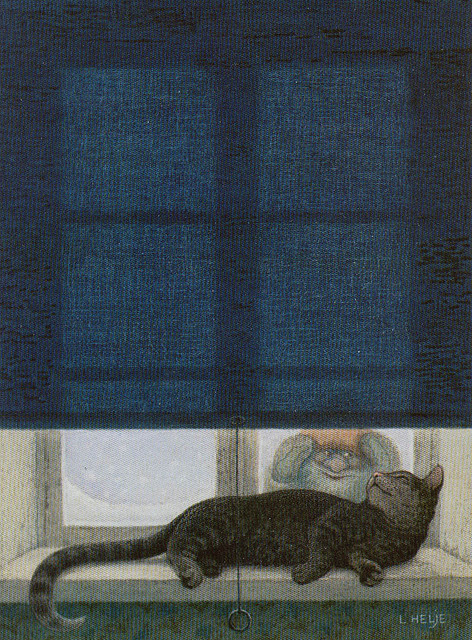
The first are those who hit the fantastic element and are transported back into the woods to a time gone by, when not all the world was known and therefore they can accept the strangeness. This group does fine when you give them Buffy, but struggle when you give them a scene like this image by L. Helje where a gnome and a house cat interact.
The second are those who hit the fantastic element and are propelled forward to the near future, when such a discovery exists. This group probably wouldn't put the gnome/cat in the past, but tries to propel Buffy the Vampire Slayer--or better examples would be Flashforward or Lost--ten years into the future just because that sort of stuff "doesn't happen now" so it must happen in the future rather than in a present altered by the author.
There's a third group, the hard core reader of urban fantasy, who sees (for example) a female witch doctor and so long as she's not wearing a gown and carrying a dirk, and the author didn't say in the year 2029, this group assumes that the jeans and Metro-card the character has, could have been bought at the very same places the reader bought hers.
And then there's the way-outliers who hit the fantastic element and that catapults them into an "other world." These people assume all fantasy must take place in a secondary world of the imagination that has nothing to do with the primary world we live in. Which is an intriguing psychological state of being, but not all fantasy is second-world fantasy. And frankly, I don't want to live in a world where there's absolutely no room for wonder, so let's not even contemplate those people.
I sincerely want my writing to put everyone on the same page. The third group gets it, the fourth isn't worth bothering with, so my conundrum is how do I convince groups one and two that we're in the world of the present day? Stick in a description of a kid with an iPod? The way to convince someone that you're not in the present is to present them with items that stick out as not-right. Sipping orange Nehi,** or carrying a ray gun. But to convince us we're in the now without putting a year/date on it? ... I'm frankly feeling rather stumped.
I've had it suggested to me that my characters could/should spend more time observing/interacting with their world as a means of setting the time frame. I'm beginning to think that more time spent contemplating the world would be good for narrative voice as well, because it would allow me to develop voice, character, and setting all at once. I pulled back from this between my undergrad writing and now because in undergrad I ONLY set stories using the voice of the protagonist because that voice was (ahem) mine. Unfiltered and undiluted. I wanted to branch out as a writer, so I developed a calmer, more reserved, writerly voice which worked for me in the third person.
Ah well, wax on, wax off. Time to apply everything I've learned
(The Dandelion image at the top of the post, btw, comes from this etsy shop which I love, love, love and bought some note cards from at one point.)
*I just read David Hartwell's essay on "The Making of the American Fantasy Genre" where he writes about the pulp magazine origins of urban fantasy (yes, before Charles de Lint). The discussion of urban fantasy is tangential to his discussion of the publishing of second-world fantasy, but he had my full attention for both. Also, discusses John W. Campbell's attempts to codify urban fantasy like he did with science fiction. The essay's not in my copy of Age of Wonders (I have the 80s edition, but it's supposedly in the 90s edition) but it is in The Secret History of Fantasy in extended form.
**Apparently, along with retro-candy there's now retro-soda, and that means you can get your bottle of orange Nehi once again. Though let's face it, at that price point you've gotta be hankering some nostalgia for that atmosphere the fictional reference is trying to create.

 In a Fix, by Linda Grimes is a fun, fast paced, urban fantasy romp. Ciel is an aura shifter. That is, she can morph to look like anyone. And, for a fee, you can hire her to stand in for you at whatever social event you just can't stand the thought of attending. Which was all fine and dandy, even if it barely pays the bills, until a group of neo-Viking separatists tried to blow up the client she's impersonating.


 Fifty Shades of Chicken is an honest to goodness cookbook/great


 Major, major improvement over previous covers, particularly book two where the heroine looked more like a stripper.




 I picked up A Discovery of Witches to find out why a book that was essentially an urban fantasy -- witches and demons and vampires, oh my! -- was being marketed so heavily at the mainstream. It had a prominent (non-urban fantasy) slot on the Barnes & Noble e-newsletter, and it is still hanging out on their front of store promotion tables. The other thing that differentiates its marketing from that of most urban fantasy books is that there's no representations of the characters on the cover. That might have been the biggest flag for me: what was so different about this novel that the publishers thought they didn't need to use the biggest telltale signs of the genre to get readers?
 There's a great Ursala Le Guin essay that's (re)printed in
  (primarily a short story collection with a couple of essays). In her essay, Le Guin points out that while fantasy fiction and surrealism differentiate themselves from realism by dealing in that which is realistically impossible, fantasy and surrealism are not interchangeable.
 series by Patricia Briggs were just awesome. Book four was necessary because the scene at the end of three remains unfinished until chapter one of book four! (a cheap shot ? I think it was more like Briggs realized she couldn't end it where she ended it and took book four as an opportunity to rewrite the action by altering the "ending.") But the plot of book four was abysmal. Books four and five sort of wash together in my memory because of how unspectacular they were compared to the tight, directed plots of books 1-3. Thankfully, book six got interesting because it solved some of the unsolved mysteries brought up as early as book one (why Mercy is the only coyote skin walker she's ever met). Book five sort of did the same thing with Samuel. But book four? Yeah, still don't see the redeeming value there.
 novels by Jim Butcher to know how Butcher handles the series character. But he's got at least 13 of these novels out and the popularity only seems to grow.
  drew the reader into the world and left us with more than we started with, but my feeling was that Harry Dresden was roughly in the same place as he was before. That's what I mean when I say "episodic": things happen but the world returns to the way things were without permanently altering much.
 aired on the SciFi Channel, it got even more episodic feeling and accidental feeling -- characters would accidentally run into Harry or Harry would brush up against their world without seeming to have any reason to -- so it's not all that surprising that it didn't last long on television in spite of how much fans loved the show. The Harry Dresden I watched on TV encountered a lot of creatures and characters and nothing changed him or made him grow. He was passive. And I was bored.


 , and
, and  have married the idea of the series with the "completeness" the romance genre requires of its novels -- each novel shows the trials, tribulations, and eventual success of one couple's romantic journey. So they base a series of novels in the same world, and the main characters of the first novel become secondary characters in the next. Then for the third novel, other characters who've been in the background become main characters. And so on. When these novels work well, the series world has some growing tension that each novel must deal with as well as "complete" the romance. When these novels don't work so well, the "growing tension" feels more like a background game of Farmville where we're just waiting for the next Mystic Egg to be collected
 .
.
 The other was to approach paranormal romance (and these often straddle the line between paranormal romance and urban fantasy), is to have a focus cou
 ple who remain the main characters throughout the entire series like
  did in the Cat & Bones books (technically they're called the "
 " series)
 s (I have the 80s edition, but it's supposedly in the 90s edition) but it is in