As Hurricane Sandy smacks down into the eastern seaboard of the United States, I can't help my overwhelming urge for finger foods. Snacky-snacks. Should I go out and buy chips and salsa? Should I make peanut butter cookies? Banana bread?
There's a rational reason behind this desire: should the power go out, I'd need foodstuffs that do not require heat to prepare or refrigeration to keep.
There's an irrational reason too: Hurricane Sandy is the best reality TV of the season. All consuming drama. Infinite outcome possibilities. Occurring in real time. With chance of interactivity should the storm reach where you live. This sort of drama needs snacks.
Or at the very least we can all tweet #HurricaneSandy again and again.
I thought that, seeing as I'm hunkered down in the Midwest, that the hurricane posed no issue for me. Then I saw the Weather Channel's map of "likely power outages" (not me) and "possible power outages" (holy crap, that's me!) and I decided it couldn't hurt to take a trip to the store, stock up on essential snack food, get some fresh batteries, and fill a couple pitchers with drinking water.
They've not said if the power outages are possible all the way as far inland as Chicago and Wisconsin because of the winds alone (they're gonna be doozies) or if it's going to be because of rolling outages and demands on the grid. I remember all too well the rolling blackout of 2003 that darkened New York to Detroit. That was actually the first time in my life I'd ever seen a "brown out" before the blackout. My mother later told me that "brown outs" were common when she was a kid -- the television, which was on at the time, got dim, then came back, then dimmed to almost nothing, then came back, then ... nothing. Four days worth of nothing.
President Obama got on air and made a very calm, very presidential, very rambling statement that people need to follow evacuation orders so that the first responders we have in place won't be unnecessarily put in harm's way. Reading between the lines: don't be selfish.
New Jersey's governor -- and I know very little about New Jersey's governor but this statement fits with everything I know of him -- says simply: "Don't be stupid. Get out."
Their concern is well founded. My New Yorker friend reposted this link to a Hurricane Irene cartoon today on Facebook. The fear among public officials, weather forecasters, and FEMA is always that when we predict a bad storm and it doesn't happen, that the next prediction will be seen as crying wolf.
Of course, all it takes is looking at the water mark in Battery Park. Today, four hours before the storm makes landfall, the water mark is only an inch below its height during Irene.
I'm not terribly worried for me, but being prepared never hurts.
Prepared. Like buying tortilla chips.
Twitter abounds with pictures of people's preparedness bounty. Namely beer. Practical for multiple reasons -- passing the time and, should the power go out, having all that cold beer filling the fridge will help keep the entire contents from rapid spoilage. (Not that we need more reasons for beer.)
Prepared. Like laying in supplies of brie and water crackers, Swiss Roll Cakes and salsa.
Prepared. Like checking the flashlight, finding it dead, then being responsible and purchasing new batteries for it, only to put in said new batteries and have the light bulb pop and die. So I have no flashlight. The good news is that I have plenty of candles and those at least give off heat -- important for someone looking to be prepared for a Midwestern windstorm and/or winter. Unfortunately, they also give off scent.
Scented candles: ready to stink up blackouts in pastel colors and high class holders. And banana bread (it's cooling on the rack). Yep. We're prepared.
New York, NY (July 2, 2012) – World Weaver Press(Eileen Wiedbrauk, Editor-in-Chief) has announced Shards of History, debut novelby author Rebecca Roland and their first full-length publication as a small press, will be available as a digital edition on Tuesday, August 21, 2012. “I'm incredibly pleased that our first novel is such a great story featuring a strong heroine who doesn't shirk responsibility even when a perfect storm of conflicts and disasters descends on her,” commented Wiedbrauk. “Shards of History is a fast, interesting read that I hope readers will love as much as I do. Rebecca Roland is a strong new voice in the field of fantasy fiction.”
Like all Taakwa, Malia fears the fierce winged creatures known as Jeguduns who live in the cliffs surrounding her valley. When the river dries up and Malia is forced to scavenge farther from the village than normal, she discovers a Jegudun, injured and in need of help.
Malia’s existence--her status as clan mother in training, her marriage, her very life in the village--is threatened by her choice to befriend the Jegudun. But she’s the only Taakwa who knows the truth: that the threat to her people is much bigger and much more malicious than the Jeguduns who’ve lived alongside them for decades. Lurking on the edge of the valley is an Outsider army seeking to plunder and destroy the Taakwa, and it’s only a matter of time before the Outsiders find a way through the magic that protects the valley--a magic that can only be created by Taakwa and Jeguduns working together.
Rebecca Roland lives in Albuquerque, New Mexico, where she writes primarily fantasy and horror. Her short fiction has appeared in Uncle John’s Flush Fiction and in Stupefying Stories, and she is a graduate of the Odyssey Writing Workshop. When she’s not writing, she’s usually spending time with her family, torturing patients as a physical therapist, or eating way too much chocolate. You can find her online at Spice of Life, her blog, or follow her on Twitter @rebecca_roland.
World Weaver Press is a publisher of fantasy, science fiction, and nonfiction, dedicated to producing quality novels, novellas, collections, and anthologies. As a small press, World Weaver seeks to produce books that engage the mind and ensnare the story-loving soul.
Over the weekend, the 2012 Hugo Award nominees were announced(full list). Awards to be presented September 2, 2012 at Chicon7. Voting is open to members until early August. Last year they streamed the awards ceremony live online; hopefully they’ll do the same this year for all of us who can’t get out to Chicago.
Speculative art and design rules: There are these great “Urban Astronaut” paintings by Jeremy Geddes that I’m absolutely in love with, and then there’s the Dark Shadows Barnabas Portrait Project a Deviant Art contest with three winning artists to be chosen for monetary prizes by Tim Burton himself.
Chuck Wendig’s 25 things you should know about word choice is a tour de force article on writing. An entire workshop’s worth (or five workshop’s worth) of prose style and word choiceadvice vulgarly put.
My absolute favorite discussion this week comes from the podcast Adventures in Sci-Fi Publishing: It’s a panel discussion on the publishing industry’s recent “turmoil” regarding authors vs. Amazon and Paypal vs. Smashwords — the end summation? A good dose of common sense. All these crazy things are just businesses practicing business; writers should keep writing and not worry about it. They make other wonderful statements directed at writers:make your name, diversify, and don’t turn down any market. And then get in a few good nudges at publishing, suggesting that publishing needs to become more like other businesses, get out of [the] Madison Avenue offices and out of the the golden age mindset of “owning writers.” The podcast is about an hour long and I can’t recommend it enough.
Cross-posted with World Weaver Press' "Books & Pieces" weekly news round-up segment.
A cache of 500 folk tales were discovered in Germany recently, many of which have not been a part of our previously documented understanding of the folk tradition in Europe. From that trove, the fabulous tale of the "Turnip Princess" -- which could easily be retitled "The Tao of the Turnip" -- the likes of which we've never seen before.
This amazing bit of animation is a beautiful, bloody, Red Riding Hood becomes an interesting twisted-origin story of folk lore's favorite caped crusader. The short film is titled simply "RED": RED from RED on Vimeo.
The film puts me in mind of one of Roald Dahl's poems "Little Red Riding Hood and the Wolf." And if you know Roald Dahl, you know the man had a wicked sense of -- well, of humor most certainly, but he also had a wicked sense of the wicked.
Moving slightly out of the realm of folklore and into the realm of myth, Amalia T. has a fascinating blog post up on the forbidden nature of love poems in ancient Norse society. Apparently, magical ensnarement of women was such a big deal that there were laws against it. Amalia rationalizes the situation, writing:
How can you be sure that a poem is just a poem, and not a spell meant to seduce your daughter and ultimately dishonor her? How can you even be sure that the person writing the poem isn't Odin, for that matter, or worse, Loki, who is also known for shape shifting, come to take advantage of your daughter/sister.
Admittedly, not being seduced by Loki is a good thing -- unless you have a bad boy complex. Dating preferences aside, it's a fabulous example of the power and magic of mere words.
Snow White and the Huntsmanlooks like it just might be the fantasy film of the summer. The second trailer (below) is awe inspiring. This film promises to deliver what other recent fairy tale adaptations haven't: a plot with folk lore roots that we actually want to see. Red Riding Hood last spring was ... pretty. And admittedly Amanda Seyfried's character showed a surprising amount of agency for what we'd originally pegged to be a film that was just an excuse to shoot a bunch of dramatic looking footage of a red cape against snow. And while I'll freely admit that if I was 17 years-old when that film came out, I'd own the DVD right now, the truth is Red Riding Hood didn't appeal much beyond teenagers and scholars of little red cap tales.
And even though it's hard to buy that Kristen Stewart is, or ever will be, more beautiful than Charlize Theron, the special effects are cool enough and the plot dark enough that we're willing to forgive such things. More forgiveness is found when the extended sneak peek (!) has a nice little flashback snippet of dialog between Snow White-as-girl-child and the now-dead Queen-her-mother, wherein the Queen tells her daughter that her fairness lies "in here," and then pats the girl's heart. Oh, so that's what you meant? Gotcha.
**Late addition:“Frog/Prince” a short story up on Daily Science Fiction (an online sf/f magazine) today is an marvelous little tale about what it means for a frog to become a prince or a prince to become a frog. Clever and heartbreaking. Well worth the read.
For more links to interesting articles and genre related cartoons, check out and "like" World Weaver Press' Facebook page, updated daily.
Cross-posted from World Weaver Press as "Books & Pieces" where I'm in charge of their weekly round-up of news and factoids.
If you enjoyedJoss Whedon’s Dr. Horrible’s Sing Along Blog there’s more Dr. Horrible in the works according to wired.com! Neil Patrick Harris and Nathan Fillion will both be returning for the sequel.
This is your brain on fiction. A New York Times article highlights recent research which shows the brain functions at a different level when reading fiction than it does when doing other types of reading. Particularly that it processes sensory details like sound and smell as if it was receiving real stimuli — all the more reason for to incorporate more and more awesome sensory details in a story!
Writer Jay Ridlergives us five reasons to love short story collections.
And speaking of short story collections, there are contests going on right now on two blogs for free copies of Susan Abel Sullivan’s first collection Cursed: Wickedly Fun Stories. Check out Fang-tastic Books and I’m a Reader, Not a Writer to find out how to enter.
Last night, the Hunger Games movie took in an estimated $20 million just from its Midnight showing according to Publisher’s Marketplace (via). Even Weather.com's lead story is Hunger Games related this morning.
The top ten sword fight scenesever were given to us by io9 this week (sci-fi and fantasy only). We have only one thing to say on the topic: My name is Inigo Montoya, you killed my father, prepare to die.
World Weaver Press answered the question this week: Just what is “speculative” fiction, anyway?
World Weaver Press author Susan Abel Sullivan stopped by the UK-based Becky’s Barmy Book Blog to give a fun little post about first realizing that she was a humor writer. On her own blog, Susan crafted an insightful post about her early love of monster movies.
Lastly, these little robot-dudes are so cool. And supposedly Amazon is going to have a whole warehouse full of them along with Walgreens and a few other American companies that already employ the inventory-finding bots.
A few quick sound bites for you for this Thursday afternoon ...
PayPay repeals its policies of censoring legal fiction at Smashwords. Somewhat questionable but not illegal love shall be censored no more!
Darth Vaderleaves the Empire. In his terms, the Empire isn't taking Vader's interests and talents seriously anymore, nor do they have their priorities straight:
"throttling people with your mind continues to be sidelined in the way the firm operates and thinks about making people dead."
The SF/F magazine Beneath Ceaseless Skies is giving away two copies of George R.R. Martin's tribute anthology Songs of the Dying Earth, signed by Mr. Martin. Rules to enter.
Chrystall Thoma writes about The Dangerous Task of Writing a Sequel. Lions and tigers and -- two bears? -- oh my!
And lastly, it was seventy years ago yesterday that the first human life was saved with penicillin, an antibiotic discovered accidentally by Alexander Fleming in 1928.
You may have heard about the PayPal imposed Smashwords censorship that went down earlier this month, where PayPal placed the muscle for credit card companies that don't want their product used to purchase erotic novels that deal with rape, incest, or bestiality, and told Smashwords it would have to pull all such titles from its catalog or risk PayPal not working with them.
People brought up the slippery slope argument: if it's "no rape-as-titillation" today, what will they censor next?!
Many publishers already have these items on their no-no list -- erotica publishers and others. While I'm not writing this post to praise self-publishing as a bastion of moral depravity, it does commendably stand as a place where people who are not writing in the main stream can publish without rules on their content.
I'm not going to run out and buy a novel I know has incest-as-titillation, but I like knowing that the option to exercise one's free speech to reach the masses is out there and available. Traditional publishing marginalizes many acts and groups; self publishing doesn't ... until now. Slippery slope.
Among the paranormal crowd, I heard the ever popular (and important!) argument: Are all inter-species relations "bestiality"? What about werewolves and faeries and sexy aliens?
Captain Kirk could seduce blue extraterrestrials in miniskirts, but can the hero of a Smashwords novel?
But rest easy, Smashwords has clarified that were-creatures can still get their freaky on.
And then there's the who really needs 'em? argument.
But Smashwords can't just tell PayPal to screw off. The two are incredibly intertwined.
PayPal processes credit card transactions for the online retailer (and as their online, their business is almost entirely done by credit card). Besides, PayPal is just the muscle, not the source.
Should Smashwords get a new company to process credit cards, the credit card companies would only turn that new processor into their hired muscle.
My twitter feed today was all mentions of the recent JK Rowling related press release: she's coming out with a book for "grown ups" with Little Brown. Everybody wants to talk about whether she'll be able to have success writing for a new target market ... but what I really want to know is what the hell the book is about, and no one is talking about that!
The pundits and the reporters and the trend watchers can speculate all they want about potential and market and viability. I'm not a trend watcher; I'm a reader. I want to know if I think I'd like to read the book.
They're not even saying if it's fantasy or realism or something else, for crying out loud!
Let me know in the comments if someone finds actual information about the novel not just the news of the novel. Thanks!
Romance as a fiction genre continues to boom, romance as a real life institution is on the decline. Match.com recently funded university researchers to gauge of single Americans' attitude toward romance in general and matrimony specifically. The result? Only 34% of single Americans said they knew they wanted to get married. another third were "uncertain."
But it's not actually the statistics on marriage which I found all that surprising; it was the statistics on those who are looking for a relationship, or more precisely, aren't looking:
80.8% of single Americans aren't actively seeking a relationship right now (this includes those who "don't have time," "want to stay unattached" and who just aren't putting in any effort). Of that 80.8%, only 48% said that while they weren't actively looking, they'd consider a relationship if the right person should drop into their lap ... metaphorically speaking.
But don't try to tell yourself that the reason you fall into one group or the other has to do with your geography, notably the lack of suitable (wo)men in your region, not until you let the Icelandic people put that one into perspective for you. In Iceland -- an isolated island country with roughly the population of Pittsburg -- there is an online incest database where you can check out just how related you are before things get too serious. It takes the notion of Googling your date to a whole new level.
Meanwhile, sales of romantic fiction stay steady (even grow) while other genres decline. Romance novels used to be seen as the fantasy which married women or wistful teens engaged in, but give the data it's not surprising that the romance novel remains popular, particularly the paranormal romance: singles don't expect to experience it themselves; they approach it as purely a fantasy whether or not it contains a vampire.
I recently heard a re-broadcast series of radio-articles from NPR's Radio Lab that explored the question of what makes us ourselves. Not just what makes us human, but what makes us have the personalities that we do and, essentially, how we understand our own personal histories and use those histories to create identity.
But what struck me as the most memorable moment of the show -- and the whole thing was fascinating to me as a writer and creator of fictional people, and I think most writers would agree with me that the discussion is fascinating in a philosophical sort of way -- was when they boiled down what creates the "self":
The "self" is the ability to experience, then abstract those experiences into story.
They were talking mainly about the ability to tell people stories about your day, and dig up your war stories to rehash around the fire. But they also touched on the ability to fictionalize. And to imagine that which we've never seen. No one's every seen a man with wings, but we are able to abstract the experience of man and the experience of bird and then imagine an angel.
I think these radio articles are fascinating for any writer and a must-hear for fantasy writers out there.
Just before Christmas, two very intriguing things happened: Brandon Sanderson announced via tweet that he had finished the first draft of the final novel of the Wheel of Time series -- yes, the series of doorstopper fantasy novels that could not be stopped even by original author Robert Jordan's untimely death is finally coming to an end after fourteen volumes -- and the first teaser trailer for The Hobbit dropped.
The VLA is made up of several of those GIANT dish-like radio antennas -- like the ones featured in Contact or The Dish -- and is out in some part of New Mexico that I've never heard of. Although, to be honest, if it's not near-Santa Fe or near-Albuquerque then all of New Mexico is a giant question mark for me geographically.
Have to say that I totally loved Contact and I might have even loved The Dish more. The Dish is a fabulous film that is both funny and historical -- a radio dish in small town Australia (the dish is literally located in a sheep paddock) is tapped by NASA to help track Apollo 11 and man's first steps on the moon. And The Dish has Sam Neil in it -- who doesn't like Sam Neil characters?
Go here if you have an idea for a more interesting name than "Very Large Array" -- a name which has been on the welcome sign for years now. I went with murmuration, the same term as is applied to a group of starlings taking off.
Perhaps I am still an Obama-fangirl and that skews my take on things -- but how can you not love a truly great orator? -- but seriously people, com-pra-fricking-mise. This is serious. Stop the TEA party shenanigans for a moment and think.
Pop up bookstore to appear in a shuttered Borders store in Pittsburgh. If it wasn't for Top Chef, I don't think I would understand what a "pop up" business is. This one will last for a minimum of a month. I would totally go shop at one of these if it popped up in my state. Oh, and you can ask the store to stock your indie book too.
You've probably heard about the ebook author Jacqueline Howett who freaked out, behaving like she was on Jerry Springer, not getting her self-published book reviewed. It's been all over Twitter and used everywhere as a cautionary tale of how not to behave. A friend sent me to this train wreck through Facebook. I arrived, saw the first three comments and thought wow. But then I kept reading, and the tragedy stretched on ... and on. I was literally slack jawed by the time I finished reading.
What my writing friends are saying privately is that while we are fascinated by the potential of ebooks, we are terrified of going that route because of authors like Howett who bare the name "indie writer" and then throw tantrums in public. Of course, actors can throw tantrums in public and that doesn't make other people not want to be actors--that just makes us think that Charlie Sheen's an ass and that someone should really give Lindsey Lohan a cheeseburger, not more crack.
What's up with that whole "indie" label anyway? Indie bands sign with indie record labels. They tend not to release on their own (although they can). But indie bands are cool. Hip And they've therefore made the term "indie" cool and hip. That it's been co-opted by writers who are going DIY seems to be co-opting the cool without any of the work. So if I repaint my kitchen, am I an indie decorator? If I help my friend move into a new place and he pays me with a six-pack of beer am I an indie mover? Indie contractor?
Former agent and media-specialist Nathan Bransford, crunches the indie/legacy numbersin his Monday post of his author monetization week. Essentially, if you can get your book picked up by legacy publishers, you'll make more money because they have better distribution and people are still buying paper books despite the growth of ebooks. Oops, Barry Eisler; turning down a cool half-mill advance might be a great stunt but maybe not so great a monetary decision. But Bransford is assuming that your book gets picked up at all. Which means that all the un-pick-up-able books still get to be "indie" books. Which doesn't feel very cool or hip.
Although it could be cool and hip if "indie" authors worked to push the envelope and write about topics that make the mainstream uneasy, or things that are experimental in form.
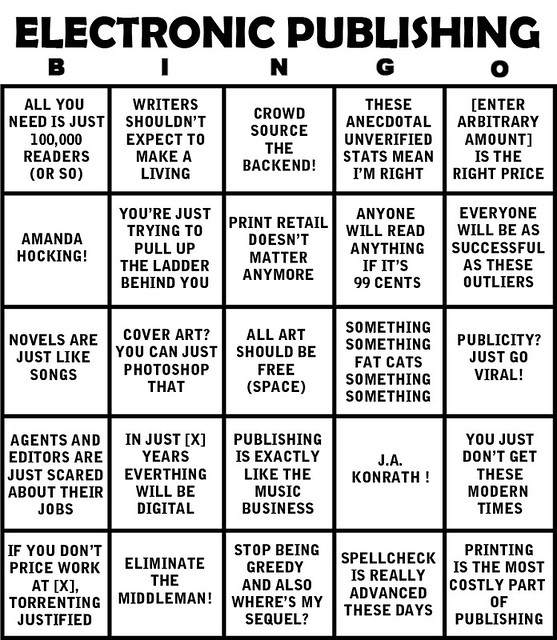
At first I thought of taking the card and playing seriously with it. That is, marking down each time I saw one of the things in the squares during my readings of blogs, articles, and list serve discussions. Then I realized, what fun would that be? I'd fill the card in an hour of reading. Two max.
Maybe this shows more what I've been reading than that the world is all atwitter over the topic.
BTW, anyone else annoyed that they feel like they can't use the word "atwitter" anymore because it's too close to Twitter? Every time I go to type atwitter, I wonder if I should only use it to refer to that which Twitter is atwitter about and that makes me sad.
I'm terribly interested in e-publishing information, but then again I'm terribly interested in publishing information, period. I even took a graduate level course on publishing this past fall. I find it all fascinating, and I think that shrewd business moves can be made through the use of ebook publication. Then again, it's not the medium or the market that has the golden touch, it's the author. And just as many stupid business moves can be made through ebook publication as smart ones (probably more if human nature has anything to say about it).
I'm interested, I'm just starting to get very annoyed with all those out there talking about e-publishing like it is the messiah come to save us from the publishing industry, low authors' advances, mistreatment of mid-list authors, mistreatment of new authors, the decline of hard cover books, the decline of mass market paperback books, the decline in reading, the increase in reading that's not novels, growth of technology use, the death of paper, the death of brick and mortar book stores, the death of polar bears, cheap readers with limited discretionary funds who can afford a $200 e-reader but not the $10 book to read on it, and those nasty nasty gatekeeping agents who want to do things like sell your book.
Don't get me wrong folks, I find it interesting, but I'm not bowing at the altar.
And here I was thinking dystopia was hot in YA novels. Turns out the governor of my state is also a fan.
Gov. Snyder has said he wants to tax pensions (which is the "tax old people" part of the above report). He's also "selflessly" declared he will work for only one dollar a year -- no doubt trying to assuage the anger of people's retirement money now being taxed. Gov. Snyder, however, is a millionaire who owns at least one big Michigan based business (I think they make closet organizing systems or something like that, but I could be wrong); he doesn't need to worry about his retirement.
To be fair, I'm guessing the intent behind the bill is to prevent some of the situations we've seen around the state like those we've seen with the Detroit Public School System. But this proposal is using a hatchet to kill a fly.
What a nightmare. At best this provides writers with a ready-made dystopia--no need to design your own!
There's been a lot of internet chatter about Amanda Hocking and her self-publishing escapades this week. USA Today, The Huffington Post, Business Inisder, and her local NBC news affiliate gave her some air time (see video, though the first 30 seconds is just the anchors talking about wtf a Nook is).
"Rejected by countless book publishers" seems like a subjective phrase which *might* have just been blown out of proportion. Ms. Hocking got fed up with the system at age twenty-five. She submitted each subsequent novel she wrote to fewer and fewer agents (as per admission of her own blog).
Most agents will tell you that it's often not the first book you write that's the first book you sell. In Ms. Hocking's defense, she claims to have written 19 novels, many as a teenager. Now, no offense, but I remember what I wrote as a teenager and I teach teenagers writing and that teenage writing has about as much chance of making it with a publisher as I do of winning the lottery on any given day. Eragon = lotto winner.
Also agents (and successful traditionally published authors) point out that most writers do rounds and rounds of queries--sending out ten queries a week for months--before they find the right fit for a successful agent-novel-author experience. It's about finding an agent who is passionate enough about your book to want to sell it as much as you do, not finding someone to schlep paper for you.
Anyway, I bring this all up because I have my doubts about how the news media is portraying her "perseverance." But that's just me.
But it turns out she didn't need to persevere or gain a sound understanding of the publishing industry. She'd already done "market research" by browsing the Wal-Mart book rack (Ididn't make that up), she wrote YA paranormal because she it was what she saw the most of. She knew it was hot, so she stuck it up on Amazon, B&N, and several other epub platforms and made it available POD through Amazon's Lulu. Less than a year later she's self-published eight novels and one novella out and, according to her blog, sold over 900,000 units. Priced at $0.99 or $2.99, Ms. Hocking makes 30% or 70% of that as profit, respectively. According to her local news station, she's made enough to buy a house in cash.
Ms. Hocking is twenty-six and impatient. IMHO.
I don't mean to misrepresent her. It appears that she already feels enough of the internet is doing that. So I won't take some of the pot shots that I could. But I'm the kind of person who believes in the strength of patience, perseverance, and education. Formal education is helpful, but education is out there in thousands of different forms, you only have to ask for and accept it. Reading agent blogs daily is a form of education. Researching publishing is a form of education, learning grammar and style is a form of education. Knowing you need a good copyeditor is a form of education. Learning about things like book bloggers before you jump into the world of epublishing is a form of education. Reading books on craft, being part of a workshop, finding a critique partner, subscribing to publishers marketplace, reading in your genre, reading out of your genre -- these are all forms of education, patience, and (if you keep writing with all you're learning) perseverance. A classroom with a teacher in it isn't necessary to learn.
I'm twenty-seven, only one year older than Ms. Hocking, and I think that if there had been an easy way for me to throw my work into the sales arena when I was twenty-two, I might have done it. But I'm not that impatient now. And I shudder to think of my work when I was twenty-two given all I've learned in the interim.
Ms. Hocking also writes on a recent blog (to clear up things "the internet is saying ... about me"), that she feels a "tremendous sense of urgency, like if I don't get everything out now and do everything now, while the iron is hot, everything I've worked for will just fall away." This also leads to the feeling I get from looking at all of the facts (those presented by her in interviews and those presented on her blog) that her ebook sale boom is the result of impatience.
The SF/F/H writer list serve I'm on is in a tizzy contemplating the viability of the e-publishing-- the phrase "future of publishing" has been bandied about so much that it's ceased to hold meaning for me. Those who seem the most interested are people who are writing "between genres" or in not easily defined areas of the market who don't feel the traditional publishing market is open to them. Meanwhile the listserve's many voices are not really paying mind to the fact that Hocking is writing in a market that's not just hot, it's hott: YA paranormal romance.
Ms. Hocking's first novel has a good concept, but its market niche is one that is begging for content. My local Barns & Nobel has devoted an entire shelving section to "Teen Paranormal" -- more space than "Christian Fiction" gets . . . and on the conservative west side of Michigan, that means something. This is the one genre where publishers can't put out enough material to meet the demand.
Believing that you can epublish in a different genre and take off the same way is a mistake. IMHO. What sells and what doesn't is always hit or miss. No one knows what the next big seller is going to be. But let me present a case to back up my opinion.
Consider this: as much as I am a part of the cult of Firefly, I knew the moment I saw the first episode why it had only lasted one season (obvi, I was watching on Netflix). A space western could have been one of those things that exploited the interstices of genre and boomed, but it exploited the interstices of two declining genres -- dying genres, if we're going to be morose. The space opera and the western haven't been doing well in print or on screen. Speculative fiction has been there, but all you need to do is look at the declining number of episodes each new cast/crew of Star Trek made to see the writing on the wall.
So just because the internet is a way to publish in a declining genre without the editors fearing the decline, doesn't mean success will come your way. There's a guy out there trying to raise $3,000,000 to get Firefly back on the air (or air on the internet). Will his internet grass roots movement catch fire? Grass fire? Prairie fire? He wants people to pledge $40 per season to see the show online. Maybe he'll make his goal. Maybe he won't. But he's got one giant plus on his side: people have already seen the show. It's been on air, on TV, on Netflix, and in traditional theaters (Serenity). This "unproducible" TV show was produced -- your "unpublishable" novel hasn't been published.
The point I'm making: could this Amanda-Hocking-success-story happen for a writer not working in Teen Paranormal? Yes. Would I bet on it? No, I'd bet against it. And I'd make a big wager.
What I do see as worthwhile, competent epublishing ventures or --go forth and epublish now:
Authors publishing their out of print backlist (or like JA Konrath, publishing the backlist and then writing more books in the same series and epubbing them)
Authors publishing short story collections of work previously published by magazines or anthologies (Chuck Wendig).
It's very, very, very hard to convince a publisher to lose money on your short story collection -- because "short story collection" to a publisher is a bit like taking a lighter to money just to watch it burn. The publishers who do pub short story collections do so because they are dedicated to art -- and usually have dedicated grant money. But if you can say look at my short stories published in magazines X, Y, and Z, now collected in one place for a low low price then hey, maybe I'll buy that. Literally.
I'll post Monday on the how to be a professional and a self-epublished author information a publicist recently gave me after a discussion of the above news articles and blog posts. It was all good information that I was going to put here, but this post has gone on far too long.
There's talk of Firefly returning to TV, which would be awesome! although dealing with the story lines of the film and the two comic series would prove interesting. Although the one series is pre-TV show timeline-wise; no idea about the Shepherd Chronicles (Dark Horse). Mostly I'd be concerned how they deal with you-know-whose death at the end of the movie. Soooo did not see that coming.
Locus came up with a short list of awesome Tor.com stories, so Tor.com went and bundled them here. Just so we're all on the same page, Tor.com is an online magazine which is affiliated with TOR-Forge press (book publisher). Poor undergrad in my graduate class on publishing flubbed that one big time when he mixed up the two. I didn't have the heart to point out the difference in front of the class -- thank goodness I was a student and not the teacher in that situation.
And last bit of news: Enchanted Conversationsis open to submissions until Thursday at Midnight. They've recently recreated themselves as a much better looking website, and a pro-paying market (10 cents per word) -- but they're only accepting stories within four day windows, fit the theme (Rumpelstiltskin, this time), and are under 2000 words. I figure that weeds most people out, but if you have a less-than-2000-word Rumpelstiltskin story, here are the much lengthier submission guidelines.
And yes, I do so happen to have an under 2000 word Rumpelstiltskin story, I am writing a folk tale inspired MFA thesis after all.
He and the Rain City Superheroes are a PhD dissertation waiting to happen. Or maybe just a Good Morning America segment.
And Joseph Campbell says that we live in a society with no myths? That our society is too much in flux to develop myths we can believe in and interact with? Pheonix Jones is nothing if not an example of a modern myth believer and interactive.
I'm working on a grad school statement of purpose along these lines. I was just going to look at speculative literature/film/comix and fandom as examples of modern myth, but these Real Life Superheroes go beyond fandom. And I might just need to modify that statement of purpose.
I spent the past two days curled up with blankets and tea watching episodes of Firefly on Netflix while trying to shake the head cold that had been tailing me--and I think I managed to lose it. Although I now understand both why Firefly had a cult following and got canceled after only one season on TV.
Also this week I discovered that perhaps the most informative time to be reading your Twitter feed is between 8:00 and 9:00 am. At this time very few people are tweeting about their dog or their fatigue or their efforts to find air tight kitchen containers ... no, wait, someone was tweeting about that ever six minutes and trust me, it's even more annoying before 9:00 am than it is after. But I found some rather interesting bookish articles out there.
New book reviews for indie press books including that of a collection of poetry produced by New Issues Press (which is cool because I know people here in town who work for New Issues.
Author Jackson Pierce explains how the NYTimes bestseller list works--a must see video for all bookish and writerly types:
Oh and then NPR has an article/podcast on why independent bookstores will survive the failing chains, you know be the wily mammal to the sickly, giant dinosaur.
And lastly, five authors talk about their book editors.


 I thought that, seeing as I'm hunkered down in the Midwest, that the hurricane posed no issue for me. Then I saw the Weather Channel's map of "likely power outages" (not me) and "possible power outages" (holy crap, that's me!) and I decided it couldn't hurt to take a trip to the store, stock up on essential snack food, get some fresh batteries, and fill a couple pitchers with drinking water.


 My twitter feed today was all mentions of the recent JK Rowling related press release: