Showing posts with label publishing. Show all posts

Sunday, March 13, 2016

Changing of the Guard

From the Editor's Desk, Eileen Wiedbrauk, World Weaver Press

Last month, I announced that I was stepping down as Editor-in-Chief of World Weaver Press, the speculative fiction small press I founded in 2012, to be succeeded by Sarena Ulibarri.

I am thrilled with what I've accomplished as Editor-in-Chief and by how far we've come in just under four years. My time as co-founder of the press has been fantastic, primarily because I've had the chance to work with such great authors crafting intensely interesting novels. I think that every reader of speculative fiction should pick up a World Weaver Press title, not because I published them, but because they are such damn engaging stories crafted by truly artful storytellers, each working in her own idiom.

I'm happy to be handing off the creative direction -- both for continuing the series we've started and to seek out new ones -- to someone who shares our vision and passion for speculative fiction and who can continue to drive World Weaver Press forward.

In her welcome post last week, Sarena Ulibarri writes:

Ever since I became aware of World Weaver Press in 2013, I’ve known it was a special corner of the publishing world, brimming with talent. The gorgeous covers and professional presentation of these books made it clear the publisher truly cared about them, and the colorful, creative, and passionate stories between those gorgeous covers always exceeded my expectations. Each World Weaver Press book is a gem, and I am grateful Eileen Wiedbrauk was able to shine each of them up and put them on display.

I joined the World Weaver Press team as an Assistant Editor in late 2014, shortly after I had finished my MFA program and attended the 6-week Clarion Writers’ Workshop. For a few months after Clarion, I felt like I was in a constant freefall. World Weaver Press gave me a place to land — a place where all my skills and passions mattered. I’m a writer too, of course, but editing, whether at the developmental level or the copy editing stage, is deeply satisfying work for me. I have learned so much about great storytelling from Eileen and from the other World Weaver Press editors and anthologists.

Over the last couple of months, I’ve had the opportunity to interact with the World Weaver Press/Red Moon Romance authors and editors at a deeper level while we prepared for this transition, and let me tell you: these are amazing people. The stories we've published and will soon publish are stories that take you far from the mundane and weave bright and interesting new worlds. Our editors are fiercely in love with the projects they’ve chosen to work on, and that love comes through in every step of the publication process. ​
In a twist that may only appeal to me, I have to mention the absolutely adorable new graphic she's chosen for her "From the Editor's Desk" posts. It still features a cup of coffee, but it now has a tiny potted cactus -- appropriate as the press's management is now moving from the Midwest to Southwest. The original "From the Editor's Desk" graphic (above) was a shot of my actual desk at the creation of WWP. A lovely IKEA feature that has since been retired after extensive, shape-changing use. The pictured moleskine notebooks, Lamy pen, and coffee mug are still very much a part of my life, however.

But isn't that the crux of life? That we are more like shape-changing IKEA desks than quality fountain pens? That the course of use changes our shape, and shape changes our intent, and eventually, our use.

It was a fascinating journey, my time as Editor-in-Chief. Some of that time was indeed spent editing, but as any editor or small business owner knows, your primary job is project management regardless of the title you hold. I'm grateful for the experience. I'm met some great people. Grown through tackling the challenges. And I'm ready to face the next chapter of my life with great vigor and determination.

One thing I'm doing in the immediate present (as opposed to the near-future present, which is totally a thing -- I swear), is freelance book design. I am available on a for-hire basis to individuals and small presses to design cover art, format ebooks, and design interior paperback layouts. Information here.

Remember how I said an editor's job is a "project manager"? Well, at a small press that's only a few year's old, it's also book formatter and cover designer. I am responsible for crafting all of the books for WWP from early 2012 to the end of 2015. The move to doing this on a for-hire basis is a natural one for me. I'll even be continuing to do the occasional cover project or other project for WWP.

Later this spring (is it spring yet? I'm ready to be done with snow) I will be rolling out pre-designed book covers for purchase. I'll post another announcement when that happens. I'm really looking forward to the gallery of all the pretty covers!

Monday, August 03, 2015

Small Press Publishers, the Tiny and the Mighty

Picture
Recently I've had the pleasure of appearing on the Odyssey Writing Workshop's blog in a "Graduate's Corner" post, discussing the merits and might of small press publishing. The small press doesn't necessarily have the reach or the flashy . . . well, the flashy anything, but it can take risks on niche titles that might not be as well-represented by large publishers.

You can read the whole blog post on the Odyssey Writing Workshop blog, where I praise Chizine and Small Beer Press (of course I mentioned SBP, because I'm a total Small Beer Press fangirl), as well as discuss some of what was important to me as I built World Weaver Press from passion into press.

Wednesday, January 07, 2015

Hibernation 2015 - wherein I discuss stashing food supplies and what I achieved of my pre-hibernation goals, and perhaps, the dreams I will dream during said winter incubation period

I recently got asked to do a Thing in another city, and I very seriously replied that I was, in fact, in hibernation until the end of February. A conservative estimate. In truth, the end of hibernation depends on the end of Snow Season, which is different from the end of Winter. Although the two are not wholly unrelated.

Northern Michigan winters are not something I take lightly. Yes, there are places where winter is worse and/or more persistent. But this is nothing to be sneezed at. Unless you have the flu on top of being trapped in your own house and really we all should have just gotten flu shots. No, I'm not completely cut off from civilization -- see, I have the internet, I have all the civilization I need -- but when your means of getting to the grocery store or anywhere else in town is a tiny compact car, you reevaluate your ability to fight the terror in white.

And damn if road slush didn't nearly do me in the other day. It wasn't even snow! Or ice! Just the goofy slush! Argh.

So I don't travel between Christmas and the start of March. Not if I can help it and certainly not for any distance.

The cupboard shall not run bare.


I have a December through March worry, which becomes a full on January and February neurotic maxim, to always have several days worth of food on hand -- food that can be turned into meals, not just a box of Cheerios and a pound of butter. Shudder. Because we never know when the next big snow is going to hit.

Last year the weather forecasts were dead on. Then again it seemed like we got 2-5" every day last winter, so I guess it's not that hard to predict. But this year they predict 3" we get none. They predict 6" we get none. They predict 5" we get 12." Sigh. And even when a mild 5" fell earlier this week, and I had diligently shoveled out all the requisite paths -- clear sidewalk for school kids, clear steps for mail man, clear driveway for me to get the car out -- I slipped and slid all over the place courtesy of aforementioned slush. So I try to stay off the roads the day of snowfall if I can. (A home office is a brilliant thing.) But if it snows for three days . . . I'm screwed. Or at least stranded.

Which is fine. Because I prepare.

I like to have enough on hand that I could, if needed, wait it out for a week until a clear day afforded me passage to the market that did not land me in the ditch or making new friends and acquaintances of the let's trade insurance information variety. At the very least I can stretch things out by eating rice and kimchi until I realize that I'm not Korean enough -- even in my own mind -- to eat kimchi with every meal. (It should be noted that technically I'm not Korean at all, I just watch too much K-drama and it's been rubbing off on me.)

Read the rest of this post...

Friday, March 22, 2013

The Truth of the Slush Pile

A recent article by David Cameron published by The Review Review poses an intriguing concept: the writer took a story printed in The New Yorker, supposedly THE magazine when it comes to literary short fiction, and submitted it to other magazines as part of an experiment to see if the story was empirically "good."

That is, would all the other magazines jump to accept the cream of the crop story on their desk?

Answer: not a one.

It should be noted that not a single one of those Top Tier or Second Tier literary magazines sent him a rejection saying this was already published in the biggest magazine in the country, who do you think you're trying to fool?

Not a one.

What does this say about literary magazine publishing? Three things:
  1. People who buy into the idea that there is a TOP magazine for short fiction are buying into a myth. There is no empirical standard for a "good story." 
  2. Not everyone who reads fiction reads the same magazines. But we should have already known this, otherwise there wouldn't be more magazines published each month than any person could possibly have time to read. 
  3. Making it to the top of the slush pile is one part good craft, one part interesting story, one part dumb luck.
"Slush sucks," Cameron says. It's a good summation. In my editorial experience, it's all about hitting the right editor on the right day with a story they're going to want to fight for. If yours is the third ornithologist with marital issues story they've seen that day, they're not going to cut you any slack. If they've just lost a family member, your piece on death that starts crass and ends poignantly isn't going to be read all the way through. There's a lot about the slush pile and the editor that you can't control or even predict.

Although the bigger the magazine or anthology I worked on, it mattered that a story ended up with the right editor eventually, but it almost mattered more that it first was shuffled to the right slush reader who read it on the right day while in the right mood and found themselves so taken with the story that they wanted to fight their editor and the other slushers to see the story got printed. When I've slushed for larger operations, I've found stories that I've passed up to the lead editor because they were good enough for a second read, or because they were my editor's "thing" even though I didn't particularly care for it. I've also passed stories on up with the note You're going to publish this one! It wasn't a threat. It was a promise. And it came true.

How do you find the right slusher? The one who's going to write the note that says publish this, who then campaigns for your story at the editorial meeting? You don't find her. At every magazine I've worked on, stories were assigned randomly to slushers.

But this is the mechanics of the slush pile, not the truth. 

The truth is that catching the right editor on the right day when she's in the right mood doesn't even touch on the fact that what each of us considers a "good short story" differs. It's not empirical. If it was, there would be only one magazine in the country and we would all read it and slobber with love over each word it printed.

Monday, July 09, 2012

Bridging gaps and weaving worlds

Today I'm the writer of the guest post for Enchanted Conversation: A Fairy Tale Magazine. Read here to see me make the obvious connection between Rumpelstiltskin and starting a small press.

Meanwhile, writer and blogger Elizabeth Twist is visiting World Weaver Press. her guest post tackles the genre of horror and whether or not it's really a genre or something more pervasive. Her article may just have you rethinking how  you define "horror."

Monday, March 12, 2012

Censor my love

You may have heard about the PayPal imposed Smashwords censorship that went down earlier this month, where PayPal placed the muscle for credit card companies that don't want their product used to purchase erotic novels that deal with rape, incest, or bestiality, and told Smashwords it would have to pull all such titles from its catalog or risk PayPal not working with them.

People brought up the slippery slope argument: if it's "no rape-as-titillation" today, what will they censor next?! 

Many publishers already have these items on their no-no list -- erotica publishers and others. While I'm not writing this post to praise self-publishing as a bastion of moral depravity, it does commendably stand as a place where people who are not writing in the main stream can publish without rules on their content.

I'm not going to run out and buy a novel I know has incest-as-titillation, but I like knowing that the option to exercise one's free speech to reach the masses is out there and available. Traditional publishing marginalizes many acts and groups; self publishing doesn't ... until now. Slippery slope.

Among the paranormal crowd, I heard the ever popular (and important!) argument: Are all inter-species relations "bestiality"? What about werewolves and faeries and sexy aliens? 

Captain Kirk could seduce blue extraterrestrials in miniskirts, but can the hero of a Smashwords novel?

But rest easy, Smashwords has clarified that were-creatures can still get their freaky on.

And then there's the who really needs 'em? argument.

But Smashwords can't just tell PayPal to screw off. The two are incredibly intertwined.

PayPal processes credit card transactions for the online retailer (and as their online, their business is almost entirely done by credit card). Besides, PayPal is just the muscle, not the source. 

Should Smashwords get a new company to process credit cards, the credit card companies would only turn that new processor into their hired muscle.

Friday, February 10, 2012

Bits and pieces

It's Friday and I'm scatterbrained. This semester (most semesters) Fridays mark the end of the regular work week and the beginning of my writerly work week. Or, erm, work weekend. Trying to get my brain around the shift and my body -- namely my fingers -- into gear, always poses a bit of a struggle. So I compensate by hanging out on social media for a while. Twitter, I've discovered, is either a pit of human mind barf, or a trove of sparkling little jewels. Today, thankfully, it's a bit more on the sparkly side, though not all of these gems were garnered from Twitter.

The Sci Your Fi Team starts off by amusing me with this notion:
Ever seen an intelligent troll? Ever seen a lumbering fairy? They’re all out there somewhere.
They have to be, right? Now I've got a half-baked idea about a fat fairy rolling around in my head. Hmm. (SYF Team Twitter and Blog)

DigiReader has up two new books as part of their Free Friday Romance eBooks promotion. I don't know much about either book, but you can check them out for yourself here.

Robyn at Seven Sassy Sisters discusses how bribery is the key to success and even provides a recipe. Saddest part of this blog post: she suggests inflicting the chocolate bribery on your family, not yourself.

Allison of Allison Writes discusses Annie Dillard's craft book The Writing Life. Which reminds me that I have a copy of Ursula Le Guin's Steering the Craft that I got as a Christmas gift sitting here on my coffee table that I really want to read but for some reason haven't gotten past the introduction. Perhaps because Le Guin is very strident about you taking her lessons seriously and spacing them out.

Book Ends (a blog and a literary agency) has posted an updated publishing dictionary -- frankly, knowing these terms is a must if you intend to write and publish whether with a traditional publisher, non-traditional publisher, or self-publish.

Linda at Visiting Reality takes the cake, literally. Oh those sprinkles are something else!

And lastly, agent Kristin Nelson who has been blogging for years at Pub Rants (which is a fab resource if you've not seen it), has started a new feature of Friday vlogs where she discusses questions she commonly receives at conferences. Below is her second episode which is about the difference between young adult and middle grade literature. I really liked this vlog because I honestly had no idea how to go about making that distinction but her theory works for me. The first episode was about how one might become a literary agent and (if she sticks to the schedule) there should be another video out today, but at the time of this posting, it hasn't yet hit the web.

Thursday, January 26, 2012

April intentions

It's hard to think about April with its post-thaw mud, tender green tree buds and the unspoken promise of light jacket weather when each morning I open the blinds each wondering how many inches of snow will be on my car today. But it appears that many people already are. Maybe it's just, you know, planning ahead on their parts. I hear some people have been known to do that though I can't say I ever plan much beyond that night's dinner if I can help it. Or maybe it's that we all desperately need something to look forward to in order to get through this bleak time of year. Whatever the case, there are some interesting writerly things coming your way this spring.

  • Angry Robot is throwing open its doors to unagented novel queries for two weeks in late April. They did this last year and signed three new authors. They're only interested in epic fantasy and YA sf/f. More information is on their website.

  • April is also the month of Script Frenzy, NaNoWriMo's dramatically inclined little cousin.


Of these three, I'll probably only get involved in the A to Z challenge. I tried it last year and it went well ... for a while. But since people and their online chatter have me thinking about it ahead of time this year, I've started generating a list of topics (and, gasp, even a theme!) and hope to succeed in making all 26 posts this time around.

Monday, November 07, 2011

The boy who cried wolf

Realms of Fantasy is closing ... again. Supposedly.  Pardon me if I don't believe that they're actually closing this time.  Twice before they've delivered their swansong performances. Then, post-swansong, someone has leaped in from offstage and saved the magazine with a giant cash infusion.

Of course both times that happened, the new publishers didn't change enough about the publishing model to make the magazine viable. In its current format, it bleeds money. Sure, they can say in their swansongs that there are "not enough" subscribers, but a different magazine with a different owner would have changed the model and made the current number of subscribers be "enough" to keep that model open.

Anyway, they've cried wolf twice before. If this time really is when the wolf comes for them, I can't say anyone will know -- we'll all still be waiting for the announcement that they're coming back.

Friday, July 08, 2011

For the love of the link

Some thoughts from the past few days, all mashed into one blog post.  Like a salad.  With croutons.

Kirk arm-wrestles Kirk -- yes, he's kicked the living shit out of himself in The Undiscovered Country, but never arm-wrestled before.

I spent the holiday weekend (yes, last weekend, not this weekend) in a book coma.  You know, read-it-all-night, can't-put-it-down, dawn-breaks-and-you-look-out-the-window-and-just-turn-off-the-lamp-and-keep-reading, book coma.

Decided that, someday, I really wanna go to Mythcon.

The book that kept me up all night was Warprize by Elizabeth Vaughan.  The book had great bones.  I fell in love with the characters -- that sort of love is the only thing that can keep me up all night.  Indifference puts me to sleep.

Wicked & Tricksy totally amuses me.  Again.

What surprised me about Warprize is that it was originally published in 2005 (TOR), its sequels in 2006 and 2007, and all three are already out of print.  Warprize, the first book, was picked up by another publisher, Berkley, and reprinted.  But I couldn't get the sequels in book format.  I had to download them Nook-for-PC style.
Is this  the legacy of Amazon?  Not the deletion of legacy publishers as middleman or the ebook revolution, but the inability to get a "new" copy of a book that was only printed four years ago?

Camp NaNoWriMo = totally fallen by the wayside.  Maybe in August?  Maybe ... November?

Then again, maybe Warprize isn't the best example to use to start making claims about what anyone's "legacy" is.  While I fell in love with the characters, I should make note of the fact that after reading, I wanted to request edits.  The series had the stuff to be epic -- a thousand pages, easily, not three volumns of 200 pages each (650ish when all is said and done).  It needed to take its time, really delve into the world.  Take it out of first person, and let all the interesting things the author created really blossom.

Also of note: It was also published by TOR, who from all my research, is great to their big name authors and really miserable to all their other authors -- more so than other big publishers in the fantasy genre.  Also, this was a TOR Romance.  Romance has a high turn over.  It's bought faster and more frequently than any other genre (I think it still outpaces YA but by a shrinking margin).  And this means that publishing house want to keep a fresh supply of new books, new life blood, for all the romance genre junkies to come snack on.  It's the last true pulp jungle left in publishing.


Kansas City Public Library, I heart you.  Hey, and this dude, too -- I also heart you ... erm, your blog that is.

And while I was busy reading all night and into the day, my neighbors were busy setting off cheap, illegal fireworks.  You know the kind: big bang, little spark.

Perhaps firecrackers would be a better term.

In the evening, late at night and -- of all times -- mid-afternoon.  I don't get that one.

Now, I find fire as fascinating as the next person.  But that's why I play with candles.  I can't say that fire crackers have ever held any entertainment for me.  Although all the banging and popping had my cats on edge for 72 hours straight.  My irregular sleep pattern didn't work to sooth them either.

Wondrous and creepy thoughts on victimization and tarot cards.

You'd think that there would be better amateur fireworks this close to the state line.  Take any road into Indiana -- any road: expressway, country highway or two-track -- and the first thing you see beyond the Welcome to Indiana! America's Crossroads sign, is a cinder brick building selling fireworks.

One night, perhaps Monday, I got to see part of the city's fireworks display right from my desk.  It was a pleasant surprise but, let me put it this way, I'm glad I wasn't waiting around for it.

Wednesday, March 30, 2011

That "indie" thing

Pop up bookstore to appear in a shuttered Borders store in Pittsburgh.  If it wasn't for Top Chef, I don't think I would understand what a "pop up" business is.  This one will last for a minimum of a month.  I would totally go shop at one of these if it popped up in my state.  Oh, and you can ask the store to stock your indie book too.

You've probably heard about the ebook author Jacqueline Howett who freaked out, behaving like she was on Jerry Springer, not getting her self-published book reviewed.  It's been all over Twitter and used everywhere as a cautionary tale of how not to behave.  A friend sent me to this train wreck through Facebook.  I arrived, saw the first three comments and thought wow.  But then I kept reading, and the tragedy stretched on ... and on.  I was literally slack jawed by the time I finished reading.

What my writing friends are saying privately is that while we are fascinated by the potential of ebooks, we are terrified of going that route because of authors like Howett who bare the name "indie writer" and then throw tantrums in public.  Of course, actors can throw tantrums in public and that doesn't make other people not want to be actors--that just makes us think that Charlie Sheen's an ass and that someone should really give Lindsey Lohan a cheeseburger, not more crack.

What's up with that whole "indie" label anyway?  Indie bands sign with indie record labels. They tend not to release on their own (although they can).  But indie bands are cool.  Hip  And they've therefore made the term "indie" cool and hip.  That it's been co-opted by writers who are going DIY seems to be co-opting the cool without any of the work.  So if I repaint my kitchen, am I an indie decorator?  If I help my friend move into a new place and he pays me with a six-pack of beer am I an indie mover?  Indie contractor? 

Former agent and media-specialist Nathan Bransford, crunches the indie/legacy numbers in his Monday post of his author monetization week.  Essentially, if you can get your book picked up by legacy publishers, you'll make more money because they have better distribution and people are still buying paper books despite the growth of ebooks.  Oops, Barry Eisler; turning down a cool half-mill advance might be a great stunt but maybe not so great a monetary decision.  But Bransford is assuming that your book gets picked up at all.  Which means that all the un-pick-up-able books still get to be "indie" books.  Which doesn't feel very cool or hip.

Although it could be cool and hip if "indie" authors worked to push the envelope and write about topics that make the mainstream uneasy, or things that are experimental in form.

Wednesday, March 23, 2011

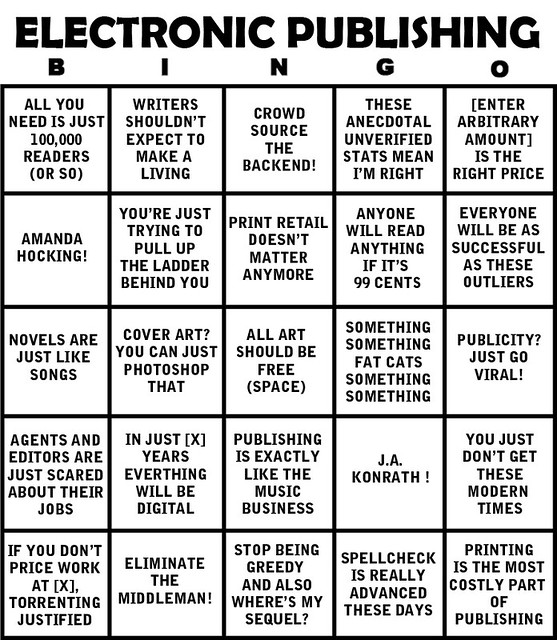
Electronic Publishing Bingo Card


Worth a post all by itself, I give you John Scalzi's electronic publishing bingo card.

At first I thought of taking the card and playing seriously with it.  That is, marking down each time I saw one of the things in the squares during my readings of blogs, articles, and list serve discussions.  Then I realized, what fun would that be? I'd fill the card in an hour of reading.  Two max.

Maybe this shows more what I've been reading than that the world is all atwitter over the topic.

BTW, anyone else annoyed that they feel like they can't use the word "atwitter" anymore because it's too close to Twitter?  Every time I go to type atwitter, I wonder if I should only use it to refer to that which Twitter is atwitter about and that makes me sad.

I'm terribly interested in e-publishing information, but then again I'm terribly interested in publishing information, period.  I even took a graduate level course on publishing this past fall.  I find it all fascinating, and I think that shrewd business moves can be made through the use of ebook publication.  Then again, it's not the medium or the market that has the golden touch, it's the author.  And just as many stupid business moves can be made through ebook publication as smart ones (probably more if human nature has anything to say about it).

I'm interested, I'm just starting to get very annoyed with all those out there talking about e-publishing like it is the messiah come to save us from the publishing industry, low authors' advances, mistreatment of mid-list authors, mistreatment of new authors, the decline of hard cover books, the decline of mass market paperback books, the decline in reading, the increase in reading that's not novels, growth of technology use, the death of paper, the death of brick and mortar book stores, the death of polar bears, cheap readers with limited discretionary funds who can afford a $200 e-reader but not the $10 book to read on it, and those nasty nasty gatekeeping agents who want to do things like sell your book.

Don't get me wrong folks, I find it interesting, but I'm not bowing at the altar.

Monday, March 14, 2011

Tell me! -- No! Shh, don't tell!

There is a lot of literature on the web about how to self-promote your writing.  Particularly how to build a platform and use it to shout across the web.  Sites like Kristen Lamb's Blog (which I find fascinating) explain how to use social media to your advantage -- effectively, she instructs you on how to do the digital equivalent of enunciating when you speak.  But for as much noise as the make-noise-brigade, um, makes, there is a quiet backlash of people who don't want to tell anyone that their publications even exist.

This weekend, Dinty W. Moore posted a fab little article on the blog of his online magazine BREVITY.*    Moore is also a faculty member of the Ohio University graduate program in creative writing.  He's noticed recently that he has students who won't tell people their work has been published.  It's not that they're shy wallflowers -- in Moore's story, he was the one offering to make the announcement, he just needed specifics from the student -- it's that they don't want to share.

I understand some of the backlash.  There is such a thing as overkill.  Or being tactless.  I don't want you to spam me about your new book, but I do want the opportunity to find out about it.  Publications are not CIA agents, they do not need to blend in and accomplish tasks that only a select few will ever know of.  But neither do we want our publications to be politicians or Paris Hiltons, always looking for the photo op or thinking about what they could do to get a sound bite on Entertainment Tonight.

Moore points out that Facebook can be nice, or it can lead to spamming.  It's all about tact.  I've read blog articles because someone has multi-posted the subject and link on Facebook and Twitter ... but I've also been put off when a find a person's entire feed is them posting links to blog entries again and again (as in, multiple links to the same entry, or suggestions to "catch up" on their old blog posts).

I got frustrated last fall when no one in the department knew that I'd gotten two short stories published because the publications had happened over the summer.  Their "not knowing" didn't bother me as much as them behaving like I was still unpublished.  I had an awkward conversation with a faculty member who told me I'd feel much better about myself once I got something published.  Awkward because I didn't feel like I could interrupt her to explain I was published, and awkward because I didn't feel any different before my publication than I did afterward.  But more to the point: we had that conversation because she didn't know.  In fact, she couldn't have known.  I wasn't cray-cray girl running around telling everyone that I had a story pubbed, but neither had I exercised the channels in place for department promotion.  Because, to be honest, I didn't even know those channels existed!  So run out and do that now: locate the person in charge of your department newsletter and find that email address.  A quick blurb will tastefully disseminate that information without being cray-cray girl.

To make it more palatable to those who would otherwise stay silent, Moore breaks it down into "sharing" vs. "promoting," with "promoting" being the creature that maybe you don't want to ride to the finish line.  He also points out that often publications (particularly independent presses and magazines) don't get bought without word of mouth sales.  "Sharing" your publications contributes to those publications audience base.

Here are Moore's six rules of sharing:

1.     Self promotion is when you spam all of your friends and those who are barely friends and repeatedly say “buy my stuff,” or “look at my stuff.”  We don’t need daily updates.
2.     Self promotion is NOT when you share good news with fellow strugglers (like grad students in your program, or the faculty who are rooting for your success).  That’s just being part of a supportive community.
3.     To my mind, even a link on Facebook, or on your blog, or as a signature line in your e-mail (subtle, not blaring), is NOT self promotion, at least not the bad kind that folks want to scorn and avoid.  Certain people wish to know your good news, or read your poem, or buy your book, so it is fully acceptable to tell them that the work is now available.  It is, in fact, inconsiderate not to tell them.
4.     Tell them once, of course, not fifty times, and give them a clean link rather than e-mailing PDFs of everything you’ve ever written.
5.     If you assume your friends would hate you for your success rather than be pleased for you, maybe it is time to look for new friends.  Or look at yourself.
6.     Writing is not bad.  Publishing your writing is not bad.  Don’t treat it as if it were.

If you're interested, I recommend the full article.

Oh, and btw, I just got a story accepted at Enchanted Conversation! (eeee!) That was an excited noise.  And I will be posting when the issue goes live.

* I love BREVITY's nonfic mini-essays ... I just wish they'd publish one of mine.


Photo credit: Sasha Wolff at SashaW

Monday, March 07, 2011

How to be a professional and a self-epublished author

Perhaps I could have titled this post simply "how to appear as a professional when you publish" and left out the distinction of self-publishing -- but presumably, if you publish with a house they are at least going to advise you on publicity if not provide you with a small amount of it.

(Not book tour publicity, but at the bare minimum all of the following information.  And most likely, they'll do some of the work for you.)

One of my good friends is a theatrical publicist who likes the same kind of fiction I do. Last week, when the Amanda Hocking headlines and chatter were strong, I mentioned the situation to my publicist friend. She read the article I sent her and began scoping out "this Amanda Hocking woman."

Speaking as a publicist, my friend declared two things to me: (1) Ms. Hocking might be making a good deal of money but she's not a professional and (2) Ms. Hocking absolutely needs a publicist.

(1) Ms. Hocking might be making good money but she's not a professional. This declaration comes from the notion that one must dress for success if one wants to succeed.  That to be taken seriously you must put your best foot forward: you don't show up to court in fluffy slippers or chew gum in front of the Queen.  When in Rome, behave in a way that makes the Romans think more of you, not try to kill you before you get back to the Tardis.

Mixed metaphors aside, what I mean is that having a web presence is not the same as having a professional web presence.

I thought about getting into a discussion of the differences between person, personal, and persona, but I think that is another post all in itself. For the sake of this post, I'll say that your web presence should not be "you" it should be your "writer-on-the-internet persona."

With that in mind, I get to things the publicist told me:

  • If you're selling something (a book, a watch, your cupcakes, your skills as an actor, tiny pieces of your soul), your presence on the internet should not be just a blog.  You must have a website.  Should you also have a blog?  That's entirely up to you.  But your blog should be in your website not in place of it.  
    • If you're working toward publication and don't have a novel to promote, then a blog is a great platform building tool. You can chat with other writers and develop connections.  And someday when you have a novel to promote, you can incorporate your blog into your website.
    • There are many free and easy ways to create a website.  Engage them.  If you're selling something (as in making money from sales), upgrade to the low level package which doesn't run ads.  The low-level upgrade on sites I've checked out like webs.com has a monthly rate that's about as much as a grande latte.  Or at very least use wordpress to create a site that looks as little like a blog as you can make it.  Unfortunately, as much as I love blogger, a blogger.com site will always look like a blog.
  • Your website should have separate pages for your publications, bio, press kit, and news.  
    • Publications: where you list and link your novels.  Use cover art.  List and link your short stories.  Use the magazine's cover art.  
    • Biography: write it in the third person.  It's a biography, not an "about me."  Look at the "About the Author" in the back of your favorite book -- it's written in the third person, not the first.*  
    • Press kit: pertinent facts and cover art for those who may be interested in reviewing, interviewing, or writing articles on you/your books.  
    • News: not what you ate for lunch.  This page should list and link all the places you've guest blogged; list and link all your favorable reviews and all reviews (favorable or not) from big venues; articles written about you/your book; places your press release has appeared; places you have or will be appearing, lecturing, signing, or teaching; and future release dates. 
  • Don't put your direct, personal, non-professional email address on the site.  "She's got her hotmail listed!" my publicist friend shrieked when she poked around Ms. Hocking's blog.  "First off, it's not professional," she told me.  "Second, you don't want that kind of email going into your personal account.  Third, it should be going through a publicist or agent or at least your mother."  Then she amended the statement further: even if you-the-author manage this account, it shouldn't be your main account and it shouldn't sound like your main account.  It needs to sound professional because it's @authorname.com (not @hotmail or @gmail or @yahoo), and it should be something like contact@authorname.com or publicity@authorname.com or the like.  Something that does not suggest OMG we can be bffs if you stalk me and send me a :) email after you finish each chapter of my book and an lol mssg after each of my #CharlieSheenIsAnAss tweets!

(2) Ms. Hocking absolutely needs a publicist.

Lastly, hire a real publicist.  No, don't run out and do it now.  But if you find yourself in the prized position of having local and national news media interviewing you and reporting on your success, or if you find yourself getting nominated for national awards, then don't try to do it all yourself.

A publicist is not like a personal assistant; she takes on many clients at once so you don't have to have oodles of work for her to do all the time.  But for a media blitz, she's worth having around.

Ms. Hocking posted last week that she had spent several days doing nothing but answer emails, and it frustrated her because it was taking time away from her writing.  Hopefully that made her see that she needs to hire help (at least temporarily) to deal with her sudden fame.

A real publicist would advise her on all of the above and more.  A real publicist would weed through the emails.  A real publicist would provide someone for the press to contact instead of contacting the author directly and having honest-to-god interview requests getting mixed in with fan/stalker/plz-tell-me-the-secret-of-your-success emails and ignored for lord knows how long.  Most importantly, a real publicist would take care of publicity and let the writer have time to write.

Photo credit: madaise

*Where a bio should be written in the third person, I've been assured that a blog's "about me" should be in the first person. Your choice between the two depends on what persona you want to bring to the table, a professional writer with published novels, or a personable blogger writing about her journey.

Friday, March 04, 2011

The Amanda Hocking factor

There's been a lot of internet chatter about Amanda Hocking and her self-publishing escapades this week. USA Today, The Huffington Post, Business Inisder, and her local NBC news affiliate gave her some air time (see video, though the first 30 seconds is just the anchors talking about wtf a Nook is).


"Rejected by countless book publishers" seems like a subjective phrase which *might* have just been blown out of proportion.  Ms. Hocking got fed up with the system at age twenty-five.  She submitted each subsequent novel she wrote to fewer and fewer agents (as per admission of her own blog).

Most agents will tell you that it's often not the first book you write that's the first book you sell.  In Ms. Hocking's defense, she claims to have written 19 novels, many as a teenager.  Now, no offense, but I remember what I wrote as a teenager and I teach teenagers writing and that teenage writing has about as much chance of making it with a publisher as I do of winning the lottery on any given day.  Eragon = lotto winner.

Also agents (and successful traditionally published authors) point out that most writers do rounds and rounds of queries--sending out ten queries a week for months--before they find the right fit for a successful agent-novel-author experience.  It's about finding an agent who is passionate enough about your book to want to sell it as much as you do, not finding someone to schlep paper for you.

Anyway, I bring this all up because I have my doubts about how the news media is portraying her "perseverance."  But that's just me.

But it turns out she didn't need to persevere or gain a sound understanding of the publishing industry.  She'd already done "market research" by browsing the Wal-Mart book rack (I didn't make that up), she wrote YA paranormal because she it was what she saw the most of.  She knew it was hot, so she stuck it up on Amazon, B&N, and several other epub platforms and made it available POD through Amazon's Lulu.  Less than a year later she's self-published eight novels and one novella out and, according to her blog, sold over 900,000 units.  Priced at $0.99 or $2.99, Ms. Hocking makes 30% or 70% of that as profit, respectively.  According to her local news station, she's made enough to buy a house in cash.

Ms. Hocking is twenty-six and impatient.  IMHO.

I don't mean to misrepresent her.  It appears that she already feels enough of the internet is doing that.  So I won't take some of the pot shots that I could.  But I'm the kind of person who believes in the strength of patience, perseverance, and education.  Formal education is helpful, but education is out there in thousands of different forms, you only have to ask for and accept it.  Reading agent blogs daily is a form of education.  Researching publishing is a form of education, learning grammar and style is a form of education.  Knowing you need a good copyeditor is a form of education.  Learning about things like book bloggers before you jump into the world of epublishing is a form of education.  Reading books on craft, being part of a workshop, finding a critique partner, subscribing to publishers marketplace, reading in your genre, reading out of your genre -- these are all forms of education, patience, and (if you keep writing with all you're learning) perseverance.  A classroom with a teacher in it isn't necessary to learn.

I'm twenty-seven, only one year older than Ms. Hocking, and I think that if there had been an easy way for me to throw my work into the sales arena when I was twenty-two, I might have done it.  But I'm not that impatient now.  And I shudder to think of my work when I was twenty-two given all I've learned in the interim.

Ms. Hocking also writes on a recent blog (to clear up things "the internet is saying ... about me"), that she feels a "tremendous sense of urgency, like if I don't get everything out now and do everything now, while the iron is hot, everything I've worked for will just fall away."  This also leads to the feeling I get from looking at all of the facts (those presented by her in interviews and those presented on her blog) that her ebook sale boom is the result of impatience.

The SF/F/H writer list serve I'm on is in a tizzy contemplating the viability of the e-publishing-- the phrase "future of publishing" has been bandied about so much that it's ceased to hold meaning for me.  Those who seem the most interested are people who are writing "between genres" or in not easily defined areas of the market who don't feel the traditional publishing market is open to them.  Meanwhile the listserve's many voices are not really paying mind to the fact that Hocking is writing in a market that's not just hot, it's hott: YA paranormal romance.

Ms. Hocking's first novel has a good concept, but its market niche is one that is begging for content.  My local Barns & Nobel has devoted an entire shelving section to "Teen Paranormal" -- more space than "Christian Fiction" gets . . . and on the conservative west side of Michigan, that means something.  This is the one genre where publishers can't put out enough material to meet the demand.

Believing that you can epublish in a different genre and take off the same way is a mistake.  IMHO.  What sells and what doesn't is always hit or miss.  No one knows what the next big seller is going to be.  But let me present a case to back up my opinion.

Consider this: as much as I am a part of the cult of Firefly, I knew the moment I saw the first episode why it had only lasted one season (obvi, I was watching on Netflix).  A space western could have been one of those things that exploited the interstices of genre and boomed, but it exploited the interstices of two declining genres -- dying genres, if we're going to be morose.  The space opera and the western haven't been doing well in print or on screen. Speculative fiction has been there, but all you need to do is look at the declining number of episodes each new cast/crew of Star Trek made to see the writing on the wall.

So just because the internet is a way to publish in a declining genre without the editors fearing the decline, doesn't mean success will come your way.  There's a guy out there trying to raise $3,000,000 to get Firefly back on the air (or air on the internet).  Will his internet grass roots movement catch fire?  Grass fire?  Prairie fire?  He wants people to pledge $40 per season to see the show online.  Maybe he'll make his goal.  Maybe he won't.  But he's got one giant plus on his side: people have already seen the show.  It's been on air, on TV, on Netflix, and in traditional theaters (Serenity).  This "unproducible" TV show was produced -- your "unpublishable" novel hasn't been published.

The point I'm making: could this Amanda-Hocking-success-story happen for a writer not working in Teen Paranormal?  Yes.  Would I bet on it?  No, I'd bet against it.  And I'd make a big wager.

What I do see as worthwhile, competent epublishing ventures or --go forth and epublish now:
  • Authors publishing their out of print backlist (or like JA Konrath, publishing the backlist and then writing more books in the same series and epubbing them)
  • Authors publishing short story collections of work previously published by magazines or anthologies (Chuck Wendig).  
It's very, very, very hard to convince a publisher to lose money on your short story collection -- because "short story collection" to a publisher is a bit like taking a lighter to money just to watch it burn.  The publishers who do pub short story collections do so because they are dedicated to art -- and usually have dedicated grant money. But if you can say look at my short stories published in magazines X, Y, and Z, now collected in one place for a low low price then hey, maybe I'll buy that.  Literally.

I'll post Monday on the how to be a professional and a self-epublished author information a publicist recently gave me after a discussion of the above news articles and blog posts.  It was all good information that I was going to put here, but this post has gone on far too long.

Tuesday, February 22, 2011

Quick news post for writers, Firefly geeks, and fairy tale fans

Nebula Award nominations are up.

There's talk of  Firefly returning to TV, which would be awesome! although dealing with the story lines of the film and the two comic series would prove interesting.  Although the one series is pre-TV show timeline-wise; no idea about the Shepherd Chronicles (Dark Horse).  Mostly I'd be concerned how they deal with you-know-whose death at the end of the movie.  Soooo did not see that coming.  

Locus came up with a short list of awesome Tor.com stories, so Tor.com went and bundled them here. Just so we're all on the same page, Tor.com is an online magazine which is affiliated with TOR-Forge press (book publisher).  Poor undergrad in my graduate class on publishing flubbed that one big time when he mixed up the two.  I didn't have the heart to point out the difference in front of the class -- thank goodness I was a student and not the teacher in that situation.

Donald Maass' The Career Novelist: A Literary Agent Offers Strategies for Success is available as a free PDF.  Which is great, because I'm fairly certain it's out of print otherwise, so grab a copy now.

And last bit of news: Enchanted Conversations is open to submissions until Thursday at Midnight.  They've recently recreated themselves as a much better looking website, and a pro-paying market (10 cents per word) -- but they're only accepting stories within four day windows, fit the theme (Rumpelstiltskin, this time), and are under 2000 words.  I figure that weeds most people out, but if you have a less-than-2000-word Rumpelstiltskin story, here are the much lengthier submission guidelines.  

And yes, I do so happen to have an under 2000 word Rumpelstiltskin story, I am writing a folk tale inspired MFA thesis after all.

Friday, May 28, 2010

History of the Liteary Undead

Have you noticed all the historically undead on the bookshelves lately? Is it all just a response to the surprise success of Pride and Prejudice and Zombies, or is there something else afoot that has so many writers (and publishing houses) going in for remaking history with zombies, werewolves, vampires and monster hunters?

Jane SlayreI should preface by saying that I've not read any of these books, but I've heard that the latest one to make a splash, Jane Slayer by Sherri Browning Erwin, is well done. Or, more precisely, my Source said it's well done if you're into that sort of thing -- I don't know if that sort of thing meant paranormal  fiction (which I'm a fan of) or if it meant the reworking of classics with modern twists of fantasy (which I don't really have an opinion on) -- one can never tell with Source what Source is really getting at.

Although, to be honest, the novel's tag line has me thinking I might get it the next time I'm in the store:
Reader, I buried him.

Queen Victoria: Demon HunterPublisher's Weekly calls it the "growing genre of horror mashups."   Including Queen Victoria: Demon Hunter, and the soon to be published Shakespeare Undead (chapters 1-5 available to read online until the book's release on June 8), or Abraham Lincoln: Vampire Hunter by Seth Grahame-Smith (the guy who did P&P&Zombies).

You can now take your pick of literary figures turned slayers or historical figures turned slayers.

Abraham Lincoln: Vampire HunterSome seem quite amusing and well done. From the Amazon review of Abraham Lincoln:Vampire Hunter:
While Abraham Lincoln is widely lauded for saving a Union and freeing millions of slaves, his valiant fight against the forces of the undead has remained in the shadows for hundreds of years. That is, until Seth Grahame-Smith stumbled upon The Secret Journal of Abraham Lincoln, and became the first living person to lay eyes on it in more than 140 years.
Sense and Sensibility and Sea MonstersMany are jumping on the bandwagon without much worry about how well they're done. Two that I doubt I'll ever read include Sense and Sensibility and Sea Monsters and Boleyn: Tudor Vampire (in which Anne Boleyn is conveniently not beheaded and can therefore return as the undead), but the mere presence of these two novels does make me smile -- if perhaps only weakly.

But why the sudden popularity?  Is it the logical outcome of two simultaneous pop culture crazes (Austen and Zombies)? Is it an ability to both enjoy the classics and laugh at them -- Publisher's Weekly claims that if you're a horror fan but not familiar with Jane Eyre you'll like the novel but miss much of the comic nuance -- or is it a sign that the contemporary urban fantasy market is saturated? 

Shakespeare UndeadOf course, people have been predicting the death of vampires as a genre for years now.  And -- like any good undead being -- vampires just keep coming back (with or without the use of Shakespeare).  So I hesitate to say the historical undead are a sign of saturation.  Which I'm just fine with; I like a good vampire from time to time so long as he doesn't go all sparkly in the sun.

I was about to make a guess that Wuthering Heights would be the next to receive a makeover from Gothic to Horror/Urban Fantasy, and then realized that Heathcliff is already scarier and more menacing than any werewolf could ever be. You wouldn't have to change anything about the novel except for adding a single line that said he'd been bitten as a boy and you'd still have a believable novel on your hands. Maybe that's why I always liked Wuthering Heights more than Jane Eyre.

Edit: Wuthering Bites hmm. I have to say the Bronte titles are much more creative than the others.

Saturday, March 27, 2010

Pondering an untapped criminal market.

Fabulous post by steampunkish author Gail Carriger on seeing her first book on store shelves.

And over at Writer Beware a listing of people who have done research on first publications and novel advances in different genres. Particularly fabulous was the survey and analysis done by Jim C. Hines; Hines set out to debunk as many myths and "pieces of good advice" as he could. I love people who analyze "good advice" rather than take it blindly. Stubborn, reticent, free thinking people of the world unite! ... then again I don't really know Jim C. Hines all that well so maybe I'm just talking about me.

Of course, none of this data is as good as it could be ... but as good as it could be would mean large houses releasing their payscales to the public and that ain't gonna happen any time soon honey. We'll have to deal with second best until then.

Tuesday, March 23, 2010

Around the Web

I may or may not have mentioned on this blog that I'm also working on the Third Coast magazine blog. I am very excited to have our latest feature up and running (at last!): literary guest bloggers!

Our first guest blogger is Erin Fitzgerald who writes the blog "Rarely Likable" and edits the Northville Review. She's written a lovely post for Third Coast about how (and where) to jump in to the world of literary magazines. It's chockablock with links to databases, sites and services for writers looking to learn and publish -- some of which I'd never heard of! (Very thorough.) Below Erin's guest blog entry is also a review of her short fiction.

I'm in contact with other writers/bloggers about future entries but, by all means, let me know if you have a nomination or suggestion.

The other nice thing that is going on over on the Third Coast blog is a series of monthly post by one of our fiction interns Nathan Norton. He's writing about some of the pitfalls of writing that he sees while reading slush and how writers can avoid them.

Friday, January 15, 2010

TIBAL: Do I Need an Agent to Get Published?

The "Things I've Been Asked Lately" series of posts (TIBAL) is exactly what it sounds like. People ask me questions in real life, on the blog, or on forums, and I endeavor to do my best to answer them. Of course, this is all IMHO.

Do you really need an agent to get a novel published?

This question arrived courtesy of CityGirl over the holiday season. We sat around for hours talking along with Paralith; mostly we talked about our pets and the cute things they do (we so sounded like young parents) but we also talked shop about our current jobs/pursuits. CityGirl wanted to know about this whole agent thing.

The short answer:
Yes.

The short answer I would give under oath:
In most cases, yes, though there are a still a few exceptions depending on your genre and the publisher you're targeting (such as small presses that run contests for best short story collection).

The long answer: No, technically you don't always need an agent, but you're doing yourself a disservice if you don't have one.

Consider this: would you buy or sell a house without a Realtor?

Truth is you'd probably hire a Realtor unless you were (a) uber-knowledgeable about property law/contracts or (b) you were selling a really shitty piece of land, or (c) didn't care if you got swindled.

My questions is therefore why would any normal person not want a knowledgeable person who knows the lay of the land, who has contacts, who knows who is and isn't a crook, who is uber-familiar with the standard contracts of the industry, to go out there and find the best place for you and get you the best deal because they're advocating for you? Because that is exactly what an agent does: she act as an *ahem* agent between you and the person trying to buy your property, smooths the way, soothes hurt feelings, and keeps everyone honest.

Unfortunately, there's a notion out there that getting an agent is just another hoop to jump through, or that agents are the evil gatekeepers to the publishing world. Not entirely certain where these notions came from.

Yes, agents act as a means of thinning the herd before the herd gets to the editors, but it's not like the entire herd was getting published back when they could all stampede the editor without an agent.

Still not convinced? Here's the real argument clincher: in the publishing industry as it stands today, editors are looking for manuscripts that are ready to be published. This means that editors don't edit, agents edit. And if you don't have an agent your story might be too much work for an overworked, overstressed, worried-about-being-downsized publishing house editor.

There are some exceptions to this. I previously mentioned small literary presses that run short story contests. They're looking for you to submit your collection on your own. They'll edit (slightly) but they're pretty much still looking for something that's ready to go to press. There's also category romances that still troll the slush piles of unagented submissions. Although don't mistake the term "category romance" for romances in general. Many romance publishers still want agents to do the first few rounds of editing. "Category romance" means those thin little books on their own special rack at the book store that change every month. Both of these would be considered niche markets: they produce a limited number of copies for a very specific audience. Anything that's hoping to have commercial appeal or sell to a big name publishing house should have an agent attached to it.

Elmore Lenard called it "the best 15% you'll ever spend." That's what an agent's fee is: 15% of your sale. (Don't ever pay an agent in advance -- that's a scam, not an agent.)

You also do not need an agent to publish a single short story in a magazine. You're completely on your own for that even if you've already gotten an agent and published a novel. Magazine/journal publishing is all DIY submissions.

Suggested reliable online sources for further reading:
Bookends LLC blog
Nathan Bransford
Pub-rants (publishing rants)

Highly Recommended