When I think about writing and craft, I break it down into sub parts.
There are grammar and punctuation rules -- important, but a low order concern in comparison.
There are style and clarity issues -- things like keeping it all in a consistent point of view and paying attention to the order of words in a sentence so that they are as precise in meaning as possible, often like cutting the fat.
Then there are what I think of as storytelling concerns -- these are the items that would be the same for an oral storyteller as they would for the writer: pacing, voice, use of description, and the awareness of how all of those things make the reader feel at any given moment in the story.
Recently, I've found myself in a situation where the choice between first person and third person point of view is no longer a style choice; it's become a storytelling issue.
I used to write everything in first person when I was a college student because -- duh -- I thought in first person. So writing first person was the moy easy choice. I suppose it helped that in college all of my narrators were spunky, eccentric, feminist, twenty-year-old women with a bit of a cruel streak when it came to sticking it to their ex-boyfriends. I suppose.
These pieces ended up being all about voice: how quirky could I make her voice? how intriguingly awful could I make her thoughts? (Because everyone loves to read about characters thinking the things we all think but are too polite to say.) And I started to think of writing in the first person as easy because I just settled my writing-self right down in my stream of consciousness and typed away ... ahem, I meant the character's stream of consciousness.
But eventually, I got bored writing that same character and I wanted to branch out. But I still thought first person was the easiest, or at least the quickest means of pounding out a story. So when faced with a looming 8:00AM deadline for a completed short story, and not a word written on the page at 7:30 PM the night before, I wrote in first person because I needed all the speed I could get.
The story's gone through many drafts since, gotten shorter, gotten longer, gotten much longer, outlined it as a novel. I've toyed with what person I want to put it in, first or third, but always came back to first. First person sounded better because it was the way I'd originally written the draft, and you can't argue with original recipe.
Then I did something drastic: I rewrote the opening twice, without looking at the original. Once in third person, then in first.
And a magical thing happened. When I was no longer beholden to my previous draft -- or unduly influenced by it -- brand new bits of story popped up that I hadn't been expecting. Particularly in the third person version. [For purposes of clarification I will mention that this is not merely changing all the pronouns from I to she, but changing the location/distance of the narrator and the narrative techniques.]
This is the situation I mentioned at the beginning of the post where point of view stopped being a style choice and started being a storytelling choice.
The story I'd originally written had a very narrow scope of the things which the character thought or wanted to stop and tell us. I worked hard to excise things she would not think about from her first person narration. The third person story could (even though the narration is still close to the main character) employ many of the narrative techniques of storytelling: I can lightly drop in information and backstory without it feeling like a character spilling her guts to us unprompted. And by moving myself outside of her head, the rest of the world essentially bloomed around me. -- Told ya it was a magical thing that happened.
I challenge anyone to rewrite a story from the beginning without looking at the original (and then tell me what happens!) -- you don't have to change person, although that's helpful to get you out of the previous mindset, but you just can't look at the original. Has anyone else tried this -- what were your results? What tools or tests do you use to figure out what person to write a story in?
Photo credit: dogbomb on flickr
Showing posts with label notes on craft. Show all posts
Wednesday, August 31, 2011
Friday, May 20, 2011
Fantasy's contract with the finite world
Surrealism, she says, is when the rules of reality are subverted.
Fantasy is when the rules of reality are subverted, and replaced with a new set of rules.
Therefore fantasy is more like realism than surrealism. You read fantasy fiction and realism expecting a certain set of rules to shape and guide the world and your reading of it. Therefore, if something strange happens in a fantasy story, you don't ask if it was a dream. Fantasy authors aren't subverting rules, or trying to trick your mind; if they tell you something happened, then it happened. Believe the words on the page: it was real, not a dream.
(You have no idea how badly I wish I could have gotten my MFA workshop groups to read this Le Guin essay or at least listen to the above statements, but I digress.)
And so the fantasy reader enters into the novel having a contract with the finite world. The realism reader makes that contract with the author before she opens the book. The fantasy reader gives the author (roughlyt) the first 50-100 pages to set the terms of the contract. She'll believe events that are based off of that contract -- but throw any "extras" at her, and she's likely not buying.
I've been struck more than once by a situation (often near the end) which a dramatist would call deus ex machina -- essentially, a moment when a god or some other device, enters into the novel and "fixes" the narrative problem, allowing everyone a happily ever after.
Why am I writing about this specifically in the context of fantasy? Because sometimes you'll be reading a fantasy novel with, say, vampires and then the narrative problem will be solved by the appearance of, oh let's say, a ghost.
It's all gravy, right? I mean it's a fantasy novel -- we expect fantastic things, right?
Wrong.
The appearance of the ghost is a form of deus ex machina because the sudden appearance of the ghost broke the contract with the finite world. In Le Guin's terms, the fantasy broke the rules of reality that it had established for itself.
If the viability of ghosts in this vampire world was established early on as part of the rule building / world building, then the sudden interruption of a ghost at the end of the story would not warrant a cry of deus ex machina. It would warrant perhaps a subtle oh, another ghost -- clever.
Yesterday I posted about series novels, and discussed the ever-growing superpowers as a breech of contract with the finite world. If we're sticking with the contract metaphor, then every-growing superpowers (the kind that get surprisingly bigger and better with each book) would be a legal gray area. Not an outright violation, but not exactly in the spirit of the contract either. As a reader, I'd much rather see characters deal with the situation using what they have, getting cunning and clever -- after all, making a character work within the rules of her reality makes her story resonate with the human experience, and that's what all fiction, no matter the genre, should strive to do.
Friday, March 04, 2011
The Amanda Hocking factor
There's been a lot of internet chatter about Amanda Hocking and her self-publishing escapades this week. USA Today, The Huffington Post, Business Inisder, and her local NBC news affiliate gave her some air time (see video, though the first 30 seconds is just the anchors talking about wtf a Nook is).
"Rejected by countless book publishers" seems like a subjective phrase which *might* have just been blown out of proportion. Ms. Hocking got fed up with the system at age twenty-five. She submitted each subsequent novel she wrote to fewer and fewer agents (as per admission of her own blog).
Most agents will tell you that it's often not the first book you write that's the first book you sell. In Ms. Hocking's defense, she claims to have written 19 novels, many as a teenager. Now, no offense, but I remember what I wrote as a teenager and I teach teenagers writing and that teenage writing has about as much chance of making it with a publisher as I do of winning the lottery on any given day. Eragon = lotto winner.
Also agents (and successful traditionally published authors) point out that most writers do rounds and rounds of queries--sending out ten queries a week for months--before they find the right fit for a successful agent-novel-author experience. It's about finding an agent who is passionate enough about your book to want to sell it as much as you do, not finding someone to schlep paper for you.
Anyway, I bring this all up because I have my doubts about how the news media is portraying her "perseverance." But that's just me.
But it turns out she didn't need to persevere or gain a sound understanding of the publishing industry. She'd already done "market research" by browsing the Wal-Mart book rack (I didn't make that up), she wrote YA paranormal because she it was what she saw the most of. She knew it was hot, so she stuck it up on Amazon, B&N, and several other epub platforms and made it available POD through Amazon's Lulu. Less than a year later she's self-published eight novels and one novella out and, according to her blog, sold over 900,000 units. Priced at $0.99 or $2.99, Ms. Hocking makes 30% or 70% of that as profit, respectively. According to her local news station, she's made enough to buy a house in cash.
Ms. Hocking is twenty-six and impatient. IMHO.
I don't mean to misrepresent her. It appears that she already feels enough of the internet is doing that. So I won't take some of the pot shots that I could. But I'm the kind of person who believes in the strength of patience, perseverance, and education. Formal education is helpful, but education is out there in thousands of different forms, you only have to ask for and accept it. Reading agent blogs daily is a form of education. Researching publishing is a form of education, learning grammar and style is a form of education. Knowing you need a good copyeditor is a form of education. Learning about things like book bloggers before you jump into the world of epublishing is a form of education. Reading books on craft, being part of a workshop, finding a critique partner, subscribing to publishers marketplace, reading in your genre, reading out of your genre -- these are all forms of education, patience, and (if you keep writing with all you're learning) perseverance. A classroom with a teacher in it isn't necessary to learn.
I'm twenty-seven, only one year older than Ms. Hocking, and I think that if there had been an easy way for me to throw my work into the sales arena when I was twenty-two, I might have done it. But I'm not that impatient now. And I shudder to think of my work when I was twenty-two given all I've learned in the interim.
Ms. Hocking also writes on a recent blog (to clear up things "the internet is saying ... about me"), that she feels a "tremendous sense of urgency, like if I don't get everything out now and do everything now, while the iron is hot, everything I've worked for will just fall away." This also leads to the feeling I get from looking at all of the facts (those presented by her in interviews and those presented on her blog) that her ebook sale boom is the result of impatience.
The SF/F/H writer list serve I'm on is in a tizzy contemplating the viability of the e-publishing-- the phrase "future of publishing" has been bandied about so much that it's ceased to hold meaning for me. Those who seem the most interested are people who are writing "between genres" or in not easily defined areas of the market who don't feel the traditional publishing market is open to them. Meanwhile the listserve's many voices are not really paying mind to the fact that Hocking is writing in a market that's not just hot, it's hott: YA paranormal romance.
Ms. Hocking's first novel has a good concept, but its market niche is one that is begging for content. My local Barns & Nobel has devoted an entire shelving section to "Teen Paranormal" -- more space than "Christian Fiction" gets . . . and on the conservative west side of Michigan, that means something. This is the one genre where publishers can't put out enough material to meet the demand.
Believing that you can epublish in a different genre and take off the same way is a mistake. IMHO. What sells and what doesn't is always hit or miss. No one knows what the next big seller is going to be. But let me present a case to back up my opinion.
Consider this: as much as I am a part of the cult of Firefly, I knew the moment I saw the first episode why it had only lasted one season (obvi, I was watching on Netflix). A space western could have been one of those things that exploited the interstices of genre and boomed, but it exploited the interstices of two declining genres -- dying genres, if we're going to be morose. The space opera and the western haven't been doing well in print or on screen. Speculative fiction has been there, but all you need to do is look at the declining number of episodes each new cast/crew of Star Trek made to see the writing on the wall.
So just because the internet is a way to publish in a declining genre without the editors fearing the decline, doesn't mean success will come your way. There's a guy out there trying to raise $3,000,000 to get Firefly back on the air (or air on the internet). Will his internet grass roots movement catch fire? Grass fire? Prairie fire? He wants people to pledge $40 per season to see the show online. Maybe he'll make his goal. Maybe he won't. But he's got one giant plus on his side: people have already seen the show. It's been on air, on TV, on Netflix, and in traditional theaters (Serenity). This "unproducible" TV show was produced -- your "unpublishable" novel hasn't been published.
The point I'm making: could this Amanda-Hocking-success-story happen for a writer not working in Teen Paranormal? Yes. Would I bet on it? No, I'd bet against it. And I'd make a big wager.
What I do see as worthwhile, competent epublishing ventures or --go forth and epublish now:
I'll post Monday on the how to be a professional and a self-epublished author information a publicist recently gave me after a discussion of the above news articles and blog posts. It was all good information that I was going to put here, but this post has gone on far too long.
"Rejected by countless book publishers" seems like a subjective phrase which *might* have just been blown out of proportion. Ms. Hocking got fed up with the system at age twenty-five. She submitted each subsequent novel she wrote to fewer and fewer agents (as per admission of her own blog).
Most agents will tell you that it's often not the first book you write that's the first book you sell. In Ms. Hocking's defense, she claims to have written 19 novels, many as a teenager. Now, no offense, but I remember what I wrote as a teenager and I teach teenagers writing and that teenage writing has about as much chance of making it with a publisher as I do of winning the lottery on any given day. Eragon = lotto winner.
Also agents (and successful traditionally published authors) point out that most writers do rounds and rounds of queries--sending out ten queries a week for months--before they find the right fit for a successful agent-novel-author experience. It's about finding an agent who is passionate enough about your book to want to sell it as much as you do, not finding someone to schlep paper for you.
Anyway, I bring this all up because I have my doubts about how the news media is portraying her "perseverance." But that's just me.
But it turns out she didn't need to persevere or gain a sound understanding of the publishing industry. She'd already done "market research" by browsing the Wal-Mart book rack (I didn't make that up), she wrote YA paranormal because she it was what she saw the most of. She knew it was hot, so she stuck it up on Amazon, B&N, and several other epub platforms and made it available POD through Amazon's Lulu. Less than a year later she's self-published eight novels and one novella out and, according to her blog, sold over 900,000 units. Priced at $0.99 or $2.99, Ms. Hocking makes 30% or 70% of that as profit, respectively. According to her local news station, she's made enough to buy a house in cash.
Ms. Hocking is twenty-six and impatient. IMHO.
I don't mean to misrepresent her. It appears that she already feels enough of the internet is doing that. So I won't take some of the pot shots that I could. But I'm the kind of person who believes in the strength of patience, perseverance, and education. Formal education is helpful, but education is out there in thousands of different forms, you only have to ask for and accept it. Reading agent blogs daily is a form of education. Researching publishing is a form of education, learning grammar and style is a form of education. Knowing you need a good copyeditor is a form of education. Learning about things like book bloggers before you jump into the world of epublishing is a form of education. Reading books on craft, being part of a workshop, finding a critique partner, subscribing to publishers marketplace, reading in your genre, reading out of your genre -- these are all forms of education, patience, and (if you keep writing with all you're learning) perseverance. A classroom with a teacher in it isn't necessary to learn.
I'm twenty-seven, only one year older than Ms. Hocking, and I think that if there had been an easy way for me to throw my work into the sales arena when I was twenty-two, I might have done it. But I'm not that impatient now. And I shudder to think of my work when I was twenty-two given all I've learned in the interim.
Ms. Hocking also writes on a recent blog (to clear up things "the internet is saying ... about me"), that she feels a "tremendous sense of urgency, like if I don't get everything out now and do everything now, while the iron is hot, everything I've worked for will just fall away." This also leads to the feeling I get from looking at all of the facts (those presented by her in interviews and those presented on her blog) that her ebook sale boom is the result of impatience.
The SF/F/H writer list serve I'm on is in a tizzy contemplating the viability of the e-publishing-- the phrase "future of publishing" has been bandied about so much that it's ceased to hold meaning for me. Those who seem the most interested are people who are writing "between genres" or in not easily defined areas of the market who don't feel the traditional publishing market is open to them. Meanwhile the listserve's many voices are not really paying mind to the fact that Hocking is writing in a market that's not just hot, it's hott: YA paranormal romance.
Ms. Hocking's first novel has a good concept, but its market niche is one that is begging for content. My local Barns & Nobel has devoted an entire shelving section to "Teen Paranormal" -- more space than "Christian Fiction" gets . . . and on the conservative west side of Michigan, that means something. This is the one genre where publishers can't put out enough material to meet the demand.
Believing that you can epublish in a different genre and take off the same way is a mistake. IMHO. What sells and what doesn't is always hit or miss. No one knows what the next big seller is going to be. But let me present a case to back up my opinion.
Consider this: as much as I am a part of the cult of Firefly, I knew the moment I saw the first episode why it had only lasted one season (obvi, I was watching on Netflix). A space western could have been one of those things that exploited the interstices of genre and boomed, but it exploited the interstices of two declining genres -- dying genres, if we're going to be morose. The space opera and the western haven't been doing well in print or on screen. Speculative fiction has been there, but all you need to do is look at the declining number of episodes each new cast/crew of Star Trek made to see the writing on the wall.
So just because the internet is a way to publish in a declining genre without the editors fearing the decline, doesn't mean success will come your way. There's a guy out there trying to raise $3,000,000 to get Firefly back on the air (or air on the internet). Will his internet grass roots movement catch fire? Grass fire? Prairie fire? He wants people to pledge $40 per season to see the show online. Maybe he'll make his goal. Maybe he won't. But he's got one giant plus on his side: people have already seen the show. It's been on air, on TV, on Netflix, and in traditional theaters (Serenity). This "unproducible" TV show was produced -- your "unpublishable" novel hasn't been published.
The point I'm making: could this Amanda-Hocking-success-story happen for a writer not working in Teen Paranormal? Yes. Would I bet on it? No, I'd bet against it. And I'd make a big wager.
What I do see as worthwhile, competent epublishing ventures or --go forth and epublish now:
- Authors publishing their out of print backlist (or like JA Konrath, publishing the backlist and then writing more books in the same series and epubbing them)
- Authors publishing short story collections of work previously published by magazines or anthologies (Chuck Wendig).
I'll post Monday on the how to be a professional and a self-epublished author information a publicist recently gave me after a discussion of the above news articles and blog posts. It was all good information that I was going to put here, but this post has gone on far too long.
Monday, February 07, 2011
Here and now, here and previously, or here and later?
I'm writing what can be best labeled as "urban fantasy": contemporary setting, fantastical elements.* When you start writing realism, the reader assumes you're in the "now" (the contemporary present) unless you tell them otherwise. But lately, I'm having a hard time cuing my readers in to the fact that we're in the "now" not the past or the future.Oh I'd love to blame this on the people who tell me I'm writing surrealism -- which, by the way, I'm not; surrealism undermines the rules of reality, fantasy replaces the rules of reality with its own (there's a fabulous Ursala Le Guin essay about this and other things in The Secret History of Fantasy
I would love for all readers to walk into all stories and assume "here and now" until their told differently, not assume "here and now" until they encounter a fantastic element, but that's what I'm seeing:
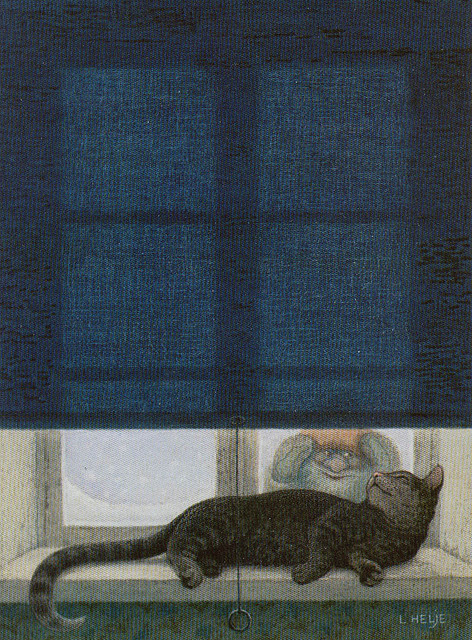
The first are those who hit the fantastic element and are transported back into the woods to a time gone by, when not all the world was known and therefore they can accept the strangeness. This group does fine when you give them Buffy, but struggle when you give them a scene like this image by L. Helje where a gnome and a house cat interact.The second are those who hit the fantastic element and are propelled forward to the near future, when such a discovery exists. This group probably wouldn't put the gnome/cat in the past, but tries to propel Buffy the Vampire Slayer--or better examples would be Flashforward or Lost--ten years into the future just because that sort of stuff "doesn't happen now" so it must happen in the future rather than in a present altered by the author.
There's a third group, the hard core reader of urban fantasy, who sees (for example) a female witch doctor and so long as she's not wearing a gown and carrying a dirk, and the author didn't say in the year 2029, this group assumes that the jeans and Metro-card the character has, could have been bought at the very same places the reader bought hers.
And then there's the way-outliers who hit the fantastic element and that catapults them into an "other world." These people assume all fantasy must take place in a secondary world of the imagination that has nothing to do with the primary world we live in. Which is an intriguing psychological state of being, but not all fantasy is second-world fantasy. And frankly, I don't want to live in a world where there's absolutely no room for wonder, so let's not even contemplate those people.
I sincerely want my writing to put everyone on the same page. The third group gets it, the fourth isn't worth bothering with, so my conundrum is how do I convince groups one and two that we're in the world of the present day? Stick in a description of a kid with an iPod? The way to convince someone that you're not in the present is to present them with items that stick out as not-right. Sipping orange Nehi,** or carrying a ray gun. But to convince us we're in the now without putting a year/date on it? ... I'm frankly feeling rather stumped.
I've had it suggested to me that my characters could/should spend more time observing/interacting with their world as a means of setting the time frame. I'm beginning to think that more time spent contemplating the world would be good for narrative voice as well, because it would allow me to develop voice, character, and setting all at once. I pulled back from this between my undergrad writing and now because in undergrad I ONLY set stories using the voice of the protagonist because that voice was (ahem) mine. Unfiltered and undiluted. I wanted to branch out as a writer, so I developed a calmer, more reserved, writerly voice which worked for me in the third person.
Ah well, wax on, wax off. Time to apply everything I've learned
(The Dandelion image at the top of the post, btw, comes from this etsy shop which I love, love, love and bought some note cards from at one point.)
*I just read David Hartwell's essay on "The Making of the American Fantasy Genre" where he writes about the pulp magazine origins of urban fantasy (yes, before Charles de Lint). The discussion of urban fantasy is tangential to his discussion of the publishing of second-world fantasy, but he had my full attention for both. Also, discusses John W. Campbell's attempts to codify urban fantasy like he did with science fiction. The essay's not in my copy of Age of Wonder
**Apparently, along with retro-candy there's now retro-soda, and that means you can get your bottle of orange Nehi once again. Though let's face it, at that price point you've gotta be hankering some nostalgia for that atmosphere the fictional reference is trying to create.
Monday, January 24, 2011
Flashback pros and cons
Not long ago, Writer Unboxed had a "Flashback Feud" (read parts one and two). They lay out some interesting points.Flashbacks, when people ask me about them and where I stand on their usage, are one of the things that make me sigh. There's no short answer.
Well, there's a very short answer -- don't use 'em unless you have to -- but it leaves a lot to be desired. For instance, what "you have to" means.
It's also a matter where my training conflicts.
My academy based education has a certain love of what I call strange usages of time, which encompasses the flashback, nonconsecutive parallel stories (like the one discussed in part one of "Flashback Feud"), the nonlinear story (i.e. a bunch of really fucked up flashbacks). And then there's all the time bundles that people often declare their love for. I love that it all happens in the span of one day / hour / year!
The notion here is that if manipulating time adds to the cool factor, then dude, you've just added to your cool factor.
My Odyssey Writing Workshop education taught me that a writer should be wary of the flashback, like a person with acid reflux is wary of the hotsauce. That it's one thing to sneak in the past via dialog or through a carefully placed line of exposition (go easy on the exposition or it'll give you heartburn too), but if an event is important enough to put into scene, then it's probably important enough to put into scene chronologically.
There are really extremely interesting, beautiful mindfucking things an author can do with well-developed, well-placed non-chronological scenes. (The Hundred Thousand Kingdoms
But for most stories, jumping around in time is doing the story a disservice.
Life unfolds chronologically (unless you've got a suped up DeLorean you're not telling me about). Therefore it's the story form that has the most verisimilitude. So the distinction then becomes whether the story serves the artistry or the artistry serves the story.
If the work showcases the story, then don't do something that draws the reader out of the immediacy of the story like flashing back into another time in place.
If the story's purpose is to showcase the writing technique, then do whatever you want.
In the past year, I've had several people (people who've never met each other) say to me why not just put it in chronological order? It was like a little light bulb went on. Or perhaps a whole series of them. Suddenly I was not walking down a dark and twisty path, but hanging out in a well lit neighborhood. Things were nowhere near as daunting to write (omg, the where do I put that scene? factor drove me nuts when I went un-chronological), but they also appealed more to my readers.
As far as my own writing goes, I try very hard not to include flashbacks these days.
Friday, January 14, 2011
(Not) Writing to the trend
Advice to genre writers is always "don't write to the trend." Teenage wizard goes to wizarding school is hot? Don't write it. Teenage vampire romance is hot? Don't write it. At least, don't write it if your heart's not in it 100%. Don't write it just to hop on the bandwagon because (a) your book will suck if you're not in love with it and (b) the bandwagon might be gone by the time your book comes to market.
This advice is readily available to writers seeking instruction in commercial fiction, so why is no one saying it to MFA students?
I've become aware lately that many of the "rules of good writing" spouted off with great authority by students in writing programs are, in fact, trends. Faculty tend not to spout as definitively or level as broad, sweeping statements about the art and artifice of writing. Faculty tend to encourage experimentation. Students, however, encourage sameness in their peers: Trendiness.
In their written critiques of my work, I've had fellow students deliver "reminders" to not experiment. Remember: followed by some supposed rule of narrative. To which my faculty member asked, Why? Why does that have to be? and could not get a satisfactory answer from the students.
Certain pieces of craft like grammar and clarity (sentence level and story level) are tools not trends. But just about everything else -- prose styling, subject matter, and point of view included -- is a trend.
Particularly smacking of trendiness is the desire of today's American MFA student to write like Hemingway -- the idealized version of Hemingway, not the actual one. Trend.
Fiction goes through trends. "Highbrow" fiction goes through trends more slowly -- perhaps because fewer people write or read it, and therefore the impetus to change and innovate isn't as strong because the field isn't as deep -- but it's still changing. Look at fiction from 50 years ago, compared to today, or 100 years ago or 200 years ago: the high minded fiction of any given time period is different. It changes based on trends. It changes based on what today's readers expect and what they're willing to accept.
I refuse to believe the New Critical notion that there is such a thing as "imperatively "good" writing that is "good" without taking into consideration the context in which it was written. If that was the case then no one would still be studying Shakespeare (his language is wordy and obtuse and the plots are unoriginal [even back then] and melodramatic) or Hawthorn (his novels crawl along like a dull snail in order to get to a few poignant and beautiful passages). Their work is not inherently "good art" yet there are myriad other reasons why we study those writers and why their prose endures, most of which can be appreciated contextually.
Don't believe me? Try taking a piece that shifts between free verse and rhyming pentameter to your MFA workshop.
Perhaps the slowness of trends in supposedly high minded fiction has as much to do with the depth of the field as it does with the training of writers moving into academia.
Precisely when writing attached itself to the academy is debatable. It depends which self-important entity you choose to believe. Was the first writer's program at Bread Loaf? Harvard? Or was there no creative writing in the academy until Iowa? (all of them claim the distinction) Where it started doesn't really matter. What is certain is that after WWII, writing programs began appearing more and more regularly at colleges until there was a boom of them in the 80s -- a boom which has not yet slacked off. In fact, it might be in a second boom with the 21st century improvements in communication that allow for long distance and low residency MFA programs.
The MFA allows for a single style to be perpetuated and touted over all others. For a trend to be codified into the rules of fiction. For the production of the McPoem, as Donald Hall called it, ten billion served.
It's true that there was no way the peer who wrote to encourage me to Remember the "rule" could have known that I had already considered said "rule" and discarded it in order to serve my purposes. But that doesn't change the fact that it's a prime example of the rules of the trend being touted as the rules of all fiction.
And there have been other examples -- okay one example -- from my experience where my peers said fuck the rule, you should really run with it.
You could probably show up to an MFA program and learn all the trends, be praised for your ability to recreate fiction that fits the trendy comprehension of the genre, graduate, and never challenge yourself to experiment. And, given the glacial pace of literary fiction, you work wouldn't date itself until the tail end of your life. However, the data shows that it's much more likely that you'll leave your MFA and never write again.
This advice is readily available to writers seeking instruction in commercial fiction, so why is no one saying it to MFA students?
I've become aware lately that many of the "rules of good writing" spouted off with great authority by students in writing programs are, in fact, trends. Faculty tend not to spout as definitively or level as broad, sweeping statements about the art and artifice of writing. Faculty tend to encourage experimentation. Students, however, encourage sameness in their peers: Trendiness.
In their written critiques of my work, I've had fellow students deliver "reminders" to not experiment. Remember: followed by some supposed rule of narrative. To which my faculty member asked, Why? Why does that have to be? and could not get a satisfactory answer from the students.
Certain pieces of craft like grammar and clarity (sentence level and story level) are tools not trends. But just about everything else -- prose styling, subject matter, and point of view included -- is a trend.
Particularly smacking of trendiness is the desire of today's American MFA student to write like Hemingway -- the idealized version of Hemingway, not the actual one. Trend.
Fiction goes through trends. "Highbrow" fiction goes through trends more slowly -- perhaps because fewer people write or read it, and therefore the impetus to change and innovate isn't as strong because the field isn't as deep -- but it's still changing. Look at fiction from 50 years ago, compared to today, or 100 years ago or 200 years ago: the high minded fiction of any given time period is different. It changes based on trends. It changes based on what today's readers expect and what they're willing to accept.
I refuse to believe the New Critical notion that there is such a thing as "imperatively "good" writing that is "good" without taking into consideration the context in which it was written. If that was the case then no one would still be studying Shakespeare (his language is wordy and obtuse and the plots are unoriginal [even back then] and melodramatic) or Hawthorn (his novels crawl along like a dull snail in order to get to a few poignant and beautiful passages). Their work is not inherently "good art" yet there are myriad other reasons why we study those writers and why their prose endures, most of which can be appreciated contextually.
Don't believe me? Try taking a piece that shifts between free verse and rhyming pentameter to your MFA workshop.
Perhaps the slowness of trends in supposedly high minded fiction has as much to do with the depth of the field as it does with the training of writers moving into academia.
Precisely when writing attached itself to the academy is debatable. It depends which self-important entity you choose to believe. Was the first writer's program at Bread Loaf? Harvard? Or was there no creative writing in the academy until Iowa? (all of them claim the distinction) Where it started doesn't really matter. What is certain is that after WWII, writing programs began appearing more and more regularly at colleges until there was a boom of them in the 80s -- a boom which has not yet slacked off. In fact, it might be in a second boom with the 21st century improvements in communication that allow for long distance and low residency MFA programs.
The MFA allows for a single style to be perpetuated and touted over all others. For a trend to be codified into the rules of fiction. For the production of the McPoem, as Donald Hall called it, ten billion served.
It's true that there was no way the peer who wrote to encourage me to Remember the "rule" could have known that I had already considered said "rule" and discarded it in order to serve my purposes. But that doesn't change the fact that it's a prime example of the rules of the trend being touted as the rules of all fiction.
And there have been other examples -- okay one example -- from my experience where my peers said fuck the rule, you should really run with it.
You could probably show up to an MFA program and learn all the trends, be praised for your ability to recreate fiction that fits the trendy comprehension of the genre, graduate, and never challenge yourself to experiment. And, given the glacial pace of literary fiction, you work wouldn't date itself until the tail end of your life. However, the data shows that it's much more likely that you'll leave your MFA and never write again.
Labels:
genre,
MFA,
MFA life,
notes on craft
Monday, October 25, 2010
Tone in Writing
My students often stumble when I ask them to describe the "tone" of a piece we've read. For some reason, they always say the tone of text book articles and news paper articles is "informational." Far too many students in different classes have said this to me for it to be some sort of fluke. Someone out there has to be teaching that "informational" is a tone. It's not.
When trying to describe tone, use words that would also describe someone's emotions. Don't think what was the text's tone? think how did Jane sound when you talked to her today? If Jane sounded like a newspaper article, then chances are she sounded serious or unemotional. If Jane sounded like a humor column then she probably sounded funny, amused, humorous. If she was announcing the death of a much liked person, then she probably sounded grave, serious, or perhaps a bit shocked.
Tone in writing is much like tone of voice: it comes from word choice and sentence structure. Speaking in short bursts or writing in short sentences is often used to convey that a speaker/writer is angry or excited. Choosing long, sonnorous words and sentences conveys a sense of tiredness or sadness.
So back to work for me -- tomorrow's another day of teaching America's college students that "informational" is not an emotion.
When trying to describe tone, use words that would also describe someone's emotions. Don't think what was the text's tone? think how did Jane sound when you talked to her today? If Jane sounded like a newspaper article, then chances are she sounded serious or unemotional. If Jane sounded like a humor column then she probably sounded funny, amused, humorous. If she was announcing the death of a much liked person, then she probably sounded grave, serious, or perhaps a bit shocked.
Tone in writing is much like tone of voice: it comes from word choice and sentence structure. Speaking in short bursts or writing in short sentences is often used to convey that a speaker/writer is angry or excited. Choosing long, sonnorous words and sentences conveys a sense of tiredness or sadness.
So back to work for me -- tomorrow's another day of teaching America's college students that "informational" is not an emotion.
Monday, June 14, 2010
"I Don't Believe in Writers' Block"

I don’t believe in writers’ block. Plumbers don’t get plumbers’ block. Why should writing be the only profession that gives a special name to the difficulty of working.
- Philip Pullman
There are some authors who have no problem meeting their daily word count. Stephen King, in his hybrid memoir-manual On Writing
Knit afghans? Organize church bazaars? Deify plums? I’m probably being snotty here, but I am also, believe me, honestly curious. If God gives you something you can do, why in God’s name wouldn’t you do it?Sage, if somewhat flippant advice.
The OWL at Purdue (the go-to site for every college Writing Center Office in America because they'd like to make their own resources look like this but why bother when Purdue's already done the work?) claims writer's block is real. Their Symptom/Possible Cure approach doesn't challenge the writer's belief in being blocked -- but if you look carefully at the symptoms you'll see that they all fall under "things I've done to myself that make writing impossible."
Not everyone's as nice as the online writing lab at Purdue. Some are tough-love-bitches on the subject: "There is no such thing as writer's block. Anyone who says they have it is just in denial."
Just when I begin to think the condition doesn't exist I find proof that it does: Writer's Block Wines out of California. With a nice picture of the Bard on the label to remind you of how prolific he was and how prolific you ... maybe better just to drink the wine until you can't think.I now know what writer’s block is. It’s the fear you cannot do what you’ve announced to someone else you can do, or else the fear that it isn’t worth doing. That’s the rarer form.
Tom Wolfe in an interview with George Plimpton in Writers at Work: The Paris Review Interviews: Ninth Series (Viking 1992).
Isaac Asimov had writer's block once. It was the worst ten minutes of his life.
* Attributed to Harlan Ellison
So, what do you think? Does it exist? What is it? Have you suffered it? Or just bantered witty quotes about it?
Monday, April 19, 2010
Don't be so "serious"
Laura Miller addresses why writers shouldn't strive to be "serious," and makes other helpful noises from one reader to all those writers out there.
In another essay, I found out that the phrase "Writing is rewriting" is apparently an "old saying." While I agree with the sentiment, I can't say I've ever heard the phrase before, new, old or otherwise. Otherwise, this essay is full of good stuff to think about when editing. I know I mentioned recently that the "literary types" are horrible at teaching novel writing (they're more of if you build it, they will come which is fine when you're Kevin Costner, but when you're me? Not so much). So I've been hunting down novel writing instruction from the genre people, which is better but not as good as what you'll find at the bottom of the article on editing. Screenwriters. I should have already known that screenwriters-turned-novelists are the gold standard for teaching structure in long-form storytelling. Because they are. And the only teacher I've ever had who was willing to tackle teaching novel writing was a screenwriter-turned-novelist.
But before the writer gets to that, she stars off the essay by listing all the things she was "before she was a writer," which makes me sad and frustrated. Lately I've been thinking about my own "before I was a writer" list of jobs and, honestly, I'd rather just get to the damn writing part. I'm coming up on some "free time" between semesters. I could spend it visiting friends and family, or I could get the damnwriting done.
I recently had an acquaintance who took a week off of work and in ten days she kicked out a 50,000 word first draft of the novel she's been toying with for months. It's ... well, it's many things, including crazy, but it's also inspiring.
I too have notes and notes and notes drafted for two different popular novel projects. Two weeks, fourteen days, 70,000 words between the end of April and the middle part of May. I'd be crazy to do it. I'd be crazy not to do it. Better to do the damnwriting than keep adding bizarre jobs to my "before I was a writer" list.
In another essay, I found out that the phrase "Writing is rewriting" is apparently an "old saying." While I agree with the sentiment, I can't say I've ever heard the phrase before, new, old or otherwise. Otherwise, this essay is full of good stuff to think about when editing. I know I mentioned recently that the "literary types" are horrible at teaching novel writing (they're more of if you build it, they will come which is fine when you're Kevin Costner, but when you're me? Not so much). So I've been hunting down novel writing instruction from the genre people, which is better but not as good as what you'll find at the bottom of the article on editing. Screenwriters. I should have already known that screenwriters-turned-novelists are the gold standard for teaching structure in long-form storytelling. Because they are. And the only teacher I've ever had who was willing to tackle teaching novel writing was a screenwriter-turned-novelist.
But before the writer gets to that, she stars off the essay by listing all the things she was "before she was a writer," which makes me sad and frustrated. Lately I've been thinking about my own "before I was a writer" list of jobs and, honestly, I'd rather just get to the damn writing part. I'm coming up on some "free time" between semesters. I could spend it visiting friends and family, or I could get the damnwriting done.
I recently had an acquaintance who took a week off of work and in ten days she kicked out a 50,000 word first draft of the novel she's been toying with for months. It's ... well, it's many things, including crazy, but it's also inspiring.
I too have notes and notes and notes drafted for two different popular novel projects. Two weeks, fourteen days, 70,000 words between the end of April and the middle part of May. I'd be crazy to do it. I'd be crazy not to do it. Better to do the damnwriting than keep adding bizarre jobs to my "before I was a writer" list.
Tuesday, March 23, 2010
Around the Web
I may or may not have mentioned on this blog that I'm also working on the Third Coast magazine blog. I am very excited to have our latest feature up and running (at last!): literary guest bloggers!
Our first guest blogger is Erin Fitzgerald who writes the blog "Rarely Likable" and edits the Northville Review. She's written a lovely post for Third Coast about how (and where) to jump in to the world of literary magazines. It's chockablock with links to databases, sites and services for writers looking to learn and publish -- some of which I'd never heard of! (Very thorough.) Below Erin's guest blog entry is also a review of her short fiction.
I'm in contact with other writers/bloggers about future entries but, by all means, let me know if you have a nomination or suggestion.
The other nice thing that is going on over on the Third Coast blog is a series of monthly post by one of our fiction interns Nathan Norton. He's writing about some of the pitfalls of writing that he sees while reading slush and how writers can avoid them.
Our first guest blogger is Erin Fitzgerald who writes the blog "Rarely Likable" and edits the Northville Review. She's written a lovely post for Third Coast about how (and where) to jump in to the world of literary magazines. It's chockablock with links to databases, sites and services for writers looking to learn and publish -- some of which I'd never heard of! (Very thorough.) Below Erin's guest blog entry is also a review of her short fiction.
I'm in contact with other writers/bloggers about future entries but, by all means, let me know if you have a nomination or suggestion.
The other nice thing that is going on over on the Third Coast blog is a series of monthly post by one of our fiction interns Nathan Norton. He's writing about some of the pitfalls of writing that he sees while reading slush and how writers can avoid them.
Thursday, March 11, 2010
This is why I'm going to grad school
This notion of lyricism is part of the reason I'm paying money to get a degree in writing: a few years ago I thought that was artful.
(Please, read the post linked above -- it's short -- but resist the impulse to read the comments, they're inane, asinine and repetitive in not only syntax but in sentiment, which means that none of the first dozen commenters realized they were committing the error both intentionally and unintentionally therefore destroying any achievement of wit on their parts.)
There have to be well regarded novels out there that pull of that kind of shit in the extreme -- otherwise we wouldn't all think that it was how we should write when we want to be poetic. And there's the fact that that sort of repetition works in oratory, particularly when you're attempting to hype up a crowd. So talk about mixed messages -- we're allowed to take it in but not allowed to produce it ... kinda like when I wandered into the bathroom when I was four while my father had his head under the sink trying to fix the drain and walked back out saying well shit, shit, shit.
There's a lot of reasons I'm in a writing program that fit under the umbrella of "I want to learn to write well." And one of them is nuance and subtlety in phrasing and prose styling. (Trust me, I'm still a student, but I'm trying.)
"Prose styling" -- now there's a phrase I never would have used two years ago.
I looked at Nathan Bransford's post and thought this is atrocious, but I know ways that I could rework this to keep the same feeling and lose the pretentious, seasick feeling that comes with reading it. Then again, it would have to be earned, and you can't earn anything in 250 words. I'm in grad school to learn how to think these fixing sort of thoughts.
I'm also in grad school because, as I mentioned above, reading widely isn't enough for me to learn what to do, when to do it and why it's sometimes better not to do it -- just like listening to what everyone around me said wasn't enough when I was four. I need someone to plod through the murky details of things with me. To have a discussion. To inform me. To lay down some boundaries and some conditions which I can apply to situations so that I can determine for myself when it's best to wander around muttering shit shit shit.
(Please, read the post linked above -- it's short -- but resist the impulse to read the comments, they're inane, asinine and repetitive in not only syntax but in sentiment, which means that none of the first dozen commenters realized they were committing the error both intentionally and unintentionally therefore destroying any achievement of wit on their parts.)
There have to be well regarded novels out there that pull of that kind of shit in the extreme -- otherwise we wouldn't all think that it was how we should write when we want to be poetic. And there's the fact that that sort of repetition works in oratory, particularly when you're attempting to hype up a crowd. So talk about mixed messages -- we're allowed to take it in but not allowed to produce it ... kinda like when I wandered into the bathroom when I was four while my father had his head under the sink trying to fix the drain and walked back out saying well shit, shit, shit.
There's a lot of reasons I'm in a writing program that fit under the umbrella of "I want to learn to write well." And one of them is nuance and subtlety in phrasing and prose styling. (Trust me, I'm still a student, but I'm trying.)
"Prose styling" -- now there's a phrase I never would have used two years ago.
I looked at Nathan Bransford's post and thought this is atrocious, but I know ways that I could rework this to keep the same feeling and lose the pretentious, seasick feeling that comes with reading it. Then again, it would have to be earned, and you can't earn anything in 250 words. I'm in grad school to learn how to think these fixing sort of thoughts.
I'm also in grad school because, as I mentioned above, reading widely isn't enough for me to learn what to do, when to do it and why it's sometimes better not to do it -- just like listening to what everyone around me said wasn't enough when I was four. I need someone to plod through the murky details of things with me. To have a discussion. To inform me. To lay down some boundaries and some conditions which I can apply to situations so that I can determine for myself when it's best to wander around muttering shit shit shit.
Labels:
MFA,
notes on craft,
style
Wednesday, February 10, 2010
TIBAL: Can I Use Brand Names in My Writing?
The "Things I've Been Asked Lately" series of posts (TIBAL) is exactly what it sounds like. People ask me questions in real life, on the blog, or on the forums I follow and I endeavor to do my best to answer them.
Can I Use Brand Names in My Writing?
Yes.
No, Wal-Mart will not sue you. Coca-Cola will not sue you. Neither with 3M sue you for having a character who covers the walls of her entire apartment with Post-it notes. (Yes, the term "Post-it" is a registered trademark.)
Your characters can go Rollerblading instead of inline skating. They can Xerox files instead of copying them. They can even reach for a Kleenex instead of a tissue when their lovers are hit by cars the day they were supposed to run away with each other. (These are all trademarks that are likely to slip into common usage in the next few decades.) And they can drink all the Starbucks their caffeinated little bodies can hold. (Most likely not going to slip into common usage but the point is that it doesn't matter.)
There are no legal ramifications of adding these things into your writing. There are, however, craft ramifications: Consider whether using a product brand name will date your writing.
Maybe dating your writing is what you want -- you know you're not in the twenty-first century when your character reaches for an ice cold Nehi** -- and those sorts of details add authority to your voice and credibility to your setting.
But perhaps your writing loses out for including something that's trendy at the moment. I snicker when I read fiction that is supposed to be "contemporary" but the characters carry PDAs -- the term may have been hot when the novel was drafted, but no one still carries a PDA that isn't also a smart-phone ... and an mp3 player ... and a GPS device and ... you get the picture.
Is it worth having your characters carry cell phones? Yes. consider that the cell phone is now ubiquitous in American culture. You'd almost need to explain why your character doesn't carry a phone if you set the story in the present day.
What it comes down to is two things. One: do you want to "date" your writing to a certain time period, or do you want it to attempt at being "timeless" and ubiquitous? If you have no doubts that it is of a certain time period/year, go for those specifics that have change or will change. If you want to create a false sense of it-could-be-set-anytime-recently then go easy on the brand specifics.
Two: don't over do it. Examples: Curious, Rachel decided to turn on her iBook open Firefox and Google it. Blah. Brand name overload. It wreaks the same as someone who always has to name drop. (Do you like my purse? It's Kate Spade.) Choose not to over do the brand name dropping: Curious, Rachel decided to do some online research.
** Ten points to the first person to correctly identify TV's favorite lover of orange Nehi and the show that featured said character.
Can I Use Brand Names in My Writing?
Yes.
No, Wal-Mart will not sue you. Coca-Cola will not sue you. Neither with 3M sue you for having a character who covers the walls of her entire apartment with Post-it notes. (Yes, the term "Post-it" is a registered trademark.)
Your characters can go Rollerblading instead of inline skating. They can Xerox files instead of copying them. They can even reach for a Kleenex instead of a tissue when their lovers are hit by cars the day they were supposed to run away with each other. (These are all trademarks that are likely to slip into common usage in the next few decades.) And they can drink all the Starbucks their caffeinated little bodies can hold. (Most likely not going to slip into common usage but the point is that it doesn't matter.)
There are no legal ramifications of adding these things into your writing. There are, however, craft ramifications: Consider whether using a product brand name will date your writing.
Maybe dating your writing is what you want -- you know you're not in the twenty-first century when your character reaches for an ice cold Nehi** -- and those sorts of details add authority to your voice and credibility to your setting.
But perhaps your writing loses out for including something that's trendy at the moment. I snicker when I read fiction that is supposed to be "contemporary" but the characters carry PDAs -- the term may have been hot when the novel was drafted, but no one still carries a PDA that isn't also a smart-phone ... and an mp3 player ... and a GPS device and ... you get the picture.
Is it worth having your characters carry cell phones? Yes. consider that the cell phone is now ubiquitous in American culture. You'd almost need to explain why your character doesn't carry a phone if you set the story in the present day.
What it comes down to is two things. One: do you want to "date" your writing to a certain time period, or do you want it to attempt at being "timeless" and ubiquitous? If you have no doubts that it is of a certain time period/year, go for those specifics that have change or will change. If you want to create a false sense of it-could-be-set-anytime-recently then go easy on the brand specifics.
Two: don't over do it. Examples: Curious, Rachel decided to turn on her iBook open Firefox and Google it. Blah. Brand name overload. It wreaks the same as someone who always has to name drop. (Do you like my purse? It's Kate Spade.) Choose not to over do the brand name dropping: Curious, Rachel decided to do some online research.
** Ten points to the first person to correctly identify TV's favorite lover of orange Nehi and the show that featured said character.
Thursday, June 18, 2009
Term
notes on craft
It's the end of the summer term. Which seems odd. Seven weeks and it's practically over. For me, all that remains is a term paper.
I've located a shareware concordance program (not that the normal person ever has need of one, but it's here if you're interested) and I'm analyzing my own writing. Namely I'm looking for features that appear in "literary" attempts at writing that may not appear in my attempts at "popular" writing and vice versa.
I shocked quite a few people in my class (including my literature/linguistics professor) by stating that my writing instruction in the MFA had firmly suggested that literary writers today should avoid verb tenses ending in -ing.
I do not mean gerunds, or nouns that end in -ing such as her singing was awful. [Just learned what that part of speech was called!]
For a piece that is written in the past tense, these verb forms often take the shape of participial phrases. I have been instructed that using the simple past is essentially stronger, more direct, less "common" and, in general, preferred. I've had this verbalized to me, but if anyone's seen it in print I would love to know where so that I could read/cite something for my paper.
To take a cliche phrase that fits the bills:
They dragged her away kicking and screaming.
Would be liter-ified by changing it to
She kicked and screamed as they took her away.
Or
She kicked. She screamed. But still they dragged her away.
You get the idea.
Of course, all stylistic advice is arbitrary, but this was something I have heard ONLY within the world of literary fiction and that all important institutional MFA stamp of approval. Other places note caution of the participial phrase because it often creates confusion:
Undressing, Larry stepped into the shower.
Truth is that this sentence is more the work of a lazy writer -- or a lazy showerer who wants to wash their clothes and skin simultaneously -- but in a more complicated sentence the logic confusion can sneak up on you. So "doing away with it" would seem only practical. But genre writing doesn't say you must. In fact, the Science Fiction Writers of America in their online tips and essays offer ways to avoid undressing in the shower and other confusions by putting the sentence into passive voice. I shit you not. If we're dealing with two evils here, then passive voice is definitely the greater of the two.
So losing the participial phrase loses the confusion of action, the confusion of subjects that follow the phrase (see SFWA article) and the frequent "fix" of passive voice. It also allows the writer to do more artistic things with the sentence and to avoid tired, cliche phrasings. See how "kicking and screaming" changed in the above example? No, it wasn't a genius-level rewrite, but it's much nicer than the commonplace phrasing. And if there is one thing literary writing does not want it is to appear commonplace or use any of the crutches popular writers and average speakers can get away with.
It's the end of the summer term. Which seems odd. Seven weeks and it's practically over. For me, all that remains is a term paper.
I've located a shareware concordance program (not that the normal person ever has need of one, but it's here if you're interested) and I'm analyzing my own writing. Namely I'm looking for features that appear in "literary" attempts at writing that may not appear in my attempts at "popular" writing and vice versa.
I shocked quite a few people in my class (including my literature/linguistics professor) by stating that my writing instruction in the MFA had firmly suggested that literary writers today should avoid verb tenses ending in -ing.
I do not mean gerunds, or nouns that end in -ing such as her singing was awful. [Just learned what that part of speech was called!]
For a piece that is written in the past tense, these verb forms often take the shape of participial phrases. I have been instructed that using the simple past is essentially stronger, more direct, less "common" and, in general, preferred. I've had this verbalized to me, but if anyone's seen it in print I would love to know where so that I could read/cite something for my paper.
To take a cliche phrase that fits the bills:
They dragged her away kicking and screaming.
Would be liter-ified by changing it to
She kicked and screamed as they took her away.
Or
She kicked. She screamed. But still they dragged her away.
You get the idea.
Of course, all stylistic advice is arbitrary, but this was something I have heard ONLY within the world of literary fiction and that all important institutional MFA stamp of approval. Other places note caution of the participial phrase because it often creates confusion:
Undressing, Larry stepped into the shower.
Truth is that this sentence is more the work of a lazy writer -- or a lazy showerer who wants to wash their clothes and skin simultaneously -- but in a more complicated sentence the logic confusion can sneak up on you. So "doing away with it" would seem only practical. But genre writing doesn't say you must. In fact, the Science Fiction Writers of America in their online tips and essays offer ways to avoid undressing in the shower and other confusions by putting the sentence into passive voice. I shit you not. If we're dealing with two evils here, then passive voice is definitely the greater of the two.
So losing the participial phrase loses the confusion of action, the confusion of subjects that follow the phrase (see SFWA article) and the frequent "fix" of passive voice. It also allows the writer to do more artistic things with the sentence and to avoid tired, cliche phrasings. See how "kicking and screaming" changed in the above example? No, it wasn't a genius-level rewrite, but it's much nicer than the commonplace phrasing. And if there is one thing literary writing does not want it is to appear commonplace or use any of the crutches popular writers and average speakers can get away with.
Labels:
notes on craft
Wednesday, March 25, 2009
(Ad)Verbs
Notes on Craft
Today my students and I will talk about "verbs that zing" and ones that "wimp out" courtesy of Patricia O'Conner and her lovely book on writing Words Fail Me
. She also wrote Woe Is I
(grammar for grammarphobes) which I have just obtained a copy of but have not yet read. One of these will be assigned in its entirety to my students next fall.

O'Conner is witty. She talks about verbs that feel like a dead fish or a limp handshake. Why say fell quickly when plummeted serves your purpose so much more aptly and in one less word?
Which brings us to the Stephen King quote from On Writing, seen at the top of this post: adverbs are not your friend.
I will reiterate what King and O'Conner and many a creative writing instructor has said: if you have to say it with an adverb then you're not saying it right.
Adverbs clutter up the writing as they attempt to make up for lackluster verbs. By definition, the job of an adverb is to modify the verb so that the meaning is altered. But there are so many great verbs out there to use plain, why attach modifiers to them? It's like buying a low end computer and then buying an upgrade for the motherboard, some kick ass speakers and replacing the monitor, then getting one of those ergonomic keyboards. Why didn't you just spend the money getting a nicer computer than spend the same about of money (in addition to your time searching out those "extras") as you did with the piecemeal contraption you've now made?
"Adverbs are not your friend."
- Stephen King
O'Conner is witty. She talks about verbs that feel like a dead fish or a limp handshake. Why say fell quickly when plummeted serves your purpose so much more aptly and in one less word?
Which brings us to the Stephen King quote from On Writing, seen at the top of this post: adverbs are not your friend.
I will reiterate what King and O'Conner and many a creative writing instructor has said: if you have to say it with an adverb then you're not saying it right.
Adverbs clutter up the writing as they attempt to make up for lackluster verbs. By definition, the job of an adverb is to modify the verb so that the meaning is altered. But there are so many great verbs out there to use plain, why attach modifiers to them? It's like buying a low end computer and then buying an upgrade for the motherboard, some kick ass speakers and replacing the monitor, then getting one of those ergonomic keyboards. Why didn't you just spend the money getting a nicer computer than spend the same about of money (in addition to your time searching out those "extras") as you did with the piecemeal contraption you've now made?
Friday, March 13, 2009
Francine Prose Reading
Last night Francine Prose came to town and read an as of yet unpublished short story. She swears that the Holocaust isn't the only thing that she writes about but this story was set in 1930s Germany. In the two novellas in Guided Tours of Hell one features a concentration camp survivor and the other a Jewish American male who harbors fantasies of living in WWII Paris and doing great deeds for La Resistance.
I still think she's a lovely writer. She does the writerly things I enjoy -- such as letting characters rethink things with similes -- without being overly corny.
In the Q&A session she got rather adamant about not needing to think about form. The question was how do you know what form to put a piece into: shorty story, novel, non-fiction, etc. Ms. Prose doesn't really work in poetry [insert pun about the appropriateness of this given her last name] so she didn't address that at all, but was forceful -- even cut the woman off -- in saying that it is what it is! You either made it up or you didn't! There's no decision; it just is!
At the time I was left scratching my head at this response. But I may or may not have found the gap in communication between the two women.
Prose cited her book on Caravaggio as an example. It's not a novel because it's real; he was real. If I was more familiar with Prose's non-fiction I could tell you if all of it is factual, historical accounts, but given her comment I think it is. I think the woman asking the question in the audience heard non-fiction and thought creative non-fiction. Not histories but personal experiences.
What we should have asked, given the fact that she'd admitted one of the characters in Guided Tours of Hell is based off of a real person (which all the WMU faculty and half the MFA candidates know because he teaching in the Prague summer program), is how she decides to take a real experience of hers and make it fiction instead of memoir.
Sadly, it took me too long to understand all these disconnects. Probably another good reason that I'm not a lawyer, or at least not a trail lawyer: I'd make all my critical realizations after the verdict was announced. I need quiet meditation and time to digest stuff.
But back to the actual question. I wish the the question had been properly phrased because it is a question I struggle with. Up until New Years I thought of every experience I had, every person I met, every story I heard as fodder for my fiction. Now I'm looking at notes toward stories that I've written down to try and twist my life into fictional stories with other characters and I wonder why am I letting characters live my life for me?
No, actually I'm not wondering that. But it sounded poetic so I wrote it down.
What I'm wondering is does it make a better story when I add to it, when I purposefully mold twists and turns into it, or does it make a better story just as it is when it is my memories without any fictional muddying?
I don't have any good answers. If someone asked me this question I'd tell them to take it case by case. The only time I can't follow my own advice is when it comes to family-story.
There are thousands of little anecdotes that my family tells and retells -- your family probably has them too unless you were all raised to not be talkative -- I'll use different terms when I discuss these anecdotes but primarily I call them family-story or table-story. They are that which my family tells when together, usually at my grandmother's kitchen table. These stories seem to have none of the things that makes them good fiction: there's no character arc, the cast of characters is huge, you can't "get into" anyone's mind, and there's often not a point other than it being funny or nostalgic. Despite all this family-story draws me like a lodestone. I want to write it as non-fiction but I can't make the pieces add up to anything worthwhile, and so I have repeatedly attached these true family-stories to fictional characters in fictional scenarios. The fiction gives them a character arc, it gives them lovely neurotic tendencies and other things which are very helpful in telling a story and the family-story gives them life and breath, a history to root themselves in. I hate using family-story in fiction. It feels like a misuse of rich earth. But right now I don't have a way to use it properly.
I came back home and worked on fiction tonight, characters who could never ever be myself are starting to appeal to me in fiction. (Perhaps because I want to turn characters who are me into me?) And accidentally started reading an article in Poets&Writers on what differentiates memoir from personal essay from literary journalism from journalism. The article is written by an angry journalist-type, but once you remove his skeptical slant from the piece there is quite a bit of information lurking underneath about creative non-fiction as a genre with many forms. Article: "Green-Haired Gumshoes or Hidebound Hacks?" by Michael McGregor.
I still think she's a lovely writer. She does the writerly things I enjoy -- such as letting characters rethink things with similes -- without being overly corny.
In the Q&A session she got rather adamant about not needing to think about form. The question was how do you know what form to put a piece into: shorty story, novel, non-fiction, etc. Ms. Prose doesn't really work in poetry [insert pun about the appropriateness of this given her last name] so she didn't address that at all, but was forceful -- even cut the woman off -- in saying that it is what it is! You either made it up or you didn't! There's no decision; it just is!
At the time I was left scratching my head at this response. But I may or may not have found the gap in communication between the two women.
Prose cited her book on Caravaggio as an example. It's not a novel because it's real; he was real. If I was more familiar with Prose's non-fiction I could tell you if all of it is factual, historical accounts, but given her comment I think it is. I think the woman asking the question in the audience heard non-fiction and thought creative non-fiction. Not histories but personal experiences.
What we should have asked, given the fact that she'd admitted one of the characters in Guided Tours of Hell is based off of a real person (which all the WMU faculty and half the MFA candidates know because he teaching in the Prague summer program), is how she decides to take a real experience of hers and make it fiction instead of memoir.
Sadly, it took me too long to understand all these disconnects. Probably another good reason that I'm not a lawyer, or at least not a trail lawyer: I'd make all my critical realizations after the verdict was announced. I need quiet meditation and time to digest stuff.
But back to the actual question. I wish the the question had been properly phrased because it is a question I struggle with. Up until New Years I thought of every experience I had, every person I met, every story I heard as fodder for my fiction. Now I'm looking at notes toward stories that I've written down to try and twist my life into fictional stories with other characters and I wonder why am I letting characters live my life for me?
No, actually I'm not wondering that. But it sounded poetic so I wrote it down.
What I'm wondering is does it make a better story when I add to it, when I purposefully mold twists and turns into it, or does it make a better story just as it is when it is my memories without any fictional muddying?
I don't have any good answers. If someone asked me this question I'd tell them to take it case by case. The only time I can't follow my own advice is when it comes to family-story.
There are thousands of little anecdotes that my family tells and retells -- your family probably has them too unless you were all raised to not be talkative -- I'll use different terms when I discuss these anecdotes but primarily I call them family-story or table-story. They are that which my family tells when together, usually at my grandmother's kitchen table. These stories seem to have none of the things that makes them good fiction: there's no character arc, the cast of characters is huge, you can't "get into" anyone's mind, and there's often not a point other than it being funny or nostalgic. Despite all this family-story draws me like a lodestone. I want to write it as non-fiction but I can't make the pieces add up to anything worthwhile, and so I have repeatedly attached these true family-stories to fictional characters in fictional scenarios. The fiction gives them a character arc, it gives them lovely neurotic tendencies and other things which are very helpful in telling a story and the family-story gives them life and breath, a history to root themselves in. I hate using family-story in fiction. It feels like a misuse of rich earth. But right now I don't have a way to use it properly.
I came back home and worked on fiction tonight, characters who could never ever be myself are starting to appeal to me in fiction. (Perhaps because I want to turn characters who are me into me?) And accidentally started reading an article in Poets&Writers on what differentiates memoir from personal essay from literary journalism from journalism. The article is written by an angry journalist-type, but once you remove his skeptical slant from the piece there is quite a bit of information lurking underneath about creative non-fiction as a genre with many forms. Article: "Green-Haired Gumshoes or Hidebound Hacks?" by Michael McGregor.
Wednesday, February 18, 2009
AWP: prose poem vs. flash fiction
Me: still sick. It's a sinus thing. Yuck.
The AWP panel that claimed to discuss the differences between prose poems and flash fiction fell flat. Robert Olen Butler gave his personal definition, but no one else did. This may yet become a defining theory as he judges the Southeast Review's World's Best Short Short Fiction contest every year.
Butler's theory was that prose poems, like all poetry are about epiphanies, bright shining moments. And that flash fiction, like all fiction are narratives about yearning. The difference between long and short fiction is that the yearning becomes more condensed. That the moment when the character realizes the yearning is the end of the story in a piece of flash fiction. "Yearning" being his word for the deepest desires of the characters.
Ron Carlson said he always thought that he wrote stories not poems. But then someone approached him and asked to publish a collection of his poetry, so now Carlson supposes they're poems.
The AWP panel that claimed to discuss the differences between prose poems and flash fiction fell flat. Robert Olen Butler gave his personal definition, but no one else did. This may yet become a defining theory as he judges the Southeast Review's World's Best Short Short Fiction contest every year.
Butler's theory was that prose poems, like all poetry are about epiphanies, bright shining moments. And that flash fiction, like all fiction are narratives about yearning. The difference between long and short fiction is that the yearning becomes more condensed. That the moment when the character realizes the yearning is the end of the story in a piece of flash fiction. "Yearning" being his word for the deepest desires of the characters.
Ron Carlson said he always thought that he wrote stories not poems. But then someone approached him and asked to publish a collection of his poetry, so now Carlson supposes they're poems.
Labels:
AWP,
flash fiction,
notes on craft,
poetry,
short-short
Wednesday, January 21, 2009
Real People, Fictional Writing
notes (questions) on craft
I've been considering something lately and I'm curious for every one's thoughts. How would you address adding real people into fictional stories?
Maybe this is timely given the inauguration. Say you want to put, oh maybe, Barack Obama in your fictional story. How do you do it? But how much of a real person can you incorporate into fiction without harm or offense (assuming your intent is not to harm or offend)? Where on the character spectrum can a real, well known person fall? More integral than a reference, name dropping, vague appreciation that he is out there in the world somewhere, and yet less important (less manipulated) than any of your main characters.
Wait ... let me back up.
Context: I have written a short story that goes up for workshop tonight that features a certain real life violinist. The facts pertaining to the violinist's actions are all true, if interpreted through the lens of a less than enthusiastic narrator. The violinist appears, physically, in the story, but doesn't have any sort of a character role.
Is this heinously wrong of me to do?
My intent was to have the violinist frames the story (both in sense of time frame and inducing the protagonist's state of mind), as well as acting as a foil for another, more directly involved character. And as a tool, I think the violinist's presence in the story functions really well. Take him out and the story falls apart.
But, should I have even gone there? Does it matter that I've created all these technical story-telling justifications for using him?
So, other than reading the 5,000 word draft of the story I'm referring to in order to understand my babbling, I'll create a short example: Say you wanted to write an inauguration day story. Say you wanted to put it from the point of view of someone managing one of the events, the oath swearing, or one of the balls or the parade or something. One of the women with clipboards and headsets who tells the elected people and their escorts where to go once they get in the building, who gets to hear their conversations or something like that. Would you do it? Would you write the story about the people organizing the event and their lives and use the arrival/departure of the Obamas as the tipping point? Is that too real? Or is it just detached enough that it could work?
I'd love to hear what you think. How would you deal with this? Would you not even think of writing a story that does more than refer abstractly to "real" people? Would you attempt this if you had your facts straight? Would you read such a thing if you knew it was fiction? Goodness, is no editor going to touch this Frankenstein-baby I've created?
I'm certain the point will be addressed tonight in workshop -- I'm kind of dreading it, actually -- but I need to have the point addressed because all this has been running through my head for the past year and a half as I've slowly been working on this story.
I've been considering something lately and I'm curious for every one's thoughts. How would you address adding real people into fictional stories?
Maybe this is timely given the inauguration. Say you want to put, oh maybe, Barack Obama in your fictional story. How do you do it? But how much of a real person can you incorporate into fiction without harm or offense (assuming your intent is not to harm or offend)? Where on the character spectrum can a real, well known person fall? More integral than a reference, name dropping, vague appreciation that he is out there in the world somewhere, and yet less important (less manipulated) than any of your main characters.
Wait ... let me back up.
Context: I have written a short story that goes up for workshop tonight that features a certain real life violinist. The facts pertaining to the violinist's actions are all true, if interpreted through the lens of a less than enthusiastic narrator. The violinist appears, physically, in the story, but doesn't have any sort of a character role.
Is this heinously wrong of me to do?
My intent was to have the violinist frames the story (both in sense of time frame and inducing the protagonist's state of mind), as well as acting as a foil for another, more directly involved character. And as a tool, I think the violinist's presence in the story functions really well. Take him out and the story falls apart.
But, should I have even gone there? Does it matter that I've created all these technical story-telling justifications for using him?
So, other than reading the 5,000 word draft of the story I'm referring to in order to understand my babbling, I'll create a short example: Say you wanted to write an inauguration day story. Say you wanted to put it from the point of view of someone managing one of the events, the oath swearing, or one of the balls or the parade or something. One of the women with clipboards and headsets who tells the elected people and their escorts where to go once they get in the building, who gets to hear their conversations or something like that. Would you do it? Would you write the story about the people organizing the event and their lives and use the arrival/departure of the Obamas as the tipping point? Is that too real? Or is it just detached enough that it could work?
I'd love to hear what you think. How would you deal with this? Would you not even think of writing a story that does more than refer abstractly to "real" people? Would you attempt this if you had your facts straight? Would you read such a thing if you knew it was fiction? Goodness, is no editor going to touch this Frankenstein-baby I've created?
I'm certain the point will be addressed tonight in workshop -- I'm kind of dreading it, actually -- but I need to have the point addressed because all this has been running through my head for the past year and a half as I've slowly been working on this story.
Wednesday, November 19, 2008
Writing: Art, Craft and Beauty
From the comments to yesterday's post:
I sat down to address this comment with a firm notion of where I was going with my response. I was going to define "art" as per the academy and then I was going to talk about "craft" and then "beauty" because that "beauty" is where the soul lives. But then I choked. I couldn't get the first part down. I just sat here and turned one question over in my mind: What the fuck is art?
There's art for the sake of art -- although given that I can't find a definition of art that I believe both logically and intuitively in relation to any form of composition, we're going to have to gloss that phrase as meaning there is a reason for doing technically difficult stuff and that reason is that it's technically difficult.
I suppose that's akin to why Olympic athletes choose to do vaults or high dives that are worth a possible 10 points or a possible 9.9 instead of ones they know they can accomplish that are only worth a possible 9.6. But when they're spinning and flipping that fast all I know is that they are air born and that gravity will shortly end their flight. I only know if something went wrong when they don't stick the landing -- or because the commentators told me so. Dangerous, that last one is.
Anyway, I started this because I truly believe the purpose of writing is to produce joy, awe, wonder, to share a moment with the reader and give them something beautiful. That beauty could be sad beauty. It could be comic beauty. It could be poetic, assonance filled literary beauty. It could be scary beauty, or troubling beauty, or whimsical beauty.
I stopped myself short of sleeping beauty so we can all rest easy now that I've admitted my near miss of a bad pun.
Should writing entertain? Entertainment in that sense is a form of beauty, so why not? Should it accomplish other goals? Why not?
For whom should it be accessible? Well it damn well needs to be accessible for the author. I just finished that Nancy Kress interview in The Writer's Chronicle, and that interviewer harps on the woman constantly about "conscious decisions" in regard to genre, content and market needs/demands, and Kress seemed to get really testy because there are only so many ways she can say I wrote whatever came to my mind, I wrote in genres I had read, although I read almost every genre but romance; I didn't pick science fiction writing to make a career of, it happened simply because I was passionate.
Writing that is passionate is ten times closer to beauty, ten times closer to art than writing that is rote and dry because it is what someone else wants.
There's many an agent out there on the internet writing blogs saying yes, this is hot on the market right now, but don't write another novel just like [Twilight] just because it's hot; your novel will be stilted, boring, and the world will move on without your unimpassioned novel.
I'm here to go against the writing of the academy (a notion of contemporary fiction fashioned forty years ago as "artistic" and unanalyzed ever since) and say that writing to the academy simply for the sake of garnering their approval is exactly like writing another Twilight knock-off.
Specifically to Tanya and others in her crises: I think there is a great deal to be gained from learning how to do "academy approved" writing in an MFA program, but that doesn't mean that this is the type of writing you should be doing, nor the type of writing you need to do for the rest of your life.
The "why" needs to be because we love it. Otherwise we're doing a whole lot of work for a very tiny profit that we do not give a damn about.
Blogger Guerilla Grodd said...
A few weeks ago I was talking to my buddy Gordon, who is a very gifted composer. We were discussing the ongoing debate about the "art" of composing. What is the purpose of music? Is it a pure art form, or does it require a degree of accessibility for the listener? Can a piece of music be commercially viable AND artistically relevant? For whom is music written, the composer or the listener? I think this conundrum is also applicable to writing.
I sat down to address this comment with a firm notion of where I was going with my response. I was going to define "art" as per the academy and then I was going to talk about "craft" and then "beauty" because that "beauty" is where the soul lives. But then I choked. I couldn't get the first part down. I just sat here and turned one question over in my mind: What the fuck is art?
There's art for the sake of art -- although given that I can't find a definition of art that I believe both logically and intuitively in relation to any form of composition, we're going to have to gloss that phrase as meaning there is a reason for doing technically difficult stuff and that reason is that it's technically difficult.
I suppose that's akin to why Olympic athletes choose to do vaults or high dives that are worth a possible 10 points or a possible 9.9 instead of ones they know they can accomplish that are only worth a possible 9.6. But when they're spinning and flipping that fast all I know is that they are air born and that gravity will shortly end their flight. I only know if something went wrong when they don't stick the landing -- or because the commentators told me so. Dangerous, that last one is.
Anyway, I started this because I truly believe the purpose of writing is to produce joy, awe, wonder, to share a moment with the reader and give them something beautiful. That beauty could be sad beauty. It could be comic beauty. It could be poetic, assonance filled literary beauty. It could be scary beauty, or troubling beauty, or whimsical beauty.
I stopped myself short of sleeping beauty so we can all rest easy now that I've admitted my near miss of a bad pun.
Should writing entertain? Entertainment in that sense is a form of beauty, so why not? Should it accomplish other goals? Why not?
For whom should it be accessible? Well it damn well needs to be accessible for the author. I just finished that Nancy Kress interview in The Writer's Chronicle, and that interviewer harps on the woman constantly about "conscious decisions" in regard to genre, content and market needs/demands, and Kress seemed to get really testy because there are only so many ways she can say I wrote whatever came to my mind, I wrote in genres I had read, although I read almost every genre but romance; I didn't pick science fiction writing to make a career of, it happened simply because I was passionate.
Writing that is passionate is ten times closer to beauty, ten times closer to art than writing that is rote and dry because it is what someone else wants.
There's many an agent out there on the internet writing blogs saying yes, this is hot on the market right now, but don't write another novel just like [Twilight] just because it's hot; your novel will be stilted, boring, and the world will move on without your unimpassioned novel.
I'm here to go against the writing of the academy (a notion of contemporary fiction fashioned forty years ago as "artistic" and unanalyzed ever since) and say that writing to the academy simply for the sake of garnering their approval is exactly like writing another Twilight knock-off.
Specifically to Tanya and others in her crises: I think there is a great deal to be gained from learning how to do "academy approved" writing in an MFA program, but that doesn't mean that this is the type of writing you should be doing, nor the type of writing you need to do for the rest of your life.
Blogger Guerilla Grodd said...
... As artists, we can all study the "how" of our respective disciplines, but often we are not quite sure of the "why."
The "why" needs to be because we love it. Otherwise we're doing a whole lot of work for a very tiny profit that we do not give a damn about.
Labels:
commentary,
goals,
MFA,
MFA life,
notes on craft,
rant,
writing life
Monday, October 20, 2008
Opening with Dialog
Last night I sent off a draft of "Ten Days" to the MFA workshop group. Doing so had my stomach in knots. I keep wondering was this the right choice of story? And then I think of course it was, you fool, it was the only one you could finish in time! Still I hesitated. Did another read through. Found stupid, careless mistakes (the repeated line from merging two paragraphs together that I forgot to edit out). Reread the ending again. Took out a line. Added in two more. Removed one of the new ones, brought it back. Toyed with the strange verb tense of those new lines. Does that work? Made it one paragraph. Broke it back into two. Broke off the last line trying to see if the if its place really was with the last paragraph or if it could stand by itself.
About the time I "reattached" the last sentence for the third time I figured I was beyond the point where tinkering was actually going to help the story and just hit send.
Nothin' I can do 'bout it now.
But I am happy to say that the story did not open with dialog.
On that note, I'd like to revived the previous blog category: Notes on Craft
Recently, Nathan Bransford did a couple of posts over on his blog about opening with dialog. First he did a poll of readers "How do we feel about novels that begin with dialogue?" The results pulled in at about 77% "depends" -- possibly because the other options were "love" and "loathe." Then he put in his two cents. Basically that requested partials that started with dialog were the easiest to quickly give a thumbs up/down to. But he didn't address the reason why that was actually so easy to do -- he only attributed it to the fact that a bad writer cannot hide behind opening dialog because the dialog will fall flat as it's the hardest thing to write.
Why really is it so easy to pass on novels that start with dialog? Because it disorients the reader.
When a reader starts reading a story that reader has no idea what he is getting into. It's like walking into a dark room where tiny spotlights are slowly coming on all around him. The spotlights come on at the same pace in most stories (at the speed the reader reads) but what they illuminate is always different. The writer that can quickly shine light on things that tell the reader where the hell he is will have a more comfortable reader, and comfortable readers want to stay put and explore more. Uncomfortable readers want to get the hell out of the room.
Dialog rarely explains place, setting, time of day, time of year, indoors, outdoors, cafe, bedroom, man, woman, teenager, cowboy, republican senator ... yes some of those things can be hinted at in dialog but hints aren't spotlights, they're more like lesser shadows.
Worse than those hints is the fact that a story that opens with dialog gives the reader nothing concrete until it gets to the "tag" the he said she said at the end of the line. Before that point we don't know who's speaking. It's a disembodied voice sounding from the heavens.
Which is why we can spot "bad" opening dialog so quickly. Because almost all of it is bad.
The writing has to be friggin brilliant to do it and do it well, and the content has to trigger such a response in the reader that the reader is okay with the disorienting voice from the heavens. To established that kind of trust that quickly -- to achieve a "good" dialog opening -- is statistically ... statistically it's not worth trying. And in the meantime it's mean to toy with your reader that way.
About the time I "reattached" the last sentence for the third time I figured I was beyond the point where tinkering was actually going to help the story and just hit send.
Nothin' I can do 'bout it now.
What a great relief. For the moment. I'm sure I'll freak out about it in a week's time when I'm actually being workshopped.
But I am happy to say that the story did not open with dialog.
On that note, I'd like to revived the previous blog category: Notes on Craft
Recently, Nathan Bransford did a couple of posts over on his blog about opening with dialog. First he did a poll of readers "How do we feel about novels that begin with dialogue?" The results pulled in at about 77% "depends" -- possibly because the other options were "love" and "loathe." Then he put in his two cents. Basically that requested partials that started with dialog were the easiest to quickly give a thumbs up/down to. But he didn't address the reason why that was actually so easy to do -- he only attributed it to the fact that a bad writer cannot hide behind opening dialog because the dialog will fall flat as it's the hardest thing to write.
Why really is it so easy to pass on novels that start with dialog? Because it disorients the reader.
When a reader starts reading a story that reader has no idea what he is getting into. It's like walking into a dark room where tiny spotlights are slowly coming on all around him. The spotlights come on at the same pace in most stories (at the speed the reader reads) but what they illuminate is always different. The writer that can quickly shine light on things that tell the reader where the hell he is will have a more comfortable reader, and comfortable readers want to stay put and explore more. Uncomfortable readers want to get the hell out of the room.
Dialog rarely explains place, setting, time of day, time of year, indoors, outdoors, cafe, bedroom, man, woman, teenager, cowboy, republican senator ... yes some of those things can be hinted at in dialog but hints aren't spotlights, they're more like lesser shadows.
Worse than those hints is the fact that a story that opens with dialog gives the reader nothing concrete until it gets to the "tag" the he said she said at the end of the line. Before that point we don't know who's speaking. It's a disembodied voice sounding from the heavens.
Which is why we can spot "bad" opening dialog so quickly. Because almost all of it is bad.
The writing has to be friggin brilliant to do it and do it well, and the content has to trigger such a response in the reader that the reader is okay with the disorienting voice from the heavens. To established that kind of trust that quickly -- to achieve a "good" dialog opening -- is statistically ... statistically it's not worth trying. And in the meantime it's mean to toy with your reader that way.
Labels:
dialog,
MFA,
notes on craft,
writing advice
Wednesday, August 20, 2008
Show Don't Tell
Notes on Craft
I have absolutely no idea how many times I've heard the phrase "show, don't tell." I have even less of an idea of how many times I've used it. It's become a critique admonishment that can be delivered quickly and shame a writer into silence. It's also something that for the beginning writer moving up in the world of writing can come with it's own set of problems.
In general, the admonishment is uttered (or jotted down in the margins) when a writer has over indulged in exposition. The phrase in itself, however, doesn't do much for explaining how to get around telling, so the quick fix is said to be show through action or dialog.
Good call. Except that this new directive leads to lengthy passages of dialog where one character tells another character background information that was previously in the exposition. And -- yikes! -- I think I'd rather get it in the narrative. This phenomena is particularly rife in genre writing where writers are pushed to "balance" narrative with dialog and therefore use the dialog to do the dirty work of backstory even if no one in real life would ever sit around and do that kind of information dump. It's even easier to spot in movies. Lesser screenwriters who keenly feel the inability to use narration will introduce a secondary character (someone who has known one of the characters for ever and ever and ever) whose sole purpose in the movie is to tell the lead some bit of the other character's history that he'd never say aloud in a million years.
Basically, making the characters say it aloud doesn't make it shown, not told.
But what gets trickier -- and what I've seen an acquaintance dealing with lately -- is even knowing when telling has become an issue. Because telling is not inherently evil. You're going to have to tell on some level at some point in the story. What the writer has to do is be subtle enough in waht she chooses to tell (and trust the reader) so that the reader can take all the bread crumbs left by the writer and reassemble them into the loaf.
You're gonna have to work with me on the bread analogy but I'm trying.
I recently read a short story by Alice Munro called "What Do You Want to Know For?" If you were to ask me now what the story was about I would tell you that the character was fascinated with mortality, and the histories of people as well as the natural landscape and the history of that landscape. In all likelihood, Munro didn't use any of those nouns in the story, they were just loaves of bread I had reassembled from the different bread crumbs she had shown me. The mausoleum, the cemetery hunting, the mammogram, the searching of county records, the doctor visits, the glacier geography lesson, the interviewing of church caretakers and families that have almost vanished from the county. All just pieces.
And if that was too ethereal for you I've got a quick and dirty trick to share as well: avoid stating emotions.
A person could act sad in a hundred different ways, showing the character behaving in one of them advances the relationship between the reader and the character threefold what it would by simply telling the reader that the character was sad.
Does the quick and dirty rule apply to all writing situations? No. Of course not. But consider it the wax on wax off method of writing. You'll never have to write precisely this way, but if you practice not simply stating emotion then you'll be that much better equipped to block the urge to tell when the situation arises.
Side note: I have recently discovered there are people who honestly don't know that the "wax on, wax off" reference. Sure, there's always one person in a group that won't likely know it, but this was an entire room full of people who were kids when The Karate Kid came out. Sadness.
I have absolutely no idea how many times I've heard the phrase "show, don't tell." I have even less of an idea of how many times I've used it. It's become a critique admonishment that can be delivered quickly and shame a writer into silence. It's also something that for the beginning writer moving up in the world of writing can come with it's own set of problems.
In general, the admonishment is uttered (or jotted down in the margins) when a writer has over indulged in exposition. The phrase in itself, however, doesn't do much for explaining how to get around telling, so the quick fix is said to be show through action or dialog.
Good call. Except that this new directive leads to lengthy passages of dialog where one character tells another character background information that was previously in the exposition. And -- yikes! -- I think I'd rather get it in the narrative. This phenomena is particularly rife in genre writing where writers are pushed to "balance" narrative with dialog and therefore use the dialog to do the dirty work of backstory even if no one in real life would ever sit around and do that kind of information dump. It's even easier to spot in movies. Lesser screenwriters who keenly feel the inability to use narration will introduce a secondary character (someone who has known one of the characters for ever and ever and ever) whose sole purpose in the movie is to tell the lead some bit of the other character's history that he'd never say aloud in a million years.
Basically, making the characters say it aloud doesn't make it shown, not told.
But what gets trickier -- and what I've seen an acquaintance dealing with lately -- is even knowing when telling has become an issue. Because telling is not inherently evil. You're going to have to tell on some level at some point in the story. What the writer has to do is be subtle enough in waht she chooses to tell (and trust the reader) so that the reader can take all the bread crumbs left by the writer and reassemble them into the loaf.
You're gonna have to work with me on the bread analogy but I'm trying.
I recently read a short story by Alice Munro called "What Do You Want to Know For?" If you were to ask me now what the story was about I would tell you that the character was fascinated with mortality, and the histories of people as well as the natural landscape and the history of that landscape. In all likelihood, Munro didn't use any of those nouns in the story, they were just loaves of bread I had reassembled from the different bread crumbs she had shown me. The mausoleum, the cemetery hunting, the mammogram, the searching of county records, the doctor visits, the glacier geography lesson, the interviewing of church caretakers and families that have almost vanished from the county. All just pieces.
And if that was too ethereal for you I've got a quick and dirty trick to share as well: avoid stating emotions.
It made him sad.
She smiled happily.
He was depressed that morning when he woke.
She was thankful to them both.
A person could act sad in a hundred different ways, showing the character behaving in one of them advances the relationship between the reader and the character threefold what it would by simply telling the reader that the character was sad.
Does the quick and dirty rule apply to all writing situations? No. Of course not. But consider it the wax on wax off method of writing. You'll never have to write precisely this way, but if you practice not simply stating emotion then you'll be that much better equipped to block the urge to tell when the situation arises.
Side note: I have recently discovered there are people who honestly don't know that the "wax on, wax off" reference. Sure, there's always one person in a group that won't likely know it, but this was an entire room full of people who were kids when The Karate Kid came out. Sadness.
Labels:
notes on craft
Subscribe to:
Posts (Atom)