Splash Splash Love is a two-part 2015 Korean web drama (I watched it on Viki). Yes, just two episodes. Totaling just under two-and-a-half hours, it's meatier than most feature films but briefer than most TV dramas. Consequently, the focus stays tightly on the lead character without much visual "down time" or delving into secondary characters. But you walk away from this absolutely delightful drama feeling like you've just watched a 12 or 16 episode story.
Dan Bi (Kim Seul Gi) is a nineteen year-old student who hates math more than anything. On the day of her big exam -- one she's certain will doom her to a dismal future because she has no shot at passing math -- she runs away from the testing center. Wishing to disappear to someplace far away, she jumps into a puddle . . . and falls through the puddle into the courtyard of a Joseon king. Her sudden appearance is witnessed by not just the king, but the entire court. Desperate to be seen as someone worth not killing, Dan Bi tells the progressive king she's exactly the person he's been searching for: a mathematician. [Read more . . .]
Showing posts with label TV. Show all posts
Saturday, January 09, 2016
Tuesday, December 22, 2015
Oh My Venus!
Are you watching Oh My Venus? If you kdrama, you absolutely should be watching this show!
About a month ago, I gave my reaction to the first two episodes, I thought it was going to be awesome, and ten episodes in, it is still freaking awesome. The romantic relationship between the leads (1) does not involve fat shaming and (2) deviates from the majority of kdrama I've seen by being more grown up. The female lead is scripted to be 32, the male lead is . . . older but I couldn't say by how much. They don't do that awkward love/hate thing, or the oh-so-sweet-no-hand-holding-because-that's-skinship thing.
Love it so much!!! The first two episodes aired this week and I found myself immediately rewatching them. Oh My Venus (also titled Beautiful Lady) strikes exactly the right note.
Premise from DramaFever:
In an effort to support her family, Kang Joo Eun (Shin Min Ah in her first drama since Arrang and the Magistrate) has become a workaholic lawyer without any regard for her personal well being. Overweight, unattractive and depressed at the prime of her life, Joo Eun comes across Kim Young Ho (So Ji Sub in his first drama since The Master's Sun), a renowned personal trainer who considers health a deeply personal calling. Can Young Ho and his stubborn perfectionism whip Joo Eun’s body—and heart—back into shape?Want to know more about my assessment of the show? The heroine with a backbone, the mystery of the hero, the gorgeous tub time? Read on here. All my hopes and fears are coming and not coming to be in a way that's making me very happy. Let's hope it holds until the show's final episode!
![]() |
| Does it hurt? Not your feelings, your shoulder. I don't care about your feelings, I care about your shoulder. |
Labels:
Eileen Wiedbrauk,
kdrama,
Oh My Venus,
TV
Sunday, December 20, 2015
Bring on the Boys (Over Flowers)
I’ve been watching Meteor Garden as well as the live action Japanese version of Boys Over Flowers, which I’ll refer to as Hana Yori Dango for clarity’s sake in this post. This brings me to three viewed adaptations total. While I’m not finished watching either of the above, and I’d really like to take a look at Let’s Go Watch Meteor Shower the Chinese version filmed after the more widely known Korean remake, I’ve come to three realizations:
1. Boys Will Be Flowers. Boys Will Be Assholes

The South Korean remake, epitomizes the shiny, saccharine side of kdrama—no swearing, no drugs, no drinking, no sex. Even when the plot involves attempted rape, roofies, and sex scandals, the characters behave as if everyone in the world is equipped with a chastity belt, so no big deal.
The F4 are such perfect little-boy-dolls that I struggled (and failed) to wrap my mind around two of them as supposed rampant womanizers who, at eighteen, were regularly seducing women in their twenties. Where Joon Pyo (leader of the F4) remains a violent, destructive force, the rest of the F4 is portrayed as a moderating influence on him (my experience with teenage boys is the exact opposite—usually a group of teens tends toward the lowest common denominator) as well as a gentlemanly shield to Jan Di (female lead). Except that the F4 is, in the school, a violent force of feared and revered, untouchable bullies. The idea that they immediately melted into upstanding young men upon closer inspection was, to me, TV magic—acceptable in a scripted drama but not at all realistic.
And not workable in an American scripted drama. At least not without a deeper exploration of the psychology behind these beautiful-but-damaged boys.
I couldn't imagine an American F4 ever being produced in a way that stayed true to the manga while appealing to American TV appetites and expectations.
Then I watched the Japanese and Taiwanese adaptations of the story.
The Taiwanese F4 are drunk selfish assholes. They heckle and harass each other and Sancai (the female lead). They continue, throughout the length of show, to use other students as punching bags. They absolutely cannot stop ragging on Si (the leader of the F4) for his perpetual state of virginity.
Ooohh. Now I can totally picture an American adaptation.
The F4 are such perfect little-boy-dolls that I struggled (and failed) to wrap my mind around two of them as supposed rampant womanizers who, at eighteen, were regularly seducing women in their twenties. Where Joon Pyo (leader of the F4) remains a violent, destructive force, the rest of the F4 is portrayed as a moderating influence on him (my experience with teenage boys is the exact opposite—usually a group of teens tends toward the lowest common denominator) as well as a gentlemanly shield to Jan Di (female lead). Except that the F4 is, in the school, a violent force of feared and revered, untouchable bullies. The idea that they immediately melted into upstanding young men upon closer inspection was, to me, TV magic—acceptable in a scripted drama but not at all realistic.
And not workable in an American scripted drama. At least not without a deeper exploration of the psychology behind these beautiful-but-damaged boys.
I couldn't imagine an American F4 ever being produced in a way that stayed true to the manga while appealing to American TV appetites and expectations.
Then I watched the Japanese and Taiwanese adaptations of the story.
The Taiwanese F4 are drunk selfish assholes. They heckle and harass each other and Sancai (the female lead). They continue, throughout the length of show, to use other students as punching bags. They absolutely cannot stop ragging on Si (the leader of the F4) for his perpetual state of virginity.
Ooohh. Now I can totally picture an American adaptation.
2. America Already Has Its Boys Over Flowers
No, not that ill-fated Boys Before Friends adaptation cancelled after a few episodes because the leads and director all hated each other. I'm talking about Veronica Mars.
Think about it.
If you don't consider the mystery-solving aspect, Veronica Mars is about a working-class girl in a love/hate relationship with a clique of uber rich “It Boys” in a high school rife with class conflict. It has the deeply damaged boys who act out, the hateful mothers, the love triangle, and of course the strong, scrappy teenage girl who holds it all together and changes the lives of everyone around her.
Of course it has a strong Girl P.I. premise and plot. But in American TV there are no compelling scripted series that are solely romantic comedies the way there are in Asia. Oh, there are comedies with romances, family sagas that rely heavily on romantic relationships, but in just about every Amercian show I can think of it’s the comedy aspect that comes first (The Mindy Show), or the family drama (Gilmore Girls), or themystery (Castle), etc. Maybe there are some teen dramas that seem to be only focused on who is getting with whom, but their scopes are much larger than a single couple. I’ve yet to see an American TV show that directly correlates to the romance novel genre: a plot focus solely on the coming together of a single romantic couple. With the possible possible exception of True Blood, which let’s face it, is based on a novel. On television, the sort of romance-only plot we see in romance novels is the purview of made-for-TV movies. (Ex: just about every Christmas movie on the Hallmark Channel.) Which is all to say: I’m willing to overlook the main premise of Veronica Mars, the mystery to be solved, for the sake of this comparison.
And maybe you still don't agree with me. That's fine. It makes sense to me. But no big deal. Let's carry on.
Think about it.
If you don't consider the mystery-solving aspect, Veronica Mars is about a working-class girl in a love/hate relationship with a clique of uber rich “It Boys” in a high school rife with class conflict. It has the deeply damaged boys who act out, the hateful mothers, the love triangle, and of course the strong, scrappy teenage girl who holds it all together and changes the lives of everyone around her.
Of course it has a strong Girl P.I. premise and plot. But in American TV there are no compelling scripted series that are solely romantic comedies the way there are in Asia. Oh, there are comedies with romances, family sagas that rely heavily on romantic relationships, but in just about every Amercian show I can think of it’s the comedy aspect that comes first (The Mindy Show), or the family drama (Gilmore Girls), or themystery (Castle), etc. Maybe there are some teen dramas that seem to be only focused on who is getting with whom, but their scopes are much larger than a single couple. I’ve yet to see an American TV show that directly correlates to the romance novel genre: a plot focus solely on the coming together of a single romantic couple. With the possible possible exception of True Blood, which let’s face it, is based on a novel. On television, the sort of romance-only plot we see in romance novels is the purview of made-for-TV movies. (Ex: just about every Christmas movie on the Hallmark Channel.) Which is all to say: I’m willing to overlook the main premise of Veronica Mars, the mystery to be solved, for the sake of this comparison.
And maybe you still don't agree with me. That's fine. It makes sense to me. But no big deal. Let's carry on.
3. I’m Itching to Write My Own Adaptation
While watching Hana Yori Dango, I started to see glimmers of how this storyline could be realistic enough to be set in a US high school. Little plot bunnies started gathering on the edges of my perception, and their furry, twitching ears suggested it be set in Grosse Pointe, Michigan.
If you’re not familiar with south-east Michigan, Grosse Pointe is one of several ridiculously affluent suburbs of Detroit. Yes, the city of Detroit declared bankruptcy, and it’s considered one of the poorest, if not the poorest city in America. But don’t for a second think that this means there’s no money in the area. As a high school athlete who lived about 30-minutes from even the farthest suburbs of Detroit, we traveled into many of the suburbs for games. Some were surrounded by 8’ chain link and a sense of gloom. Some, like the private schools in Grosse Pointe were not only ridiculously shiny and well-equiped, they were remarkable for the fact that oldest, ugliest cars in the parking lot didn’t belong to the sixteen year-olds. No, those were found in the faculty lot. The student lots were full of brand new luxury cars, and VW bugs surely bought for their “cute” factor, and SUVs (frequently tricked out).
Sounds like the perfect place to set a Boys Over Flowers adaptation.
As eager as I was, it didn’t take much for me to realize that this is not what I want to spend my time writing about. I struggle to care about teen drama long enough to write or read it. I’m usually only able to take one book in any YA series before I’m over it. The exception to that not-really-a-rule are the sorts of YA that have such high tension and world-shattering impact that I must know how the world changes! Such as inHunger Games. I got two books into Divergent, but don’t know if I’ll ever pick up the third. Cinder, City of Bones, Graceling, Throne of Glass . . . they’ve all fallen victim to this one-and-I’m-outta-here malady. Thankfully Salvage, which is an amazing YA sci-fi novel, is a stand alone. There’s a second book set in the world, but it’s not a direct plot continuation. So go read Salvage by Alexandra Duncan.
But you know, says I to myself, because if you’re a writer, all you really do is talk to yourself and sometimes put it down on the page, you know how you could both stay interested in the writing, Eileen, and make allowances for even the least-realistic plot points? Bring it into your wheelhouse.
That’s right. I’m now hankering to write a Boys adaptation set in a paranormal Grosse Pointe private school.
I'll leave you with that odd little nugget.
If you’re not familiar with south-east Michigan, Grosse Pointe is one of several ridiculously affluent suburbs of Detroit. Yes, the city of Detroit declared bankruptcy, and it’s considered one of the poorest, if not the poorest city in America. But don’t for a second think that this means there’s no money in the area. As a high school athlete who lived about 30-minutes from even the farthest suburbs of Detroit, we traveled into many of the suburbs for games. Some were surrounded by 8’ chain link and a sense of gloom. Some, like the private schools in Grosse Pointe were not only ridiculously shiny and well-equiped, they were remarkable for the fact that oldest, ugliest cars in the parking lot didn’t belong to the sixteen year-olds. No, those were found in the faculty lot. The student lots were full of brand new luxury cars, and VW bugs surely bought for their “cute” factor, and SUVs (frequently tricked out).
Sounds like the perfect place to set a Boys Over Flowers adaptation.
As eager as I was, it didn’t take much for me to realize that this is not what I want to spend my time writing about. I struggle to care about teen drama long enough to write or read it. I’m usually only able to take one book in any YA series before I’m over it. The exception to that not-really-a-rule are the sorts of YA that have such high tension and world-shattering impact that I must know how the world changes! Such as inHunger Games. I got two books into Divergent, but don’t know if I’ll ever pick up the third. Cinder, City of Bones, Graceling, Throne of Glass . . . they’ve all fallen victim to this one-and-I’m-outta-here malady. Thankfully Salvage, which is an amazing YA sci-fi novel, is a stand alone. There’s a second book set in the world, but it’s not a direct plot continuation. So go read Salvage by Alexandra Duncan.
But you know, says I to myself, because if you’re a writer, all you really do is talk to yourself and sometimes put it down on the page, you know how you could both stay interested in the writing, Eileen, and make allowances for even the least-realistic plot points? Bring it into your wheelhouse.
That’s right. I’m now hankering to write a Boys adaptation set in a paranormal Grosse Pointe private school.
I'll leave you with that odd little nugget.
Labels:
Boys Over Flowers,
Eileen Wiedbrauk,
F4,
kdrama,
Meteor Garden,
TV,
writing
Friday, July 03, 2015
Kdrama: a Primer
Kdrama or k-drama is the abbreviated form of “Korean Drama,” by which we mean mostly those TV shows produced in South Korea since the early 2000s, but it also can encompass TV shows (and movies) produced in Japan, Taiwan, and mainland China.
The whole thing intersects sometimes with KPop or k-pop. K-pop can sometimes encompass kdrama and sometimes it’s used to refer exclusively to the South Korean music industry. Of course, there is huge cross over between the music industry and the drama industry in South Korea, far more than there is in America. In the States, most of us can name the Big Stars who’ve successfully crossed from music to acting or vice versa—Timberlake, J Lo, Will Smith—but in Korea these talents don’t hire their own agents who work for them; no, the talent works for an agency that shells out a lot of money to train and raise up the future star, ideally in as many entertainment fields as possible. Because if a member of Girls Generation is on a drama it guarantees a certain male audience, and if your favorite drama oppa sings you a song, you’re gonna buy his CD.
This may sound obscure to many Americans, but we’re not talking “cult classics” here. This is a finely honed money making machine that in under 15 years has come to rival Samsung* among South Korean exports. An utterly addictive, completely consuming, why-can’t-any-one-else-hit-on-this-formula, unique TV watching experience.
*(It so happens I’m watching kdrama on a Samsung TV. Totally coincidental.)
The whole thing intersects sometimes with KPop or k-pop. K-pop can sometimes encompass kdrama and sometimes it’s used to refer exclusively to the South Korean music industry. Of course, there is huge cross over between the music industry and the drama industry in South Korea, far more than there is in America. In the States, most of us can name the Big Stars who’ve successfully crossed from music to acting or vice versa—Timberlake, J Lo, Will Smith—but in Korea these talents don’t hire their own agents who work for them; no, the talent works for an agency that shells out a lot of money to train and raise up the future star, ideally in as many entertainment fields as possible. Because if a member of Girls Generation is on a drama it guarantees a certain male audience, and if your favorite drama oppa sings you a song, you’re gonna buy his CD.
This may sound obscure to many Americans, but we’re not talking “cult classics” here. This is a finely honed money making machine that in under 15 years has come to rival Samsung* among South Korean exports. An utterly addictive, completely consuming, why-can’t-any-one-else-hit-on-this-formula, unique TV watching experience.
*(It so happens I’m watching kdrama on a Samsung TV. Totally coincidental.)
No, I don't speak Korean.
Whenever I explain to people what it is I’ve been watching lately, their first question is, “Is it subtitled?” This is uttered with confusion, perhaps concern, not inquisitiveness.
Yes, they’re subtitled. After five years of public school administered French lessons I could barely order at a French delicatessen, why anyone would think I suddenly had functioning foreign language skills was beyond me.
Most of the shows with US/worldwide licensing are subtitled in English, Spanish, and Portuguese. The reallypopular ones are dubbed into Spanish. I’ve yet to see an English dubbing, and I don’t think I’d want to at this point.
Of course, I understand the tension here: “Subtitled” has come to be a code word for stuffy, pretentious, European art house films. And what I’m discussing is pure candy, fabulously low-brow, insanely addictive TV shows . . . but subtitled.
Yes, they’re subtitled. After five years of public school administered French lessons I could barely order at a French delicatessen, why anyone would think I suddenly had functioning foreign language skills was beyond me.
Most of the shows with US/worldwide licensing are subtitled in English, Spanish, and Portuguese. The reallypopular ones are dubbed into Spanish. I’ve yet to see an English dubbing, and I don’t think I’d want to at this point.
Of course, I understand the tension here: “Subtitled” has come to be a code word for stuffy, pretentious, European art house films. And what I’m discussing is pure candy, fabulously low-brow, insanely addictive TV shows . . . but subtitled.
We call it what it is: an addiction.
What I’ve found striking is that when people (online, English speakers) refer to their kdrama viewing habits, they call it “my kdrama addiction” or “I’m a kdrama addict.” And that is the long and short of it: Something about this type of entertainment breeds rabid fandom.
I can’t say I’ve ever heard someone describe themselves as an “HBO addict” or say they have a “sitcom addiction.” They express some form of like. Dislike, mild like, really like. Occasionally (rarely) love. But really, the “love” status is usually reserved for one show—I love True Blood!—rather than applied to an entire channel or genre or country’s output of TV.
Most addicting is the kdrama storytelling. Namely the lightheartedness. Dire things may happen. Horrible things may happen. But the show always resolves in a lighthearted way. “Antiheroes” aren’t really a Thing in kdrama. All the better. American and British film will only show a character alone with their emotions (particularly if those emotions are happy in nature) if it can serve as juxtapositioning for what comes next. A character alone in a car smiling is not a happy situation, it is a situation of utter dread because the absolute worst is about to unfold and a smart audience knows it--Downton Abbey, I'm looking at you. In Korean drama, a character shown driving down the road smiling, is shown to the audience to convey that he is happy, not to make more notable his eminent death.
I can’t say I’ve ever heard someone describe themselves as an “HBO addict” or say they have a “sitcom addiction.” They express some form of like. Dislike, mild like, really like. Occasionally (rarely) love. But really, the “love” status is usually reserved for one show—I love True Blood!—rather than applied to an entire channel or genre or country’s output of TV.
Most addicting is the kdrama storytelling. Namely the lightheartedness. Dire things may happen. Horrible things may happen. But the show always resolves in a lighthearted way. “Antiheroes” aren’t really a Thing in kdrama. All the better. American and British film will only show a character alone with their emotions (particularly if those emotions are happy in nature) if it can serve as juxtapositioning for what comes next. A character alone in a car smiling is not a happy situation, it is a situation of utter dread because the absolute worst is about to unfold and a smart audience knows it--Downton Abbey, I'm looking at you. In Korean drama, a character shown driving down the road smiling, is shown to the audience to convey that he is happy, not to make more notable his eminent death.
I watch kdramas for the same reason I read romance novels: I know I won’t be depressed when the story is over, which is something no other genera of novel promises in every book.
Further addicting is the format... Read the rest of this post...
Monday, June 03, 2013
The Next Doctor
Matt Smith is officially slated to leave Doctor Who during the 2013 Christmas special -- now I'd heard this news as likely coming from credible sources (namely the way that the show's creators/writers/producers were phrasing the way the talked about the future of the show) but people kept telling me it was "just a rumor," "allegedly leaving," "don't believe it."
Regardless of the naysayers, I trusted my own ears and intellect -- it's been a four year run, after all. Consequently, I've had some months to think about my top choices for which actors I'd like to see as The Next Doctor.
** Although, I should note that in the best of all possible worlds, the Doctor re-regenerates back into David Tennant. Just saying. **
Paging doctor cranky-pants
English actor Hugh Laurie, best known to Americans for his dramatic role in House M.D. We're already used to seeing him as a cranky, eccentric, meddling, lying, smartest-man-in-the-room doctor. Why not upgrade to being the Doctor?
(Note: I would probably pee my pants if this absolutely awesome idea came to fruition.)
Laurie is an amazing actor -- watching the wheels in his head turn (his characters' heads, to be exact), is fascinating. It would be so much fun to see him in an action-ish role. Lot's of running in Doctor Who, you know. But it would be beyond fun to see the Doctor with the cynical-romantic edge that Hugh Laurie portrays so well.
Am I a ginger?
The Doctor's always wanted to be a ginger, why not let him? And here I turn to suggest a former member of the Harry Potter cast -- but not one of the leads. Puhleeze. Can't imagine Ron, Harry, or Hermione stepping from one iconic British spec fic lead into another -- my little brain would explode. Although to be honest, just about all of England's finest actors and actresses have played in Harry Potter at one time or another.
I suggest for the role of the Doctor, Domhnall Gleeson who played Bill Weasley. A redhead and an Irish actor -- does that DQ him? We've had Scottish actors play Who after all. I have to admit that I'm an ignorant American when it comes to the sometimes prickly nature of English-Scottish-Irish-Welsh cultural overlap.
But how can we let such notions stand in our way when there are already movies stills of Domhnall Gleeson like this one that could come from just about any episode of Who? Puts you in mind of William Hartnell, no?
I'm a girl!
Every time the public scents a regeneration in the air, the question becomes when will everyone's favorite Time Lord appear as a Time Lady? A prospect reanimated not that long ago in the episode "The Doctor's Wife" when the 11th Doctor mentioned a particular tattoo a Time Lord friend of his got every regeneration -- whether he regenerated as male or female.
My top actress pick -- just for its timey wimey impossibilities -- would be Georgia Moffett. How awesome would it be to have the actress daughter of the 5th Doctor (Peter Davison) and the wife of the 10th Doctor (David Tennant) play the 12th Doctor? Oh yes, wibbly wobbly timey wimey goo indeed.
Alas, that seems unlikely to happen as she's already played Jenny, the Doctor's cloned daughter, and the writers of Doctor Who prefer to make sense of actors who reappear -- even going so far as to have characters take a time out while trying to save the universe from imminent destruction to explain why the Reboot Season 1 Episode 2 actress Eve Myles appears as part of the Torchwood team (a Welsh family with deep roots, apparently). Other actresses that reappear in unrelated episodes get entire story lines to explain themselves (see: Impossible Girl).
So Georgia Moffett appears to be an unreasonable addition to my list, but maybe her adorable son will one day take up acting.
In all seriousness though, what about Jennifer Ehle? An English-American actress I'm most familiar with for her roles in Pride and Prejudice (BBC version) and The King's Speech. Narratively speaking, I think that if the Doctor were to regenerate as a woman, she would need to not be a barely legal hot young thang, she would need to be a bit more mature in order to deal with all the bits and people of her past ... including her dead wife.
That's the shortlist. I'll be waiting with bated breath this Christmas to see just what the heck happens on screen. I might cry. Well, there might be tearing up. Gotta admit that I'm not likely to shed the tears I did when Tennant uttered the line "I don't want to go."
And if, for any reason, the Doctor Who production team wants to hire me to help write for the show, or cast actors, or shine Dalek chrome tops -- call me.
Regardless of the naysayers, I trusted my own ears and intellect -- it's been a four year run, after all. Consequently, I've had some months to think about my top choices for which actors I'd like to see as The Next Doctor.
** Although, I should note that in the best of all possible worlds, the Doctor re-regenerates back into David Tennant. Just saying. **
Paging doctor cranky-pantsEnglish actor Hugh Laurie, best known to Americans for his dramatic role in House M.D. We're already used to seeing him as a cranky, eccentric, meddling, lying, smartest-man-in-the-room doctor. Why not upgrade to being the Doctor?
(Note: I would probably pee my pants if this absolutely awesome idea came to fruition.)
Laurie is an amazing actor -- watching the wheels in his head turn (his characters' heads, to be exact), is fascinating. It would be so much fun to see him in an action-ish role. Lot's of running in Doctor Who, you know. But it would be beyond fun to see the Doctor with the cynical-romantic edge that Hugh Laurie portrays so well.
Am I a ginger?The Doctor's always wanted to be a ginger, why not let him? And here I turn to suggest a former member of the Harry Potter cast -- but not one of the leads. Puhleeze. Can't imagine Ron, Harry, or Hermione stepping from one iconic British spec fic lead into another -- my little brain would explode. Although to be honest, just about all of England's finest actors and actresses have played in Harry Potter at one time or another.
I suggest for the role of the Doctor, Domhnall Gleeson who played Bill Weasley. A redhead and an Irish actor -- does that DQ him? We've had Scottish actors play Who after all. I have to admit that I'm an ignorant American when it comes to the sometimes prickly nature of English-Scottish-Irish-Welsh cultural overlap.
But how can we let such notions stand in our way when there are already movies stills of Domhnall Gleeson like this one that could come from just about any episode of Who? Puts you in mind of William Hartnell, no?I'm a girl!
Every time the public scents a regeneration in the air, the question becomes when will everyone's favorite Time Lord appear as a Time Lady? A prospect reanimated not that long ago in the episode "The Doctor's Wife" when the 11th Doctor mentioned a particular tattoo a Time Lord friend of his got every regeneration -- whether he regenerated as male or female.
My top actress pick -- just for its timey wimey impossibilities -- would be Georgia Moffett. How awesome would it be to have the actress daughter of the 5th Doctor (Peter Davison) and the wife of the 10th Doctor (David Tennant) play the 12th Doctor? Oh yes, wibbly wobbly timey wimey goo indeed.
Alas, that seems unlikely to happen as she's already played Jenny, the Doctor's cloned daughter, and the writers of Doctor Who prefer to make sense of actors who reappear -- even going so far as to have characters take a time out while trying to save the universe from imminent destruction to explain why the Reboot Season 1 Episode 2 actress Eve Myles appears as part of the Torchwood team (a Welsh family with deep roots, apparently). Other actresses that reappear in unrelated episodes get entire story lines to explain themselves (see: Impossible Girl).
So Georgia Moffett appears to be an unreasonable addition to my list, but maybe her adorable son will one day take up acting.
Let me get sidetracked for a second: dangling story line here people! The Doctor's cloned daughter is still out there! Someone! Write an episode, or five, about that! Please!
In all seriousness though, what about Jennifer Ehle? An English-American actress I'm most familiar with for her roles in Pride and Prejudice (BBC version) and The King's Speech. Narratively speaking, I think that if the Doctor were to regenerate as a woman, she would need to not be a barely legal hot young thang, she would need to be a bit more mature in order to deal with all the bits and people of her past ... including her dead wife.That's the shortlist. I'll be waiting with bated breath this Christmas to see just what the heck happens on screen. I might cry. Well, there might be tearing up. Gotta admit that I'm not likely to shed the tears I did when Tennant uttered the line "I don't want to go."
And if, for any reason, the Doctor Who production team wants to hire me to help write for the show, or cast actors, or shine Dalek chrome tops -- call me.
Sunday, May 19, 2013
Dear Impossible Girl,
We've solved your existence. More or less. Now I'm half-certain that I must go and rewatch the past half-season. How am I supposed to divine the emotional thread of these things if I don't line them up end to end to analyze? This whole one-every-week thing is a nice way to watch TV, but nice apparently doesn't do it for me. I must be immersed.
And yes, I'm also the kind of person who, when I get a good novel, will stay up all night to finish it.
My thoughts on season seven part two (without divulging spoilers):
We had an over arching question -- how is the Impossible Girl possible? -- which we answered in the final episode of the season. Not to say that there aren't going to be more impossible attributes to her existence, but we did learn her origin. But we really didn't chip away at that question except in the very final episode. Personally, I was hoping for more hints, I was hoping to chip away the way we did when we got to see Rose Tyler calling out to the Doctor in her failed attempts to punch through dimensions, then her discussion with Donna, eventually heralding her actually punching through dimensions.
The end of season seven poses loads of new questions, all of which make me very excited for season eight. Of course the existence of Clara as posed by the season seven Christmas special made me very excited and well ... it sort of panned out. The final two episodes were great. The stuff in the middle of the season? ... I guess every season needs filler. Like that episode with Rose and the 10th Doctor about the support group that got assimilated into the alien's body fat. Yeah, could have done without that one too.
When people raved about Neil Gaiman's "The Doctor's Wife" a few seasons ago I raised an eyebrow -- but Mr. Gaiman has redeemed and outdone himself with "Nightmare in Silver." Not only has he upgraded Cybermen back into the realm of scary but he gives as a brilliant statement from the Cyber Planner: (to paraphrase) you may have erased yourself from history, Doctor, but there's much to be learned from the shape of the hole you've made.
Now that's cool.
We finally get sense made of the stupid leaf. The leaf was cool when it was in her book. It was stupid when it was fed to a giant planet-ish vampire. Now, come the end of the season, we understand the leaf's importance ... but it was still stupid in episode two. A bit like Rose Tyler using Bad Wolf to keep herself from burning up in the second episode then sitting on it until the finale when she realizes what it means. Although in this case I guess she was always supposed to have known what it meant, we just weren't really privy to an understanding of that information? Maybe? I feel like I'm reaching here.
Two other interesting revelations which I'm still teasing out -- and since these do have spoilers, I'm putting a cut, which you'll have to click on to read more ... unless you came to this page via direct link, in which case: ahoy! spoilers ahead!
And yes, I'm also the kind of person who, when I get a good novel, will stay up all night to finish it.
My thoughts on season seven part two (without divulging spoilers):
We had an over arching question -- how is the Impossible Girl possible? -- which we answered in the final episode of the season. Not to say that there aren't going to be more impossible attributes to her existence, but we did learn her origin. But we really didn't chip away at that question except in the very final episode. Personally, I was hoping for more hints, I was hoping to chip away the way we did when we got to see Rose Tyler calling out to the Doctor in her failed attempts to punch through dimensions, then her discussion with Donna, eventually heralding her actually punching through dimensions.
The end of season seven poses loads of new questions, all of which make me very excited for season eight. Of course the existence of Clara as posed by the season seven Christmas special made me very excited and well ... it sort of panned out. The final two episodes were great. The stuff in the middle of the season? ... I guess every season needs filler. Like that episode with Rose and the 10th Doctor about the support group that got assimilated into the alien's body fat. Yeah, could have done without that one too.
When people raved about Neil Gaiman's "The Doctor's Wife" a few seasons ago I raised an eyebrow -- but Mr. Gaiman has redeemed and outdone himself with "Nightmare in Silver." Not only has he upgraded Cybermen back into the realm of scary but he gives as a brilliant statement from the Cyber Planner: (to paraphrase) you may have erased yourself from history, Doctor, but there's much to be learned from the shape of the hole you've made.
Now that's cool.
We finally get sense made of the stupid leaf. The leaf was cool when it was in her book. It was stupid when it was fed to a giant planet-ish vampire. Now, come the end of the season, we understand the leaf's importance ... but it was still stupid in episode two. A bit like Rose Tyler using Bad Wolf to keep herself from burning up in the second episode then sitting on it until the finale when she realizes what it means. Although in this case I guess she was always supposed to have known what it meant, we just weren't really privy to an understanding of that information? Maybe? I feel like I'm reaching here.
Two other interesting revelations which I'm still teasing out -- and since these do have spoilers, I'm putting a cut, which you'll have to click on to read more ... unless you came to this page via direct link, in which case: ahoy! spoilers ahead!
Thursday, April 25, 2013
A Whovian Problem: Old men, young men, and decorative vegetables.
We've entered into a season seven (part two) Doctor Who problem which either qualifies as meta sci-fi, or the show and its production have been sucked into the Twilight Zone without its knowledge. Which is, in fact, a meta plot. So I guess that first sentence isn't so much a statement of this or that but more of a this or this non-option.
First problem: In the first few episodes of season 7.2, Clara, the current companion, comes across as more Doctor-ish than the Doctor himself. As if she's the timelord. Or as if she's draining him of his Doctor-ish mojo and his portrayal is becoming that of ... the companion.*
I told you it was very meta.
Clara is bright, witty, spunky. She delivers quick intelligent banter. And while her statements don't necessarily possess all the knowledge of centuries spent traveling the universe in an impossible time machine, she is always intelligent. Sometimes more intelligent than the Doctor. Clara also got to save the day in her first off-earth adventure ("Rings of Akhenaten") in a way that most of the other companions had to earn -- with the possible exception of Amy Pond in "The Beast Below"; although that was more of a save-the-day by gut instinct and the quick, last minute push of a button, whereas Clara had this whole drawn out speech proceeding her high-concept saving-of-the-day. All the other companions had to work up to that sort of Doctorish-understanding of how to save the universe, which makes Clara ... ahead of the game?
Unlike some past companions, Clara doesn't ask dumb questions or jump to mundane conclusions. Where Rose, Donna, and even uber-educated uppermiddleclass Dr. Martha Jones blundered into things in a very modern earth-centric human way, Clara ... doesn't.
Will this become an important aspect of her Impossible Girl conundrum? I sure as hell hope so because otherwise it's just dragging down my viewing experience. Clara's the Doctor, and the Doctor is ... old.
The character of the Doctor in season seven part two, is becoming an old man. But he's a thousand years-old, of course he's an old man! But he was so sprightly and spry when he was a mere 900 years-old, and now he's acting like when we first met him back when he was still traveling with his granddaughter Susan!
Don't think too hard on the problem of the older character now seeming older like he did when he was much much younger -- I tried and all I ended up doing was giving myself ice-cream-style brain freeze. But consider this:
The first few actors to portray Doctor Who played the character as if he were an old man. A weird old man, yes. But it wasn't until a few actors later that the Doctor gained a youthful energy.
Let me explain. No there is too much. Let me sum up.**
First problem: In the first few episodes of season 7.2, Clara, the current companion, comes across as more Doctor-ish than the Doctor himself. As if she's the timelord. Or as if she's draining him of his Doctor-ish mojo and his portrayal is becoming that of ... the companion.*
I told you it was very meta.
Clara is bright, witty, spunky. She delivers quick intelligent banter. And while her statements don't necessarily possess all the knowledge of centuries spent traveling the universe in an impossible time machine, she is always intelligent. Sometimes more intelligent than the Doctor. Clara also got to save the day in her first off-earth adventure ("Rings of Akhenaten") in a way that most of the other companions had to earn -- with the possible exception of Amy Pond in "The Beast Below"; although that was more of a save-the-day by gut instinct and the quick, last minute push of a button, whereas Clara had this whole drawn out speech proceeding her high-concept saving-of-the-day. All the other companions had to work up to that sort of Doctorish-understanding of how to save the universe, which makes Clara ... ahead of the game?
Unlike some past companions, Clara doesn't ask dumb questions or jump to mundane conclusions. Where Rose, Donna, and even uber-educated uppermiddleclass Dr. Martha Jones blundered into things in a very modern earth-centric human way, Clara ... doesn't.
Will this become an important aspect of her Impossible Girl conundrum? I sure as hell hope so because otherwise it's just dragging down my viewing experience. Clara's the Doctor, and the Doctor is ... old.
The character of the Doctor in season seven part two, is becoming an old man. But he's a thousand years-old, of course he's an old man! But he was so sprightly and spry when he was a mere 900 years-old, and now he's acting like when we first met him back when he was still traveling with his granddaughter Susan!
Don't think too hard on the problem of the older character now seeming older like he did when he was much much younger -- I tried and all I ended up doing was giving myself ice-cream-style brain freeze. But consider this:
The first few actors to portray Doctor Who played the character as if he were an old man. A weird old man, yes. But it wasn't until a few actors later that the Doctor gained a youthful energy.
Let me explain. No there is too much. Let me sum up.**
Tuesday, April 23, 2013
Grimm, Once Upon a Time & Story Structure
I'm blogging as part of World Weaver Press's Fairy Tale Festival today about the throughlines / story structure of the first seasons of GRIMM and ONCE UPON A TIME. Catch the whole article here.
Wednesday, April 17, 2013
Anyone else see the pilot of Defiance and think, 'Hey, Syfy just repurposed Eureka'?
Consider this: A new guy traveling with his angry teenage daughter arrives in town after losing his car. He strikes up a friendly relationship with the current sheriff based on one's admiration of the other. The town bosslady, however, is not so keen on him staying in town. Bosslady is hot and the new guy obviously has a thing for her, but he's not going to act on it because he's getting out of dodge as soon as his vehicle situation is remedied. But as it turns out, he has the sort of street smarts that make him useful in solving the town's problems -- and manage to alienate him in the eyes of the male tycoon. He solves the town's crisis (well, one of the town's crises), then leaves with his daughter only to return without her before the end of the episode. Don't worry, she'll be back. And by the end of the pilot, the new guy has been installed as town law man after an unfortunate incident rendered the former sheriff incapacitated.
Mmmhmm. It's true: The Eureka pilot episode is the Defiance pilot episode.
Thursday, February 28, 2013
Who's Your Friend?
No sooner had I posted what I've now come to think of as my Love Letter to Doctor Who, then my friends and acquaintances already of Who-fandom welcomed me with open arms and told me that now that I've declared citizenship, it was time to pick my favorite Doctor, favorite companion, and favorite villain. I balked. But after careful consideration of Doctors 8-11 ... I can't pick a favorite Doctor, not yet at least. But I can tell you what I think of all the companions from that time frame.
My definition of "Doctor's companion" may be looser than some's. I've expanded it to one who travels on the Tardis through time and/or space and either chooses to travel or embraces the journey. This latter qualification is the difference between Rose's mother making the list or not. I've decided not. Jackie Tyler never really embraces the journey. She boards the Tardis mainly for the purpose or getting her daughter back or getting the hell back home. While some of the list below are Tardis-kidnapped like Jackie occasionally was, they eventually got into the spirit of the thing, accepting, learning, and growing from the experience. Or they just wantonly hitched a ride with an alien. Either way, here are my top ten companions from Doctors 8-11 in descending order.
[contains spoilers through season six, and mild season sever spoilers -- I've stayed away from the biggies]
10. Dr. Grace Holloway. Welcome to 1999 via 1996. The smart, moral, cultured, disciplined, career driven woman who has a gorgeous if foppish boyfriend who can't come to terms with her demanding career cutting into their relationship. It's a very early-to-mid-1990s relationship crisis. Not to mention the whole thing feels like a giant tipping of the hat to the first two films in the Terminator franchise. But Dr. Holloway is great from a feminist point of view: she's not only smart and powerful, when the hospital head honcho says go against your integrity and cover this up she tells him stick it up your ass, and quits. Which is nice plot-wise because it frees her up for an adventure with a rather uninteresting Doctor. But Dr. Grace first falls for the Doctor against what would seem to be her better judgment only to have rationality rear its head and by the time she believes again she's become a bit of a worry wort. Terribly hard to like. Sorry Dr. Grace Holloway, you're the bottom of my list.
9. River Song. I could not get into the River Song story line. In the library episodes when she first appears, River Song presented a fascinating conundrum -- intersecting timelines that never meet in order. Wait, isn't that the plot of The Time Traveler's Wife? In this case, The Time Traveler's Time Traveling Wife? Theoretically I love the concept of two people falling in love with each other because when they met the other, the other was already in love with them. And I think if we'd seen the chronology from River's point of view, I would have enjoyed it the way I did Daughter of the Blood from Anne Bishop's The Black Jewels trilogy. But I never found a way to enter into this story line and let it sweep me away. River and the Doctor bickering like a married couple was charming, but the apparent age gap between the actors threw me -- what can I say, Time Lords screw with my perception of who is an appropriate couple.
8. Sarah Jane Smith. I don't dislike Sarah Jane, she's just not up to snuff with my third wave feminist notions. Oh yes, she's the intrepid explorer who doesn't want to stay safe or stay home -- Well done, Sarah Jane. Well done. -- but when she runs smack dab into daleks, she's a bit too quick to throw her arms over her eyes and scream like a damsel in distress. When Sarah Jane talks to Rose in season two, we get the impression that the Doctor leaving Sarah Jane ruined her life; she couldn't ever get back to "normal," because she didn't want to and she didn't know how. While it appears that The Sarah Jane Adventures portray a further tale where she reclaims much of what she "lost," I still dislike the feeling I get that the character thinks it's been "taken away from her," and frankly, I don't do victims.
7. Amy and Rory Pond. The Ponds, as we come to think of them over season six, are the ones who waited. Two of Amy's voyages are among my all time Doctor Who favorites because they feel like Classic-Who to me: "The Beast Below" and "Vincent and the Doctor." But I could forget all of season six without regret. From a plot or gender-theory point of view, the Doctor traveling with a married couple is a fun new take. Doctor-as-third-wheel is an interesting bit although the uber-nerdy Matt Smith portrayal may take this overboard. Their attempts to reconcile youthful travels-with-the-Doctor with the "average" life of the settled 21st century earthling is endearing, and very much a contemporary struggle of interest. Although personally speaking, there are other struggles I find more emotionally intriguing (and emotionally intriguing trumps intellectually intriguing any day) such as Rory, initially a pushover, managing to find his own ground to stand on, and both Rory and Amy coming to recognize the other as strong and just as much in love as the other. Amy-the-little-girl and the Doctor is a heart-wrenching tale, one that is seemingly an absent-father tale where the father figure spends the rest of her life trying to make it up to her. In the end, he can't save Amy-the-woman, but at least he has another chance to save Amy-the-little-girl. Someone very old and very kind, the last of his species, who can't stand to see children cry. I respect the Ponds, but I never came to love them as more than a lens through which to view the Doctor.
6. Wilfred Mott. Donna Noble's grandfather just about breaks my heart (in a good way) every time he appears on screen. From the first time we meet him, conversing with Donna around the telescope he has pointed to the sky, to the moment Donna does her blue-box-flyover, to Wilfred's discussion with the Doctor on what it is to be an old man, to the moment the Doctor leaves Donna and Wilfred tells the Doctor that no matter what, he'll wave up at the sky every night, for him and for Donna, so that the Doctor doesn't have to be alone. Wilfred is a fabulous foil to the Doctor; we often forget that the Doctor is an old man due to his youthful face, but next to Wilfred, we realize how similar the two are. They're seen a great deal of the world and feel it keenly, although Wilfred, unlike the Doctor, is actually able to express those feelings.
5. Captain Jack Harkness. You're never sure whether to love Jack or be suspicious of him. The Doctor is suspicious, and with good reason -- Jack's pulling a con when we first meet him. But Jack is rather lovable. An incorrigible flirt ("Jack stop flirting." / "I was just saying hello." / "For you that's flirting.") and he's just as quick with the witty line as the Doctor, he's great fun to be around, and not at all hard on the eyes. We get to see more of his backstory in Torchwood but like some other characters, we get to see his eventual death before we ever see his beginning. Crossed timelines and all that. It's also easy to love Jack because, like Martha, Jack loves the brokenhearted Doctor. Some of my favorite moments are when Jack and Martha are commiserating about men who don't even think to look at them because they're still in love with some blonde.
Labels:
Doctor Who,
sci-fi,
TV
Thursday, February 07, 2013
Doctor What? Doctor Who?
My father and I periodically exchange chatty phone calls. On Tuesday evening, I told him, "I've started watching Doctor Who."
He laughed. "Oh, really? I thought that would be too campy for you."
I should take this moment to note that my dad and I are both sci-fi/fantasy fans. I stole his Anne McCaffery and Robert Heinlein. We sat on the same couch every week to see the new FarScape episodes as they came out while I was a teen.
"But it's got this great narrative storyline." I said. Each season is downright brilliant in its structure and foreshadowing which draws to an inevitable yet surprising conclusion -- exactly what good fiction should do. "And I'm willing to forgive the campy aliens and cyborgs since I understand that they're based off a storyline born out of 1960s special effects creations." A lesson Star Wars could use (or one the Who-reboot producers derived from the utter patheticness of Star Wars I-III).
Yet, it's both more and less than that.
Doctor Who is humor and levity. There's that fight to overcome odds. There's the notion that the most ordinary and idiotic and absurd among us, those with menial jobs, and too much eyeshadow, and not enough self-worth can save the universe. A brilliant message that ordinary humans are fabulous creatures. Brilliant.
Several years ago, I unknowingly caught the latter half of one of the Christmas specials on TV. With no Whovian knowledge -- no campy effect background info or larger-message notions -- I could hardly stand watching Voyage of the Damned. And to be honest, it's not the best of the Who-verse. Not by a long shot. Although, as absurd as a giant spaceliner named Titanic was, I flipped back to the channel as many times as I flipped away. Even then I wanted to know what would happened. But arriving at it now, via a greater understanding of the mythos, I gladly watched the whole thing end to end. Not just because I know the tales of the mythos and therefore the set up and plot forms a better sort of sense in my mind, but because I have finally learned to embrace the inherent message in Doctor Who:
It's not just about ordinary people saving the world, although that is a great big giant wondrous part of it. It's about not taking yourself too seriously and yet fighting for everything that is right and important and worthwhile. That flourish and verbosity are not bad things. That shoot first and ask questions later is a bad policy. That even the malicious deserve a chance to change. That allowing someone to change their mind is a kindness, not a weakness. That we are nothing but the sum of our choices, a sum that is always changeable.
But I think I got carried away.
I just meant to say that I've previously had an issue with taking myself too seriously for my own good. It's hard to laugh at yourself if you wrapped up in (the possibility of) achieving accomplishment, accolades, recognition and advancement. Too focused on facts and figures and praise.
The new Doctor Who may have started airing seven years ago, but I wasn't ready for the message back then. But now I'm finally ready for the Doctor's visit.
Labels:
Doctor Who,
Eileen Wiedbrauk,
sci-fi,
TV
Thursday, November 01, 2012
Revolution: The Newest TV Show Worth Watching
The premise is simple, yet complicated. It's fifteen years in the future -- fifteen years after the power went out completely. No electricity, no internet, no phone service, no internal combustion engines. There's a certain stability yet instability which starting the fifteen years post tragedy allows for. Those who've survived the transition to a non-powered culture, have learned how to survive in it which means a shift in how we go about doing the necessary and how we structure our society. Flashbacks to the days after the blackout feed us breadcrumbs about what happened to the world and how the characters went from mild mannered insurance adjusters to maniacal killers, etc.
Yet it's not just about the characters, there's a fabulous techno thriller mystery that underlies it all -- why did the power go out? And go out so fully and totally so that no one could start it again? That surely isn't the sort of big "oops" that caused the giant blackout that stretched from NYC to Detroit the summer of 2003. And slowly over the first six episodes of the season, we're being dropped hints which suggest that if humans turned off the power, then there has to be a way for humans to turn it back on. And there is perhaps a bigger and badder villain out there who'll make Monroe look like nothing more than an opportunist ... but now I'm getting ahead of myself.
While I love the layers upon layers, onion-feeling to the show, I also love that the it's primarily Midwestern.
Let me tell you, this is the most airtime rural Indiana's gotten on scripted prime time television since half the cast of The West Wing got stranded in a soy field courtesy of the state's former county-by-county time zone laws. (Note: Indiana stopped that strangeness not long after said episode of The West Wing aired. Coincidence?) Then again, the location makes sense. I'm not the first one to point to Gary, Indiana, as the perfect example of what happens to modern infrastructure when it's not kept up for several decades -- those Life After People shows did just that when they explored how proximity to Lake Michigan would affect a major city.
So here we are, wandering around Indiana, and Chicago, and Wisconsin, without power, without jack shit except what we can make, grow, and scavenge. In fifteen years we've gone from looters and random violence, to militias and communes. Guns still exist and work, but bullets -- the fancy, reliable kind -- are scarce. But musket balls? Those ones you can cast over a camp fire and have to be loaded with powder and a ramrod? Those are back in vogue. Of course, they're illegal for non-militia citizens to own. There's no second amendment when there's no more US Government.
The set dressing becomes its own character and proves endlessly fascinating. The pilot shows us a little village living in what was obviously once a suburb cul-de-sac. They have five sturdy, cookie cutter houses with brightly painted doors that scream, "I was bought at the Home Depot!," with backyards full of corn, and out front a Prius full of dirt for growing herbs. The interiors of homes, hotels, even the shells of amusement parks are part modern, part 19th century, part medieval. Candles and flame-filled sconces abound. The military camps in tents that look straight out of a Civil War reenactment. People carry cloudy glass flasks and plastic juice jugs. They wear cloth that looks not-quite-homespun and carry rucksacks which are distinctly modern with their zippers and seaming. The show has yet to bore me with their depiction of modified-modern convenience.
It's those rucksacks, and the fact that they're carting them, along with bedrolls and weapons, on foot, from Chicago to Philadelphia (and farther) that puts me in mind of Tim O'Brien's "The Things They Carried." Of O'Brien's characters, the Vietnam soldiers who knew precisely what they carried and how much each piece of it weighed because wherever they went, they humped every piece of their gear there with them.
There's also a disturbing and dramatic mortality element to Revolution, and not just in the kill-or-be-killed situations so often facing survivors of the blackout. Unlike shows like Grey's Anatomy, where the characters live through all manner of should-be-deadly injuries and usually go back to being completely freakin normal within the course of a year if not merely a few episodes, injury in Revolution is almost always fatal. There are no fancypants hospitals. There's the occasional doctor, but that doesn't mean you won't die of tetanus. Or asthma Or infection. We've yet to hear anything of pandemic or viral or microbial illness, but it's bound to enter the plot line sooner or later. While they've not alluded to it, I'd bet that after the power went out, illness swept the country. But for now, most of the medical/mortality troubles come from characters bodily defending themselves, usually with swords -- the kind of swords with hilts that double as brass knuckles -- and that sort of thing is almost always fatal in a world without Emergency Rooms. Stomach wounds. Nasty buggers.
But there is a touch of humor and a good deal of poking at what we consider to be oh-so-important today. One of the characters tells how, before the blackout, he owned a plane -- one of the perks of getting rich while working for a place called Google.
"Google, that was a computer thing, right?" says the girl who was only seven when the blackout happened.
"It was an internet thing," he replies. Then, "Eighty million in the bank and I'd trade it all, right now, for a roll of Charmin."
Then there's the woman who, after fifteen years without power, still carries around her iPhone, because that phone was the only place where she had pictures of her kids.
The iPhone, and later the same woman's printed copy of The Wizard of Oz -- poignant for several reasons, not only was this the book she read to her children, but the character is the ultimate Dorothy, trapped a continent away from her family but no amount of wishing and heel clicking can get her home -- these are the only item we've been privileged to see in "The Things They Carried" style, but it's already proven damn powerful. I look forward to the writers further use of this narrative tool to color and define the characters.
Makes you really stop and question what we keep squirreled away on bits and bytes.
At the same time that it makes me stop and praise certain analog tendencies, it devastates me to look around my home and think about what I might have to leave if I were in the same situation -- namely all the books I'd have to leave. The thought of abandoning my books in order to carry with me necessary things like food and water is almost as disturbing as the medical regression that has made our lives so cushy. (What can I say? We all have our priorities and our soft spots.) And that doesn't even touch on my love of Charmin.
Labels:
Eileen Wiedbrauk,
Revolution,
sci-fi,
TV
Tuesday, September 04, 2012
Jumping the Shark
I've been thinking about writing this post for months now, ever since the spring TV season wrapped up, disappointing me in several ways that could all be attributed to one term: jumping the shark.
The term derives from Happy Days when the Fonz literally jumped over a shark on water skis. Now it's used to describe the moment when a TV show loses its relevancy and embarks on one too many gimmicks to try and retain the audience's interest. With the exception of House M.D., jumping the shark is almost always fatal to the show.
When the character House went into a mental institution, fans were certain the show had jumped the shark, ditto for when the core of secondary characters (House's team of doctors) was fired and replaced. But the show survived both instances. Perhaps because of the same sort of wit and pluck that allowed the show to craft an opening scene one episode showcasing House making an elaborate matchbox car track in an exam room, the whole purpose of which was to launch the matchbox car over a tiny toy shark -- an allusion to the show's shark-jumping tendencies.
This spring allowed for two disappointments of my long-term show lovin': when In Plain Sight ended before it could jump the shark and when Grey's Anatomy strapped on some water skis in an attempt to outdo the Fonz.
Seriously, don't try to outdo the Fonz. He's the Fonz.
In Plain Sight was a four or five season show featuring Mary McCormick as a US Marshal for the Witness Protection Program filmed in Albuquerque. The main character (also named Mary), was a hilarious, sarcastic, no-nonsense, kickass woman with abandonment issues. Mary's father had left the family when Mary was still young, leaving Mary to take care of her baby sister and alcoholic mother. Over the course of the show, Mary repairs her relationship with her mother and sister, has a baby -- which is a huge shock, since Mary and kids was always an oil and water relationship -- and finds her father again. With the father issue resolved, the show ended.
Oh, I wish it could have kept going. Mary was such a funny character and she played off her partner in the Marshalls Office beautifully. But I know that to have the show continue beyond the resolved father-issues, no matter how funny it might be, or how rushed and realistically uncertain her life/situation was in the final moments of the final episode, to keep going would be to lose the compelling storytelling elements and jump the shark. So In Plain Sight gracefully ended its run. (Watch this show if you haven't already!)
As for Grey's Anatomy... Oh, Grey's Anatomy. I shake my head at you.
After eight seasons of doctors making out in the extremely slow elevator of Seattle Grace Hospital, the main characters are finally finished with their surgical residencies. This was the moment that had been alluded to in the opening fifteen minutes of the very first episode of season one. All the doctors are accepting fellowships at different hospitals across the country. It was the logical place to end the show: the chicks fly the nest.
Perhaps they fly away to spin-off shows. Sometimes this is its own death sentence, but the show's already spawned one fairly successful if totally fluffy spin-off, Private Practice. Or perhaps they do the morph-into-a-new-show-that's-really-the-old-show thing that The Closer recently did when it dropped Kyra Segdwick (who played the titular character), kept the rest of the cast, and became the new-old Major Crimes.
Instead, as the baby birds tried to fly the nest, the show's writers crashed their plane.
Literally.
The second to last episode of the season ends with jumbled shots of scattered plane wreckage. And I'm sorry, but as I watched, I burst out into laughter. This has nothing to do with an inability to feel appropriate emotion on my part -- this show usually moves me to crying at some point during each 60 minute episode -- this has to do with the fact that the writers just totally lost me. I could no longer suspend disbelief.
The main characters over eight seasons have drowned, returned from the dead, been shot (on multiple occasions), had brain cancer, been hit by a bus, blown up, been in car wrecks ... a couple characters have died from these events, but most of them miraculously make it through their extremely high rate of tragedy. Oh and no one, and I mean no one, on this show ever has a normal pregnancy; babies are either miscarried with medical complications or born in the midst of tragedy.
In the season finale, Christina even wails, "Why does this keep happening to us?"
I blinked and flatly told my TV screen, "Because you've jumped the shark, honey."
Honestly, shooters on a rampage, car crashes, train crashes, ferry boat crashes, giant sinkholes opening in busy intersections, lions on the loose, bombs in the hospital (inside of patients) ... it's just ... too much. Now they've stuck six or so doctors in a plane crash and are letting most but all of them survive into the next season? And I'm certain they'll be healthy enough to do surgery in no time.
This used to be a good show. Too bad it couldn't end gracefully like In Plain Sight did, because I'm fairly certain it won't be rallying like House M.D.
The term derives from Happy Days when the Fonz literally jumped over a shark on water skis. Now it's used to describe the moment when a TV show loses its relevancy and embarks on one too many gimmicks to try and retain the audience's interest. With the exception of House M.D., jumping the shark is almost always fatal to the show.
When the character House went into a mental institution, fans were certain the show had jumped the shark, ditto for when the core of secondary characters (House's team of doctors) was fired and replaced. But the show survived both instances. Perhaps because of the same sort of wit and pluck that allowed the show to craft an opening scene one episode showcasing House making an elaborate matchbox car track in an exam room, the whole purpose of which was to launch the matchbox car over a tiny toy shark -- an allusion to the show's shark-jumping tendencies.
This spring allowed for two disappointments of my long-term show lovin': when In Plain Sight ended before it could jump the shark and when Grey's Anatomy strapped on some water skis in an attempt to outdo the Fonz.
Seriously, don't try to outdo the Fonz. He's the Fonz.
In Plain Sight was a four or five season show featuring Mary McCormick as a US Marshal for the Witness Protection Program filmed in Albuquerque. The main character (also named Mary), was a hilarious, sarcastic, no-nonsense, kickass woman with abandonment issues. Mary's father had left the family when Mary was still young, leaving Mary to take care of her baby sister and alcoholic mother. Over the course of the show, Mary repairs her relationship with her mother and sister, has a baby -- which is a huge shock, since Mary and kids was always an oil and water relationship -- and finds her father again. With the father issue resolved, the show ended.
Oh, I wish it could have kept going. Mary was such a funny character and she played off her partner in the Marshalls Office beautifully. But I know that to have the show continue beyond the resolved father-issues, no matter how funny it might be, or how rushed and realistically uncertain her life/situation was in the final moments of the final episode, to keep going would be to lose the compelling storytelling elements and jump the shark. So In Plain Sight gracefully ended its run. (Watch this show if you haven't already!)
As for Grey's Anatomy... Oh, Grey's Anatomy. I shake my head at you.
After eight seasons of doctors making out in the extremely slow elevator of Seattle Grace Hospital, the main characters are finally finished with their surgical residencies. This was the moment that had been alluded to in the opening fifteen minutes of the very first episode of season one. All the doctors are accepting fellowships at different hospitals across the country. It was the logical place to end the show: the chicks fly the nest.
Perhaps they fly away to spin-off shows. Sometimes this is its own death sentence, but the show's already spawned one fairly successful if totally fluffy spin-off, Private Practice. Or perhaps they do the morph-into-a-new-show-that's-really-the-old-show thing that The Closer recently did when it dropped Kyra Segdwick (who played the titular character), kept the rest of the cast, and became the new-old Major Crimes.
Instead, as the baby birds tried to fly the nest, the show's writers crashed their plane.
Literally.
The second to last episode of the season ends with jumbled shots of scattered plane wreckage. And I'm sorry, but as I watched, I burst out into laughter. This has nothing to do with an inability to feel appropriate emotion on my part -- this show usually moves me to crying at some point during each 60 minute episode -- this has to do with the fact that the writers just totally lost me. I could no longer suspend disbelief.
The main characters over eight seasons have drowned, returned from the dead, been shot (on multiple occasions), had brain cancer, been hit by a bus, blown up, been in car wrecks ... a couple characters have died from these events, but most of them miraculously make it through their extremely high rate of tragedy. Oh and no one, and I mean no one, on this show ever has a normal pregnancy; babies are either miscarried with medical complications or born in the midst of tragedy.
In the season finale, Christina even wails, "Why does this keep happening to us?"
I blinked and flatly told my TV screen, "Because you've jumped the shark, honey."
Honestly, shooters on a rampage, car crashes, train crashes, ferry boat crashes, giant sinkholes opening in busy intersections, lions on the loose, bombs in the hospital (inside of patients) ... it's just ... too much. Now they've stuck six or so doctors in a plane crash and are letting most but all of them survive into the next season? And I'm certain they'll be healthy enough to do surgery in no time.
This used to be a good show. Too bad it couldn't end gracefully like In Plain Sight did, because I'm fairly certain it won't be rallying like House M.D.
Labels:
TV
Thursday, May 24, 2012
Dear Dr. Fleischman
For your viewing pleasure, a story (music video) that tells a tale of obsessive fandom. The fabulous, and slightly creepy, "Dear Dr. Fleischman" by Meira Marom. And yes, that's Dr. Fleischman as in the 90s TV show Northern Exposure.
Tuesday, June 07, 2011
Grab-bag: TV, non-alcoholic wine, and a real fast talker
I've never gotten into American Idol. Never have. But I am in love with the new singing competition show The Voice. I've been watching for the past six weeks when they did blind auditions and duet face-offs. Love it. Four established singers picked teams of eight and then the eight had to face off against their own teammates to whittle the teams down to four each. Tonight they go to live shows where I have no idea what the format will be. But I'll get all tripped up in the stories and the sining and we'll all watch Christina Aguilera's big eyes, Blake Sheldon narrowly miss putting his foot in his mouth in that brash country-boy way of his, Cee Lo's sly smile, and Adam Levine perk up and sort of jerk around like a gopher -- a gopher with the world's most amusing range of expressions.
Of course, I'm also enamored of Covert Affairs on USA -- season two starts tonight as well. I'm a sucker for spy flicks. It'll be a tough night for me as I have to decide between the two.
At the grocery store the other day, I saw that they had "alcohol removed" red wine for sale. It's less two-thirds the calories of real wine, so I figured I'd try it.
Verdict: It tastes like unsweetened grape juice. There's a slight hint of wine-ish-ness in the aftertaste. So if you like sweet wines and can't stand the dry or oaky types, this might be right up your alley. I just cut it with real wine.
And finally, the real fast talker makes some interesting points in a very entertaining way:
Of course, I'm also enamored of Covert Affairs on USA -- season two starts tonight as well. I'm a sucker for spy flicks. It'll be a tough night for me as I have to decide between the two.
At the grocery store the other day, I saw that they had "alcohol removed" red wine for sale. It's less two-thirds the calories of real wine, so I figured I'd try it.
Verdict: It tastes like unsweetened grape juice. There's a slight hint of wine-ish-ness in the aftertaste. So if you like sweet wines and can't stand the dry or oaky types, this might be right up your alley. I just cut it with real wine.
And finally, the real fast talker makes some interesting points in a very entertaining way:
Tuesday, April 05, 2011
Dexter Obsessed
My new obsession is the TV show Dexter
. I started streaming episodes of it on Netflix this weekend on a recommendation. I finished seasons one and two over the weekend. Then realized I was going to have to wait for the disks for season three (Netflix won't stream them). But I then discovered that Amazon streams TV 
shows as well as sells you the disks. And so I just got through three. I already got four. Addict.
It really took me a while to get used to the idea of "sympathetic serial killer," which was why I didn't immediately go watch the show when it was recommended to me. The constant killing does kind of overload me at times. But the character is fascinating and the narration voice-over is frequently hilarious. Season two in particular had me frequently laughing out loud. It's a very dark humor, obviously.
As a storyteller, I have to say this show does awesome things with characters. No one is a flat character. They all have masks and secrets. Everyone has their own goals, their own reasons to lie, and no one's exempt. Even the heinous mother-in-law character which most shows would leave as obnoxious and "there for the best interest of her daughter" has another layer in this show. Her self-sacrificing isn't really self-sacrificing. Of course she can move across the country to be with her daughter's family because she got fired from her job -- and hasn't told anyone. And that's just the mother-in-law character. All the characters are treated with the same sort of care. That sort of depth in storytelling is what makes stories fascinating.
And it's the kind of thing that keeps me up half the night reading, or in this case, watching.
As a storyteller, I have to say this show does awesome things with characters. No one is a flat character. They all have masks and secrets. Everyone has their own goals, their own reasons to lie, and no one's exempt. Even the heinous mother-in-law character which most shows would leave as obnoxious and "there for the best interest of her daughter" has another layer in this show. Her self-sacrificing isn't really self-sacrificing. Of course she can move across the country to be with her daughter's family because she got fired from her job -- and hasn't told anyone. And that's just the mother-in-law character. All the characters are treated with the same sort of care. That sort of depth in storytelling is what makes stories fascinating.
And it's the kind of thing that keeps me up half the night reading, or in this case, watching.
Labels:
a to z challenge,
TV
Thursday, September 24, 2009
Season Premirers

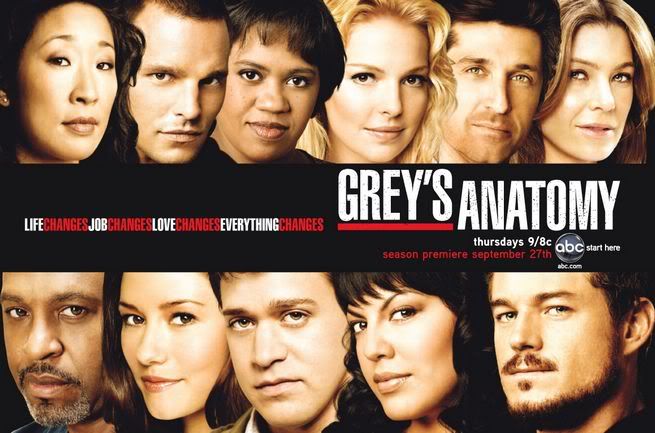
I try to stay away from TV addiction. Try being the operative word. In reality I'm addicted to House, NCIS, Law & Order (thankfully all in reruns on the cable channels which can be viewed at almost anytime), and then Top Chef, Project Runway, Burn Notice and Grey's Anatomy. For a woman who's not addicted I sure do use a lot.
Let's forget my TV consumption problem for a minute and discuss Grey's Anatomy. Yes, I just said that; don't hate me.
Here's the deal: I don't follow spoilers and I don't like entertainment tabloids -- I have a hard enough time processing real news that I certainly don't need to spend time processing fake news via Hollywood. I heard rumor (one, only one has gotten through my internal Hollywood-gossip spam filter) about what might be happening this fall and that was that actors Katherine Heigl and T.R. Knight (Izzy and George) would not be returning to the show. Ack!
Okay, let's back track.
At the end of last season both characters "died." That is to say that they crossed over to the super-bright Hospital which equals death on the show. The too-bright, empty set serves as the "other world" and occasionally as the "in between" for characters that leave the show and make us (me) cry when doing so. Meredith spent almost three episodes in the super-bright set during season three, if you'll recall, and came back just fine.
Okay, spending that long dead and returning is an absolute stretch of the imagination but, *meh* believability = not important.
Which leads me to wonder if Izzy in her "prom" dress descending in the elevator to meet George in his soldier's uniform (which he's never gotten the chance to wear in "life" btw) all in the super-bright-hospital-of-the-dead really means they will remain dead. Surely one of them will live regardless of what the TV tabloids said to me months ago. Wouldn't that make the best fake out to leak to the press?
You could shake your head and say I'm a sap for wanting them to live, but, honestly, how do you think the show will function with both the "heart and soul" characters dead? All the other characters have crazy trust issues; there's a certain disbelief in humanity that, logically, will only deepen if Izzy and George die. Okay, Little Grey still believes in people but she's about it.
Needless to say, I will be spending two hours tonight answering all these questions.
Labels:
life,
project runway,
TV
Subscribe to:
Posts (Atom)


.