And in case you're like my mother and think that "on sale now" means you can go buy the issue, don't reach for your wallet just yet. The issue is free! But my story is about a mail order company -- and yes, they're running some sales.
Pop up bookstore to appear in a shuttered Borders store in Pittsburgh. If it wasn't for Top Chef, I don't think I would understand what a "pop up" business is. This one will last for a minimum of a month. I would totally go shop at one of these if it popped up in my state. Oh, and you can ask the store to stock your indie book too.
You've probably heard about the ebook author Jacqueline Howett who freaked out, behaving like she was on Jerry Springer, not getting her self-published book reviewed. It's been all over Twitter and used everywhere as a cautionary tale of how not to behave. A friend sent me to this train wreck through Facebook. I arrived, saw the first three comments and thought wow. But then I kept reading, and the tragedy stretched on ... and on. I was literally slack jawed by the time I finished reading.
What my writing friends are saying privately is that while we are fascinated by the potential of ebooks, we are terrified of going that route because of authors like Howett who bare the name "indie writer" and then throw tantrums in public. Of course, actors can throw tantrums in public and that doesn't make other people not want to be actors--that just makes us think that Charlie Sheen's an ass and that someone should really give Lindsey Lohan a cheeseburger, not more crack.
What's up with that whole "indie" label anyway? Indie bands sign with indie record labels. They tend not to release on their own (although they can). But indie bands are cool. Hip And they've therefore made the term "indie" cool and hip. That it's been co-opted by writers who are going DIY seems to be co-opting the cool without any of the work. So if I repaint my kitchen, am I an indie decorator? If I help my friend move into a new place and he pays me with a six-pack of beer am I an indie mover? Indie contractor?
Former agent and media-specialist Nathan Bransford, crunches the indie/legacy numbersin his Monday post of his author monetization week. Essentially, if you can get your book picked up by legacy publishers, you'll make more money because they have better distribution and people are still buying paper books despite the growth of ebooks. Oops, Barry Eisler; turning down a cool half-mill advance might be a great stunt but maybe not so great a monetary decision. But Bransford is assuming that your book gets picked up at all. Which means that all the un-pick-up-able books still get to be "indie" books. Which doesn't feel very cool or hip.
Although it could be cool and hip if "indie" authors worked to push the envelope and write about topics that make the mainstream uneasy, or things that are experimental in form.
This ad (above) is the one I remember from the 80s. Actually, I remember it from my taped-from-TV version of Muppets Take Manhattan which I watched again and again over the next two decades until its mysterious disappearance of recent years.
Below is a 2007 CGI revisiting of what I always referred to as "a big mac moon tonight," which turns out not to be the actual words. (Despite what the video's youtube title says, this isn't a spoof, it appears to be an honest-to-god advertisement run regionally.)
But I have to say, digital isn't always better.
Edited to add: MonkeyLOLogist sent me to the following video. Letting me know that this commercial is a reworking of Mack the Knife.
Titled "Garbage-to-Gold Spindle! On Sale Now!" the story is a humorous bout of correspondence from a mail order catalog to one Mr. Stiltskin. At only 1,800 words, it makes for a quick read.
Actually, brevity is the name of the game for this issue of Enchanted Conversations. None of the ten pieces published in the issue are longer than 2,000 words.
Reading over the issue, I have to say that I was impressed with the poetry (which I approached with unnecessary skepticism as I've often seen folk lore meet poetry in unflattering ways). Particularly impressive was the quiet and soulful poem "Other End of the Tale" by Gerri Leen. I was also impressed by another quiet and thoughtful tale, the opening short story "Little Rattle Belly" by Mae Empson. There's even a nonfiction essay on spinning and the history of linen toward the end of the issue, "Straw Into Gold," written by Elizabeth Creith. Also enchanting was the final story of the magazine, "The Duchess's Boy," by Louise Quenneville, wherein a gnomish duchess wisely states, "I know about making bargains with humans, and they are not to be trusted to keep their end of the agreement.
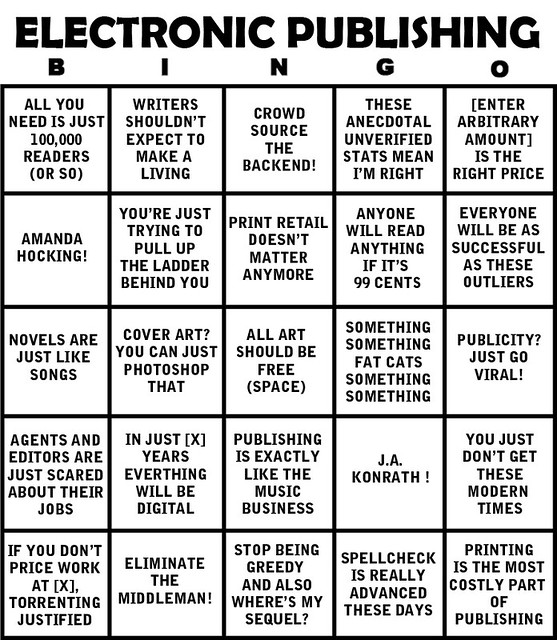
At first I thought of taking the card and playing seriously with it. That is, marking down each time I saw one of the things in the squares during my readings of blogs, articles, and list serve discussions. Then I realized, what fun would that be? I'd fill the card in an hour of reading. Two max.
Maybe this shows more what I've been reading than that the world is all atwitter over the topic.
BTW, anyone else annoyed that they feel like they can't use the word "atwitter" anymore because it's too close to Twitter? Every time I go to type atwitter, I wonder if I should only use it to refer to that which Twitter is atwitter about and that makes me sad.
I'm terribly interested in e-publishing information, but then again I'm terribly interested in publishing information, period. I even took a graduate level course on publishing this past fall. I find it all fascinating, and I think that shrewd business moves can be made through the use of ebook publication. Then again, it's not the medium or the market that has the golden touch, it's the author. And just as many stupid business moves can be made through ebook publication as smart ones (probably more if human nature has anything to say about it).
I'm interested, I'm just starting to get very annoyed with all those out there talking about e-publishing like it is the messiah come to save us from the publishing industry, low authors' advances, mistreatment of mid-list authors, mistreatment of new authors, the decline of hard cover books, the decline of mass market paperback books, the decline in reading, the increase in reading that's not novels, growth of technology use, the death of paper, the death of brick and mortar book stores, the death of polar bears, cheap readers with limited discretionary funds who can afford a $200 e-reader but not the $10 book to read on it, and those nasty nasty gatekeeping agents who want to do things like sell your book.
Don't get me wrong folks, I find it interesting, but I'm not bowing at the altar.
Have you ever been in this situation? I find myself in possession of a world I've been building for three or four years. It started when I saw a documentary on Stonehenge. This group of archeologists wasn't concentrating on the lithic henge they could see, but rather the henge they couldn't see.
They believed that 25-30 miles east of what we now know as Stonehenge, there was once a wood henge comparable in size and pattern, but instead of planting giant stones in the ground to form posts and lintels, they cut, shaped, and planted lumber there. Concentric circles of giant tree trunks. They speculated that for a procession moving on foot along the river, it would take roughly a day's walk to get from one henge to the other.
I don't remember all the particulars the documentary brought up -- I wrote them in a notebook somewhere -- but I remember it implied a life henge and a death henge. That the procession could be a funeral march, or a ritual. I started to wonder about the different events that could make a society obsessed with death to the extent that they built Stonehenge. Albeit, the ancient Egyptians were so obsessed with death that they went to much greater lengths but that thought didn't cross my mind at the time. And then I had it, a world shaped by one cataclysmic event: a race of immortals who lost their immortality, and that of their descendants, through their own actions.
So I went merrily about building this world. I gave it a form of government, a couple of cities, some natural resources, a three- to five-thousand year history that could have should have filled volumes. I gave one government sway over most of the continent. Gave them a few grumpy enemies on their borders who were too small to act on their anger. I drew a map. Gave them a system of magic that was more about throw-backs to ancient misunderstood power than magician-based. I already had their death-worship religion and therefore the mindset with which they live their lives. Hell, there were even thieves guilds in the alleys and a pirate society living on the seas!
But there was absolutely no plot.
There were no character desires in conflict with other character desires causing a series of ever more harrowing attempts to achieve said desires.
Oh, at first I thought I had a plot. I didn't. But that didn't stop me from writing 15,000 words of scenes and explanations and character sketches. It took me those 15,000 words to give up and back off because even uneducated-in-the-way-of-the-story me could see that this was a really weak storyline. Partly because I couldn't figure out who the hell the antagonist was or what he was trying to do and why. I just had four really amusing characters running around in the woods -- I even titled the Word doc I saved it in "Jaunt in the Woods" -- meeting terribly amusing dandies/pickpockets/minstrels and dragons.
Holy crap, I'd forgotten about the dragon!
And there was a girl dragon who ended up with a crush on the young protagonist.
The protagonist could, of course, speak to dragons. A fact which would become terribly important in the climatic end sequence of events if only I could figure out what the end sequence of events was.
Maybe my problem was that I'd folded ever second-world fantasy cliche into one story. But it's not like I wrote a novel full of cliches and then couldn't sell it -- I couldn't even find a plot (cliche or otherwise) to let me write the novel!
Since this world's initial creation, I've kept expanding it. I made a south continent in addition to the first. I've fleshed out different cultures of people (sort of). I've created more characters that live in this world but that don't necessarily interact with one another. I have the origin story for the high priestess of wood henge -- why we should care about her I don't know, but I could tell you about the village she grew up in. And yet, no plot.
I thought about writing short stories set in this world, but they never end up feeling like short stories according to my critique partners, but like prologues or epilogues to a much longer tale.
It is the lost world in my mind. A world with no plot. I refuse to abandon it, but neither do I know how to make it blossom.
"Coffee the Musical" to be produced in New York. I don't know why someone hasn't done this before. I mean, coffee, love, coffee shop angst and opportunity, the piazza run by minimum wage workers. Besides, any food, especially an aromatic one, can become artistically sensual.
I attended Odyssey in 2010. Odyssey Fantasy Writing Workshop is a six week, intensive writing workshop for those who are serious about speculative fiction. There's an application process, a huge time commitment, a steep fee, and almost unlimited possibility for growth as a writer.
If you write speculative fiction and you've thought about applying to Odyssey but are on the fence: do it.
It's worth it.
The application deadline is April 8 (that's a receive by date!). I waffled a lot while thinking about applying. First there was the fee to apply, which made me wonder if it was a scam -- it's not, if you're willing to take my word on it, but it is a means of cutting back on the number of applicants so that this very small operation isn't overwhelmed with aps to read. I also kept thinking I'd apply next year, when I was done with my MFA and had time to write and finish a speculative story. The speculative short story idea dropped into my lap accidentally (turns out I couldn't keep my genre from showing at workshop like I thought I could) and I got angry enough to apply (more on that story on that here), and the experience was wonderful. I'm so excited I didn't put it off til next year which we all know can indefinitely become next year.
This workshop is not about dissection. It does not open up your story like a frog in biology class, then walk away with the stomach gaping and the liver pinned to a board. This workshop is about surgery. It identifies the cancerous masses in your story and removes them, closes up, then starts the patient on a course of follow-up treatments. If you're not cool with someone discussing ways to fix (i.e. change) or possibly re-write your story then maybe you shouldn't apply. I've posted an entire page on my experience and assessment with the workshop.
My neighbors, however, are not gaga over the chance to learn story structure and resolve narrative weaknesses. They are batshit crazy over St. Patrick's day, Guinness, and cheap beer -- green or otherwise.
At Western Michigan University, the students take their drinking holidays very seriously.
Starting at noon when I opened my windows today, the noise and the clad-in-green-tee-shirt foot traffic has steadily increased. The party attitude would be present regardless of the weather, but the fact that the temp has broken sixty degrees for the first time in weeks helps a lot.
I'd say that it's a great time to gather real world dialog without leaving my apartment, but the dialog mostly sounds like:
Dude: I'm gonna get piss-ass wasted.
Girl: I've gotta be at work at five.
Dude: What? Why? Call in drunk.
So maybe not all that useful.
I will not be going anywhere. I will be holed up inside, tolerating the noise and not getting on the road with any of them. Previous observation of antics in this neighborhood leads me to believe that by 9:30 PM the fights in the parking lot will start, yelling and/or fist fights, (usually they begin around 2:00 AM) and by 10:30 or 11:00 things will be quiet again -- not even 21 year-olds can sustain 12+ hours of intoxication and partying.
And finally some absolutely fabulous geekery and British humor. Love.
There is a lot of literature on the web about how to self-promote your writing. Particularly how to build a platform and use it to shout across the web. Sites like Kristen Lamb's Blog (which I find fascinating) explain how to use social media to your advantage -- effectively, she instructs you on how to do the digital equivalent of enunciating when you speak. But for as much noise as the make-noise-brigade, um, makes, there is a quiet backlash of people who don't want to tell anyone that their publications even exist.
This weekend, Dinty W. Moore posted a fab little article on the blog of his online magazine BREVITY.* Moore is also a faculty member of the Ohio University graduate program in creative writing. He's noticed recently that he has students who won'ttell people their work has been published. It's not that they're shy wallflowers -- in Moore's story, he was the one offering to make the announcement, he just needed specifics from the student -- it's that they don't want to share.
I understand some of the backlash. There is such a thing as overkill. Or being tactless. I don't want you to spam me about your new book, but I do want the opportunity to find out about it. Publications are not CIA agents, they do not need to blend in and accomplish tasks that only a select few will ever know of. But neither do we want our publications to be politicians or Paris Hiltons, always looking for the photo op or thinking about what they could do to get a sound bite on Entertainment Tonight.
Moore points out that Facebook can be nice, or it can lead to spamming. It's all about tact. I've read blog articles because someone has multi-posted the subject and link on Facebook and Twitter ... but I've also been put off when a find a person's entire feed is them posting links to blog entries again and again (as in, multiple links to the same entry, or suggestions to "catch up" on their old blog posts).
I got frustrated last fall when no one in the department knew that I'd gotten two short stories published because the publications had happened over the summer. Their "not knowing" didn't bother me as much as them behaving like I was still unpublished. I had an awkward conversation with a faculty member who told me I'd feel much better about myself once I got something published. Awkward because I didn't feel like I could interrupt her to explain I was published, and awkward because I didn't feel any different before my publication than I did afterward. But more to the point: we had that conversation because she didn't know. In fact, she couldn't have known. I wasn't cray-cray girl running around telling everyone that I had a story pubbed, but neither had I exercised the channels in place for department promotion. Because, to be honest, I didn't even know those channels existed! So run out and do that now: locate the person in charge of your department newsletter and find that email address. A quick blurb will tastefully disseminate that information without being cray-cray girl.
To make it more palatable to those who would otherwise stay silent, Moore breaks it down into "sharing" vs. "promoting," with "promoting" being the creature that maybe you don't want to ride to the finish line. He also points out that often publications (particularly independent presses and magazines) don't get bought without word of mouth sales. "Sharing" your publications contributes to those publications audience base.
Here are Moore's six rules of sharing:
1. Self promotion is when you spam all of your friends and those who are barely friends and repeatedly say “buy my stuff,” or “look at my stuff.” We don’t need daily updates.
2. Self promotion is NOT when you share good news with fellow strugglers (like grad students in your program, or the faculty who are rooting for your success). That’s just being part of a supportive community.
3. To my mind, even a link on Facebook, or on your blog, or as a signature line in your e-mail (subtle, not blaring), is NOT self promotion, at least not the bad kind that folks want to scorn and avoid. Certain people wish to know your good news, or read your poem, or buy your book, so it is fully acceptable to tell them that the work is now available. It is, in fact, inconsiderate not to tell them.
4. Tell them once, of course, not fifty times, and give them a clean link rather than e-mailing PDFs of everything you’ve ever written.
5. If you assume your friends would hate you for your success rather than be pleased for you, maybe it is time to look for new friends. Or look at yourself.
6. Writing is not bad. Publishing your writing is not bad. Don’t treat it as if it were.
If you're interested, I recommend the full article.
Oh, and btw, I just got a story accepted at Enchanted Conversation! (eeee!) That was an excited noise. And I will be posting when the issue goes live.
* I love BREVITY's nonfic mini-essays ... I just wish they'd publish one of mine.
And here I was thinking dystopia was hot in YA novels. Turns out the governor of my state is also a fan.
Gov. Snyder has said he wants to tax pensions (which is the "tax old people" part of the above report). He's also "selflessly" declared he will work for only one dollar a year -- no doubt trying to assuage the anger of people's retirement money now being taxed. Gov. Snyder, however, is a millionaire who owns at least one big Michigan based business (I think they make closet organizing systems or something like that, but I could be wrong); he doesn't need to worry about his retirement.
To be fair, I'm guessing the intent behind the bill is to prevent some of the situations we've seen around the state like those we've seen with the Detroit Public School System. But this proposal is using a hatchet to kill a fly.
What a nightmare. At best this provides writers with a ready-made dystopia--no need to design your own!
I teach college composition. No, I teach in a computer lab, not a one room school house as pictured on the left, but what else do you think of when you think of teaching? Rulers? Chalk? Alphabets written in comic sans? Well none of that applies to my college classroom experience either. Not even the chalk board -- we've got dry erase.
What I've found over the past few years is that some classes -- some groups of people, really -- bring their own energy. You walk in and people are talking to each other, they talk to you, you talk to them as a group and at least someone responds. These groups of people have thoughts they want to share with each other even if they are not necessarily course-related thoughts. I encourage that. I love "coffee shop" classrooms, where the students feel as comfortable verbalizing their own random association as I do -- and I'm very comfortable with off the wall or fucked up metaphors if it gets my point across.
Not all groups are like this. Oh, I wish they were. Alas. Some groups don't want to chat. With each other. With the teacher. At. All. They don't want to elaborate when called on. They will chat on their phones to people of their choosing, but they choose not to bring that energy into the classroom.
In those situations as teacher I can feel the energy suck. The normal-person energy I bring to the group is not enough to light up the room. The lights dim and flicker. The computer screens brown out and -- if I'm having a really bad day -- black out completely.
Those are the B.Y.O.Energy classes.
It's taken me a long time (half a semester) to realize that one of this semester's classes is a B.Y.O.Energy. I thought they were getting into the swing of my discussion-based coffee-shop-ness a couple of times, but it still wasn't enough energy to propel the class forward and make things feel like they were clicking along.
Recently, I found the energy source for the class: me. Me behaving (a) exuberantly and (b) teacherly.
I can do the teacherly stand at the board and lecture thing, I think it benefits the students more if they can sit in a circle with me have a discussion, but I can run either kind of classroom. Some classrooms shut down when you go into stand-at-the-board mode. They take notes and stop engaging with you. Some classes (particularly the B.Y.O.E. classes) tend to like the set up. They know what to expect when you behave as the traditional teacher and they as the traditional student.
Crazy. So, now to revamp the rest of semester to stand and deliver -- oh and ham it up with the kind of energy that can only be considered wild and crazy for 8:00 AM.
Perhaps I could have titled this post simply "how to appear as a professional when you publish" and left out the distinction of self-publishing -- but presumably, if you publish with a house they are at least going to advise you on publicity if not provide you with a small amount of it.
(Not book tour publicity, but at the bare minimum all of the following information. And most likely, they'll do some of the work for you.)
One of my good friends is a theatrical publicist who likes the same kind of fiction I do. Last week, when the Amanda Hocking headlines and chatter were strong, I mentioned the situation to my publicist friend. She read the article I sent her and began scoping out "this Amanda Hocking woman."
Speaking as a publicist, my friend declared two things to me: (1) Ms. Hocking might be making a good deal of money but she's not a professional and (2) Ms. Hocking absolutely needs a publicist.
(1) Ms. Hocking might be making good money but she's not a professional. This declaration comes from the notion that one must dress for success if one wants to succeed. That to be taken seriously you must put your best foot forward: you don't show up to court in fluffy slippers or chew gum in front of the Queen. When in Rome, behave in a way that makes the Romans think more of you, not try to kill you before you get back to the Tardis.
Mixed metaphors aside, what I mean is that having a web presence is not the same as having a professional web presence.
I thought about getting into a discussion of the differences between person, personal, and persona, but I think that is another post all in itself. For the sake of this post, I'll say that your web presence should not be "you" it should be your "writer-on-the-internet persona."
With that in mind, I get to things the publicist told me:
If you're selling something (a book, a watch, your cupcakes, your skills as an actor, tiny pieces of your soul), your presence on the internet should not be just a blog. You must have a website. Should you also have a blog? That's entirely up to you. But your blog should be in your website not in place of it.
If you're working toward publication and don't have a novel to promote, then a blog is a great platform building tool. You can chat with other writers and develop connections. And someday when you have a novel to promote, you can incorporate your blog into your website.
There are many free and easy ways to create a website. Engage them. If you're selling something (as in making money from sales), upgrade to the low level package which doesn't run ads. The low-level upgrade on sites I've checked out like webs.com has a monthly rate that's about as much as a grande latte. Or at very least use wordpress to create a site that looks as little like a blog as you can make it. Unfortunately, as much as I love blogger, a blogger.com site will always look like a blog.
Your website should have separate pages for your publications, bio, press kit, and news.
Publications: where you list and link your novels. Use cover art. List and link your short stories. Use the magazine's cover art.
Biography: write it in the third person. It's a biography, not an "about me." Look at the "About the Author" in the back of your favorite book -- it's written in the third person, not the first.*
Press kit: pertinent facts and cover art for those who may be interested in reviewing, interviewing, or writing articles on you/your books.
News: not what you ate for lunch. This page should list and link all the places you've guest blogged; list and link all your favorable reviews and all reviews (favorable or not) from big venues; articles written about you/your book; places your press release has appeared; places you have or will be appearing, lecturing, signing, or teaching; and future release dates.
Don't put your direct, personal, non-professional email address on the site. "She's got her hotmail listed!" my publicist friend shrieked when she poked around Ms. Hocking's blog. "First off, it's not professional," she told me. "Second, you don't want that kind of email going into your personal account. Third, it should be going through a publicist or agent or at least your mother." Then she amended the statement further: even if you-the-author manage this account, it shouldn't be your main account and it shouldn't sound like your main account. It needs to sound professional because it's @authorname.com (not @hotmail or @gmail or @yahoo), and it should be something like contact@authorname.com or publicity@authorname.com or the like. Something that does not suggest OMG we can be bffs if you stalk me and send me a :) email after you finish each chapter of my book and an lol mssg after each of my #CharlieSheenIsAnAss tweets!
(2) Ms. Hocking absolutely needs a publicist.
Lastly, hire a real publicist. No, don't run out and do it now. But if you find yourself in the prized position of having local and national news media interviewing you and reporting on your success, or if you find yourself getting nominated for national awards, then don't try to do it all yourself.
A publicist is not like a personal assistant; she takes on many clients at once so you don't have to have oodles of work for her to do all the time. But for a media blitz, she's worth having around.
Ms. Hocking posted last week that she had spent several days doing nothing but answer emails, and it frustrated her because it was taking time away from her writing. Hopefully that made her see that she needs to hire help (at least temporarily) to deal with her sudden fame.
A real publicist would advise her on all of the above and more. A real publicist would weed through the emails. A real publicist would provide someone for the press to contact instead of contacting the author directly and having honest-to-god interview requests getting mixed in with fan/stalker/plz-tell-me-the-secret-of-your-success emails and ignored for lord knows how long. Most importantly, a real publicist would take care of publicity and let the writer have time to write.
*Where a bio should be written in the third person, I've been assured that a blog's "about me" should be in the first person. Your choice between the two depends on what persona you want to bring to the table, a professional writer with published novels, or a personable blogger writing about her journey.
Love love love this Super Bowl commercial. I'm not from Detroit, but I grew up close enough that much of the scenery is familiar to me. And what may hold the most nostalgia for me is that my view was always the same as the camera angle in the ad: from the window of a moving car.
I have to say that youtube is the only place where I've seen this extended two minute version. (I didn't watch the Super Bowl.) The version I'm seeing and loving on TV doesn't have the whole last sequence at the Fox Theater. Actually, I think the shorter version is more powerful, though I couldn't find it on youtube to post.
There's been a lot of internet chatter about Amanda Hocking and her self-publishing escapades this week. USA Today, The Huffington Post, Business Inisder, and her local NBC news affiliate gave her some air time (see video, though the first 30 seconds is just the anchors talking about wtf a Nook is).
"Rejected by countless book publishers" seems like a subjective phrase which *might* have just been blown out of proportion. Ms. Hocking got fed up with the system at age twenty-five. She submitted each subsequent novel she wrote to fewer and fewer agents (as per admission of her own blog).
Most agents will tell you that it's often not the first book you write that's the first book you sell. In Ms. Hocking's defense, she claims to have written 19 novels, many as a teenager. Now, no offense, but I remember what I wrote as a teenager and I teach teenagers writing and that teenage writing has about as much chance of making it with a publisher as I do of winning the lottery on any given day. Eragon = lotto winner.
Also agents (and successful traditionally published authors) point out that most writers do rounds and rounds of queries--sending out ten queries a week for months--before they find the right fit for a successful agent-novel-author experience. It's about finding an agent who is passionate enough about your book to want to sell it as much as you do, not finding someone to schlep paper for you.
Anyway, I bring this all up because I have my doubts about how the news media is portraying her "perseverance." But that's just me.
But it turns out she didn't need to persevere or gain a sound understanding of the publishing industry. She'd already done "market research" by browsing the Wal-Mart book rack (Ididn't make that up), she wrote YA paranormal because she it was what she saw the most of. She knew it was hot, so she stuck it up on Amazon, B&N, and several other epub platforms and made it available POD through Amazon's Lulu. Less than a year later she's self-published eight novels and one novella out and, according to her blog, sold over 900,000 units. Priced at $0.99 or $2.99, Ms. Hocking makes 30% or 70% of that as profit, respectively. According to her local news station, she's made enough to buy a house in cash.
Ms. Hocking is twenty-six and impatient. IMHO.
I don't mean to misrepresent her. It appears that she already feels enough of the internet is doing that. So I won't take some of the pot shots that I could. But I'm the kind of person who believes in the strength of patience, perseverance, and education. Formal education is helpful, but education is out there in thousands of different forms, you only have to ask for and accept it. Reading agent blogs daily is a form of education. Researching publishing is a form of education, learning grammar and style is a form of education. Knowing you need a good copyeditor is a form of education. Learning about things like book bloggers before you jump into the world of epublishing is a form of education. Reading books on craft, being part of a workshop, finding a critique partner, subscribing to publishers marketplace, reading in your genre, reading out of your genre -- these are all forms of education, patience, and (if you keep writing with all you're learning) perseverance. A classroom with a teacher in it isn't necessary to learn.
I'm twenty-seven, only one year older than Ms. Hocking, and I think that if there had been an easy way for me to throw my work into the sales arena when I was twenty-two, I might have done it. But I'm not that impatient now. And I shudder to think of my work when I was twenty-two given all I've learned in the interim.
Ms. Hocking also writes on a recent blog (to clear up things "the internet is saying ... about me"), that she feels a "tremendous sense of urgency, like if I don't get everything out now and do everything now, while the iron is hot, everything I've worked for will just fall away." This also leads to the feeling I get from looking at all of the facts (those presented by her in interviews and those presented on her blog) that her ebook sale boom is the result of impatience.
The SF/F/H writer list serve I'm on is in a tizzy contemplating the viability of the e-publishing-- the phrase "future of publishing" has been bandied about so much that it's ceased to hold meaning for me. Those who seem the most interested are people who are writing "between genres" or in not easily defined areas of the market who don't feel the traditional publishing market is open to them. Meanwhile the listserve's many voices are not really paying mind to the fact that Hocking is writing in a market that's not just hot, it's hott: YA paranormal romance.
Ms. Hocking's first novel has a good concept, but its market niche is one that is begging for content. My local Barns & Nobel has devoted an entire shelving section to "Teen Paranormal" -- more space than "Christian Fiction" gets . . . and on the conservative west side of Michigan, that means something. This is the one genre where publishers can't put out enough material to meet the demand.
Believing that you can epublish in a different genre and take off the same way is a mistake. IMHO. What sells and what doesn't is always hit or miss. No one knows what the next big seller is going to be. But let me present a case to back up my opinion.
Consider this: as much as I am a part of the cult of Firefly, I knew the moment I saw the first episode why it had only lasted one season (obvi, I was watching on Netflix). A space western could have been one of those things that exploited the interstices of genre and boomed, but it exploited the interstices of two declining genres -- dying genres, if we're going to be morose. The space opera and the western haven't been doing well in print or on screen. Speculative fiction has been there, but all you need to do is look at the declining number of episodes each new cast/crew of Star Trek made to see the writing on the wall.
So just because the internet is a way to publish in a declining genre without the editors fearing the decline, doesn't mean success will come your way. There's a guy out there trying to raise $3,000,000 to get Firefly back on the air (or air on the internet). Will his internet grass roots movement catch fire? Grass fire? Prairie fire? He wants people to pledge $40 per season to see the show online. Maybe he'll make his goal. Maybe he won't. But he's got one giant plus on his side: people have already seen the show. It's been on air, on TV, on Netflix, and in traditional theaters (Serenity). This "unproducible" TV show was produced -- your "unpublishable" novel hasn't been published.
The point I'm making: could this Amanda-Hocking-success-story happen for a writer not working in Teen Paranormal? Yes. Would I bet on it? No, I'd bet against it. And I'd make a big wager.
What I do see as worthwhile, competent epublishing ventures or --go forth and epublish now:
Authors publishing their out of print backlist (or like JA Konrath, publishing the backlist and then writing more books in the same series and epubbing them)
Authors publishing short story collections of work previously published by magazines or anthologies (Chuck Wendig).
It's very, very, very hard to convince a publisher to lose money on your short story collection -- because "short story collection" to a publisher is a bit like taking a lighter to money just to watch it burn. The publishers who do pub short story collections do so because they are dedicated to art -- and usually have dedicated grant money. But if you can say look at my short stories published in magazines X, Y, and Z, now collected in one place for a low low price then hey, maybe I'll buy that. Literally.
I'll post Monday on the how to be a professional and a self-epublished author information a publicist recently gave me after a discussion of the above news articles and blog posts. It was all good information that I was going to put here, but this post has gone on far too long.
Amy Tan speaks on creativity, focus, questioning, purpose, uncertainty, compassion, and other ideas, but namely how all of it affects her while writing a story. But the real question is what's in the bag?
Of course, me being me, I got distracted by all the statuary behind her. The storm trooper helmets and the sand trooper helmets and the lord-only-knows-what trooper helmets, and the bust of that thing from Pirates of the Caribbean , and miniature Apollo rocket model. Fascinating.
To celebrate her 125th blog follower, Elizabeth Twist is giving away two Buffy the Vampire Slayer season eight comic books (very pretty). Head over to her blog to check it out.