In my mini-series on process I decided to skip the "submission" step since I've blogged about that often enough of late and skip right on over to rejection.
For the longest time I've been collecting my rejection letters and pinning them to my bulletin board. At first I did this because my bulletin board was blank and I was hanging them up as a sign of progress and effort. A look! see, I am doing something! I'm working and trying and this is proof, damn it! sort of thing. Then I continued to do it because I read the thing from Stephen King that he pinned all his rejection letters to his wall until the thumb tack fell out and then he put a spike in the wall and kept adding letters until the spike fell out and then he got published. I wasn't big on the idea of pounding a spike into the wall but a fuzzy-happy part of my brain thought I wouldn't have to wait that long.
The push pin ain't cuttin it any more; I'm at the spike stage.
And I really don't want to invest in a spike, so all my letters and half-sheet and quarter-sheet notes are sitting in a pile beside the trash can. It was a tidy pile but the cats knocked it over. These are just the paper ones. I don't keep the email rejections because it's beyond pointless to waste trees like that.
Now I'm wondering if it's even worth keeping the stack on the floor. I don't need to keep them to prove I'm working toward my goal, I think the whole grad school thing is proof enough for the moment.
The bulletin board looks so much better without this wad of paper cluttering it up. Up there now are my two rejections with handwritten notes from the editors. (Hayden's Ferry Review and Hunger Mountain you are my favorites!) Attached above the board is my one and only acceptance letter -- I think getting the letter was better than getting the magazine with the poem in it. If those are positive energy pieces, are the rejection notes negative energy pieces? Shouldn't I be sweeping negative energy out of my life? Or have I just read way too much Natalie Goldberg and Julia Cameron?
So the real question I have for you comes down to what do you do with rejection? Since rejection comes to all writers sooner or later (most sooner) I assume that you know how to deal with it mentally; what do you do with it physically?
I have a friend who wallpapers her half-bath with her rejection letters. She's arranging them in a rather intriguing pattern. It's very much a bathroom that a writer can appreciate. Or perhaps it's commentary.

Showing posts with label rejection letters. Show all posts
Showing posts with label rejection letters. Show all posts
Thursday, April 01, 2010
Saturday, January 30, 2010
Grab Bag
Our fabulous Third Coast interns have begun their series of blog posts over at the TCBlog. Their ideas focus on revisions and the novel as a franchise.
J.D. Salinger passed away this week (or as my composition students tend to write "past away"). Thing is, no one knows if he spent the past forty years continuing to be a literary genius or just suing people for infringing on his one act of genius.
I got a rejection letter in the mail yesterday from a journal I don't remember submitting to. More pertinent, I suppose, is the fact that I didn't even know there was a journal by that name. I had to dig around in my records to find out who they were and what I'd sent them. Am I on overload, or am I pathetic?
I've only sent out two submissions this month because I've been engaged elsewhere. Actually, I've only sent out five submissions in the past three months because I've been engaged elsewhere! Does this spell doom or some other four letter word?
I loved this short story "Last Son of Tomorrow" by Greg Van Eekhout. He never uses the name 'superman' but if you were so inclined to call it "the life and death of the superman you thought you knew and understood" then you'd be highly ungifted at titling things but not far off in your meaning.
"Last Son of Tomorrow" is part of Tor.com's list of short things it's published that are eligible for the Nebula award. Things are listed here (and free to read) but you have to qualify for membership in the SFWA to vote for Nebula winners making this like the SAG Awards. Bummer.
Steve Jobs claimed years ago that Apple wasn't going to get into the e-reader race with Amazon and Sony because "people aren't reading." This week they unveiled the iPad which is a giant iTouch that functions *gasp* primarily like an e-reader. Of course they unveil this right after I get a brand new iTouch (the iPod type not the very expensive phone type). Reading on it is great, except it's too damn tiny. I can read on its default most of the time, and for webpages I can enlarge the font but it creates a peculiar side to side scrolling effect that I'd rather not have. Thankfully I'm in my twenties and can deal with this sort of eyestrain (unhappily dealing but physically capable). The iPad and similar devices are going to be necessary as I get older. Glad technology will keep up with me as my body deteriorates.
In related news I tried on some reading glasses to see what I'd look like in twenty years, and I'm happy to say that I actually look quite cute with readers.
And Google proves that a story can take the form of any medium. A painting, a photograph, a series of letters, or a search function. (see video below)
J.D. Salinger passed away this week (or as my composition students tend to write "past away"). Thing is, no one knows if he spent the past forty years continuing to be a literary genius or just suing people for infringing on his one act of genius.
I got a rejection letter in the mail yesterday from a journal I don't remember submitting to. More pertinent, I suppose, is the fact that I didn't even know there was a journal by that name. I had to dig around in my records to find out who they were and what I'd sent them. Am I on overload, or am I pathetic?
I've only sent out two submissions this month because I've been engaged elsewhere. Actually, I've only sent out five submissions in the past three months because I've been engaged elsewhere! Does this spell doom or some other four letter word?
I loved this short story "Last Son of Tomorrow" by Greg Van Eekhout. He never uses the name 'superman' but if you were so inclined to call it "the life and death of the superman you thought you knew and understood" then you'd be highly ungifted at titling things but not far off in your meaning.
"Last Son of Tomorrow" is part of Tor.com's list of short things it's published that are eligible for the Nebula award. Things are listed here (and free to read) but you have to qualify for membership in the SFWA to vote for Nebula winners making this like the SAG Awards. Bummer.
Steve Jobs claimed years ago that Apple wasn't going to get into the e-reader race with Amazon and Sony because "people aren't reading." This week they unveiled the iPad which is a giant iTouch that functions *gasp* primarily like an e-reader. Of course they unveil this right after I get a brand new iTouch (the iPod type not the very expensive phone type). Reading on it is great, except it's too damn tiny. I can read on its default most of the time, and for webpages I can enlarge the font but it creates a peculiar side to side scrolling effect that I'd rather not have. Thankfully I'm in my twenties and can deal with this sort of eyestrain (unhappily dealing but physically capable). The iPad and similar devices are going to be necessary as I get older. Glad technology will keep up with me as my body deteriorates.
In related news I tried on some reading glasses to see what I'd look like in twenty years, and I'm happy to say that I actually look quite cute with readers.
And Google proves that a story can take the form of any medium. A painting, a photograph, a series of letters, or a search function. (see video below)

Wednesday, September 16, 2009
YAY! -- Fuck.
That seems to be the way my life is operating lately. It's like the universe is really trying to get me back in sync so every time I get really excited about something I have to become really upset so that my ying and yang balances with the square root of my chi or some such shit.
YAY!
I got a personalized rejection letter!
I called both my mother and my father to tell them and they were both ... why are you happy about being rejected? Not the rejection; the personalized note! It means I'm close; it's encouragement. If nothing else it's them letting me know how close I came to getting published even if I didn't make the final cut. And if you know the publishing-in-lit-journals game you know that they send form responses to almost every submission just to help them deal with the volume. So I was pretty damn ecstatic when I got the mail.
FUCK.
My car got towed in the middle of the night from right in front of my apartment because the management is more concerned with spending money on BURRITO BARS and POOLSIDE DJs than on getting information straight and clear to their RETURNING LEASERS that the OLD parking permit is no longer valid; nor did they give us a warning shot across the bow. Bastards.
I discovered this when I went out to drive to the university to teach class. Thankfully, I live close enough that walking was feasible, however I was late, late, late, didn't have all the stuff to teach, didn't have all the stuff for my grad class because I couldn't run back and forth between classes, and then had to miserably beg rides off of very kind people to very eerie parts of town after dark. Joy.
I think I went through all the stages of grief. Disbelief as I kept looking for my car, anger and barely restrained four letter words at the office, crying between classes (and let me tell you, I'm not a cute crier), resignation as I counted out the bills to the clerk at the uber-creepy impound lot ... what other stages are there? Remorse? Is that the one I feel when I see my checking account in a few days time? Bargaining? Trust me I will be writing a pissy letter to management. Will they do anything? I have no idea, but I want the letter sent.
YAY!
I got a personalized rejection letter!
I called both my mother and my father to tell them and they were both ... why are you happy about being rejected? Not the rejection; the personalized note! It means I'm close; it's encouragement. If nothing else it's them letting me know how close I came to getting published even if I didn't make the final cut. And if you know the publishing-in-lit-journals game you know that they send form responses to almost every submission just to help them deal with the volume. So I was pretty damn ecstatic when I got the mail.
FUCK.
My car got towed in the middle of the night from right in front of my apartment because the management is more concerned with spending money on BURRITO BARS and POOLSIDE DJs than on getting information straight and clear to their RETURNING LEASERS that the OLD parking permit is no longer valid; nor did they give us a warning shot across the bow. Bastards.
I discovered this when I went out to drive to the university to teach class. Thankfully, I live close enough that walking was feasible, however I was late, late, late, didn't have all the stuff to teach, didn't have all the stuff for my grad class because I couldn't run back and forth between classes, and then had to miserably beg rides off of very kind people to very eerie parts of town after dark. Joy.
I think I went through all the stages of grief. Disbelief as I kept looking for my car, anger and barely restrained four letter words at the office, crying between classes (and let me tell you, I'm not a cute crier), resignation as I counted out the bills to the clerk at the uber-creepy impound lot ... what other stages are there? Remorse? Is that the one I feel when I see my checking account in a few days time? Bargaining? Trust me I will be writing a pissy letter to management. Will they do anything? I have no idea, but I want the letter sent.
Tuesday, July 28, 2009
Keeping the Post Office in Business
There are some days when I feel like I'm single-handedly keeping the post office in business: there weren't even bills or junk mail today, just self-addressed envelopes containing rejection letters.
When I get a paper rejection letter it's somehow more potent a rejection than the ones that come by email. First I think of something an acquaintance from the Kenyon Workshop Wrote that these are "little pieces of pain addressed to me by me." Then I think of something I've heard attributed to Stephen King: he kept all his rejection notes collected together and pinned to his wall. When the push pin fell out because there were too many pages attached, he got a spike. When the spike fell out, he got published.
Yes, I keep my rejection letters. Some people ask 'why would you ever want to do that?' They're up on my bulletin board, in plain view, as the physical proof that I am working toward a goal.
My problem with them is that they're inaction instead of action. They are dead ends where I had previously been moving forward. Nothing else to do but to turn around and try the next street; to get moving again. I sent two submissions out yesterday, got two rejections today, there'll be two more submissions in the mail tomorrow.
When I get a paper rejection letter it's somehow more potent a rejection than the ones that come by email. First I think of something an acquaintance from the Kenyon Workshop Wrote that these are "little pieces of pain addressed to me by me." Then I think of something I've heard attributed to Stephen King: he kept all his rejection notes collected together and pinned to his wall. When the push pin fell out because there were too many pages attached, he got a spike. When the spike fell out, he got published.
Yes, I keep my rejection letters. Some people ask 'why would you ever want to do that?' They're up on my bulletin board, in plain view, as the physical proof that I am working toward a goal.
My problem with them is that they're inaction instead of action. They are dead ends where I had previously been moving forward. Nothing else to do but to turn around and try the next street; to get moving again. I sent two submissions out yesterday, got two rejections today, there'll be two more submissions in the mail tomorrow.
Tuesday, July 07, 2009
Summer Holidays
My Fourth of July was unremarkable. Given where my apartment is I tend to lay low during anything that can be considered a "drinking holiday." Fourth of July isn't so bad although there was plenty of weirdness that woke me up at 3:00am but I hold to the principle that when one lives in a building primarily with 19-23 year-olds most holidays are drinking holidays. All I have to say about St. Patrick's Day was I was glad I didn't live on the first floor or I would have put plywood up over my windows.
I tried to do some writing, finished about 1000 words between two different projects and spent most of my time tinkering with edits on the pieces I'm sending out on submissions. I have sent out just over a dozen submissions in the past week. This is timely because about two months prior I had a flurry of submission activity which resulted in a flurry of rejection slips the past two weeks. My adviser has told me that I'm not allowed to change my story "Cake" until I get thirty rejections and I'm not allowed to be discouraged until I receive fifty. Working on it.
People set off all sorts of fireworks around here. I couldn't see any of them but I could hear them. The cats woke up from their perpetual naps and sat wide eyed with ears twitching for the first hour after dusk. There was this rumbling, rolling, ominous stretch that really had me on edge. It was easy to believe in those moments that it was more than just fireworks outside. And the rolling--approaching--nature of the sound gave weight to the question in my head is this what it sounds like when there's actual fire fights? But it stopped quickly enough and I retreated back into my mentality of suburban safety.
The big confrontation of the week came earlier when my father asked his new Canadian girlfriend if Canada Day (July 1) was a lot like the American Fourth of July, and she told him no: The Fourth of July is a lot like Canada Day. My father suspects she's something of a nationalist -- no reason that she shouldn't be. But do I tell her that the only three Canadians I can name are the governor of Michigan, comic-fantasy author Tanya Huff and the Bachelorette?
I tried to do some writing, finished about 1000 words between two different projects and spent most of my time tinkering with edits on the pieces I'm sending out on submissions. I have sent out just over a dozen submissions in the past week. This is timely because about two months prior I had a flurry of submission activity which resulted in a flurry of rejection slips the past two weeks. My adviser has told me that I'm not allowed to change my story "Cake" until I get thirty rejections and I'm not allowed to be discouraged until I receive fifty. Working on it.
People set off all sorts of fireworks around here. I couldn't see any of them but I could hear them. The cats woke up from their perpetual naps and sat wide eyed with ears twitching for the first hour after dusk. There was this rumbling, rolling, ominous stretch that really had me on edge. It was easy to believe in those moments that it was more than just fireworks outside. And the rolling--approaching--nature of the sound gave weight to the question in my head is this what it sounds like when there's actual fire fights? But it stopped quickly enough and I retreated back into my mentality of suburban safety.
The big confrontation of the week came earlier when my father asked his new Canadian girlfriend if Canada Day (July 1) was a lot like the American Fourth of July, and she told him no: The Fourth of July is a lot like Canada Day. My father suspects she's something of a nationalist -- no reason that she shouldn't be. But do I tell her that the only three Canadians I can name are the governor of Michigan, comic-fantasy author Tanya Huff and the Bachelorette?
Tuesday, August 12, 2008
How to Take Rejection
If you take a look at the time stamp on this entry you had better believe what you see. It's 6:50 am and I've been awake for almost two hours -- something I haven't done since I stopped working the morning shift at the coffee shop. The reason for my early morning exuberance is that today I am the person solely in charge of getting the garbage to the curb before 7:00 am so that the recycling guy doesn't go off on my ass. Seriously. 7:30 does not cut it even if you don't try to put out the recycling because you're obviously too late and you just want to leave the garbage. Yelling will occur.
So I managed to wake myself up at 4:45 am because I was so worried about the fricking trash hitting the curb at the right hour. At 5:15 I figured what the hell, I'm awake, and got it over with. Now the sun is just pushing over the trees and it's feeling very morning-like. Kinda nice actually.
On the topic of publication, submissions and rejection I've been editing and shopping around my poetry again. I don't think of myself as a poet but it keeps me moving.
Nannette Croce recently posted this wonderful article where she tells it like it is about rejection slips and what they really mean and which ones should make your heart flutter with joy and which ones tell you you need to move on to a different magazine.
Meanwhile I got a throwaway little red slip from the Mid-American Review (print). MAR was smart and took a page out of credit card companies books and in my SASE they sent not only my rejection slip but a plug for subscribing to the magazine, a plug for their upcoming conference/workshop, and a plug for something else which I cannot recall. Pretty damn smart way of both targeting your audience and getting someone else to pay for postage! I am in awe of their cunning!
So I managed to wake myself up at 4:45 am because I was so worried about the fricking trash hitting the curb at the right hour. At 5:15 I figured what the hell, I'm awake, and got it over with. Now the sun is just pushing over the trees and it's feeling very morning-like. Kinda nice actually.
On the topic of publication, submissions and rejection I've been editing and shopping around my poetry again. I don't think of myself as a poet but it keeps me moving.
Nannette Croce recently posted this wonderful article where she tells it like it is about rejection slips and what they really mean and which ones should make your heart flutter with joy and which ones tell you you need to move on to a different magazine.
Meanwhile I got a throwaway little red slip from the Mid-American Review (print). MAR was smart and took a page out of credit card companies books and in my SASE they sent not only my rejection slip but a plug for subscribing to the magazine, a plug for their upcoming conference/workshop, and a plug for something else which I cannot recall. Pretty damn smart way of both targeting your audience and getting someone else to pay for postage! I am in awe of their cunning!
Then there's Dennis Cass, who likes to drop his suggestions for your life and your public persona as a writer. I guess that's okay since he only "wants you to be more awesome." His take is that writers should not blog about rejection if they want to be more awesome because it's completely negative. Additionally, when blogging about rejection (particularly rejection of book length manuscripts) many writers get snitty and mean about the agents/editors sending the form letters. Actually there's an entire site (an entirely ludicrous site) devoted to reading things into form rejection letters and making up gastrointestinal problems that the editors have which caused them to write such cruel sentences like "this isn't right for our publishing needs." The fact that people take offense at these form letters completely boggles the mind: the world does not revolve around you to the degree that people who have never met you care about you enough to hate you. The website is complete crap -- but more than a little like watching Jerry Springer. You can read another (thankfully sane though extremely frustrated) reaction to it here.
Anyway, I think it was David Cass that suggested that there were a couple-three ways of doing rejection tales well. And perhaps the "Epic of Rejection and Publishing" would be the way to go. I'll work on an introduction shortly, because epics can't begin in the middle.
Wednesday, June 04, 2008
Suggested Lit Magazines
Word Count: 4593
Notes on Craft
After a previous post, Taggie7 left me a question that I've been thinking on trying to come up with as good an answer as I could find. The post was about which literary journals were best suited for submissions from undergraduates or recent graduates, and you can read my answer here. Taggie asked me if there were any magazines that I highly recommended and I told her I'd have to get back to her on it.
I've really been struggling with an answer because I'm just as much of a learner as anyone else. And according to Poets & Writers there were over 600 literary magazines and journals last count, so needless to say, I couldn't possibly have a finger and the pulse of the market.
Speaking of P&W, I highly recommend their May/June 2008 issue, about a third of which is dedicated to something they call "Project Lit Mag." They interview editors of lit mags and then profile 20 new lit mags that they recommend you send your work to now. Given their urging, I'm certain that Alehouse, Alimentum, Barrelhouse, Bateau, Cadillac Cicatrix, Cave Wall, Coal Hill Review, Ecotone, Five Chapters, Fringe Magazine, Grist, HoboEye, Lumberyard, Make, Marginalia, One Less Magazine, Palabra, Quiddity, Slice, and Subtropics are now swamped with more slush then their volunteer editors can deal with. Said editors have kissed their spouses and children goodbye and have little chance of seeing them again until Christmas.
I know nothing about the 20 above mags other than they're new and recommended by P&W.
Personally, I always give Glimmer Train first crack at my work. They're yet to be as impressed with me as I am with them, but I'm keeping up the tradition nonetheless.
Some people start off by submitting their short story to The New Yorker first and then go from there. I'm yet to try this tack although I see the merit in trying to break into the undeniably most powerful short story market in America. BTW, finding the submissions guidelines and appropriate address for The New Yorker is something of a task, a first (if small) hurdle to discourage the lazy and half hearted. But back to Glimmer Train.
GT does everything online so turn around time is good and they reassure everyone that they really do read the entire story every time. They run a contest a month as well if you're willing to pay the entry fee. The magazine is known and sold across the country, and the stories have a decidedly upbeat tilt to them that makes them a pleasure to read. Not that they're all rainbows and peppermint waterfalls, but I was reading a story about a guy who had just had a heart transplant and the anti-rejection drugs he was taking were eating away his other organs and I wasn't depressed by the story. That's the kind of tilt I'm talking about.
For some reason, I've always placed some sort of mystique around The Kenyon Review. It is a very well known magazine and I think some of it's stories got nominated for Pushcarts this year. They've recently launched the Kenyon Review Online which is a supplement, not a replacement, to the print version of the KR. The KRO is free, and therefore an easy way to familiarize yourself with the type of material the KR staff seeks out. And there is a certain aesthetic to the KR (one David Lynn keeps a thumb on as Editor in Chief). The stories they print have a certain gritty edge to them. Where GT leaves me feeling hopeful, KR leaves me feeling slightly horrified. It's a thrilling, mind racing feeling, but not one I think my own work invokes. I've yet to submit anything to them because of this.
I'm a fan of the Southeast Review. Their staff has a decidedly light, playful side to them. The SER also hosts the WBSSSC (World's Best Short Short Story Contest) which comes out every year in their spring issue, which, coincidentally, is when the WBSSSC opens and closes for the next year. Winners are announced in June and, darnit, I'm not one of them this year.
I'm in love with the notion of One Story magazine, and will probably get a subscription once I move and get my new address. The idea is that you always have time for just one story; so every three weeks they send you one new short story. While they only publish one author an issue, they will never repeat a writer. So, for once in your life you can be certain you are not competing with Ron Carlson (he already had his one story).
The Michigan Quarterly Review is the one magazine which sent me a personalized rejection letter (for poetry). This is perhaps because I studied all the online offerings for the MQR and really thought about what pieces I was choosing to submit.
The Alaska Quarterly Review has been keeping itself in the news of late. I'm always impressed to see far off presses that are regularly sold at book stores here so kudos to them. The stories I've read from them did sort of suffer from the "not much happens" syndrome of undergraduate workshops, not that this makes it that much easier to crack the market.
Which brings me back to the real point of the question: I don't know which ones are the "easiest" to crack. I just know what I've read and then I apply a couple of strategies to that.
There's a struggle to find a balance in submitting. You want to be accepted by the biggest market possible, but you also want to increase your odds by submitting someplace that isn't getting a lot of gems sent to them. But more importantly, you want those magazines to be reliable: not author traps, and not going to fold before your story goes to print.
Some people approach this problem as I mentioned before: they start with The New Yorker and make their way down the list. If you're me, you're looking for magazines you know exist. Magazines I can find on the shelves of the bookstore. (On the bottom shelf of the magazine section under food and wine). But that's not a bad strategy. All the magazines I've listed I know are reliable journals. I've seen them in print and (most of them) being sold in my home town.
Short of that you can pick up a copy of The Writer's Market and start thumbing through it. It costs about $30 retail and a new edition comes out every November or December and most libraries carry multiple copies. Right now I've got a 2007 copy checked out from the library because I figured that there would be fewer hold requests placed on last year's copy while the information is roughly the same. And it's paid off. I've successfully kept my copy checked out for six months now.
If what you want is publishing credit and want it now, keep your eyes open for local contests and presses. Occasionally a newspaper will run a poetry contest. There is a publication called "eCurrent" around here (they focus on food/entertainment/culture) that runs a poetry/short story contest once a year open to people who live in the county and I won an honorable mention one year for a poem.
If you're writing in genre that changes the game entirely. Everything I just mentioned is for "literary" fiction. In genre, again, go to the book store and see what magazines they have. What you see there are the heavy hitters. "Asimov's" or "Ellery Queen's Mystery Magazine" or "Science Fiction & Fantasy" or ... I don't know a romance mag off the top of my head but I'm certain they're there, although Harlequin now e-publishes short stories if you meet their "line" guidelines. These are all big, well paying publishers. If you're looking for $20 and some spiffy cover art try ElectricSpec and it's brethren - which will take some hunting to find and some more hunting to find out if they're credible.
Right now I'm trying to get as good a feel as I can for magazines by reading them, but every time I'm ready to submit (simultaneously) I always throw in a couple markets I haven't read that I fit the guidelines for. They claim that if you read the magazine, and truly follow the guidelines (right material, right format) that you're already ahead of 80% of your competition.
Hope there's some sort of help in there. I'd love to hear anybody else's take on markets, so leave me your blog address if you've done a similar diagnostic.
Edit: There's also FAWLT magazine which is new and advertising on the MFA Blog. Obviously odds are better at someplace that's just starting up and targeting MFA candidates and applicants.
Notes on Craft
After a previous post, Taggie7 left me a question that I've been thinking on trying to come up with as good an answer as I could find. The post was about which literary journals were best suited for submissions from undergraduates or recent graduates, and you can read my answer here. Taggie asked me if there were any magazines that I highly recommended and I told her I'd have to get back to her on it.
I've really been struggling with an answer because I'm just as much of a learner as anyone else. And according to Poets & Writers there were over 600 literary magazines and journals last count, so needless to say, I couldn't possibly have a finger and the pulse of the market.
Speaking of P&W, I highly recommend their May/June 2008 issue, about a third of which is dedicated to something they call "Project Lit Mag." They interview editors of lit mags and then profile 20 new lit mags that they recommend you send your work to now. Given their urging, I'm certain that Alehouse, Alimentum, Barrelhouse, Bateau, Cadillac Cicatrix, Cave Wall, Coal Hill Review, Ecotone, Five Chapters, Fringe Magazine, Grist, HoboEye, Lumberyard, Make, Marginalia, One Less Magazine, Palabra, Quiddity, Slice, and Subtropics are now swamped with more slush then their volunteer editors can deal with. Said editors have kissed their spouses and children goodbye and have little chance of seeing them again until Christmas.
I know nothing about the 20 above mags other than they're new and recommended by P&W.
Personally, I always give Glimmer Train first crack at my work. They're yet to be as impressed with me as I am with them, but I'm keeping up the tradition nonetheless.
Some people start off by submitting their short story to The New Yorker first and then go from there. I'm yet to try this tack although I see the merit in trying to break into the undeniably most powerful short story market in America. BTW, finding the submissions guidelines and appropriate address for The New Yorker is something of a task, a first (if small) hurdle to discourage the lazy and half hearted. But back to Glimmer Train.
GT does everything online so turn around time is good and they reassure everyone that they really do read the entire story every time. They run a contest a month as well if you're willing to pay the entry fee. The magazine is known and sold across the country, and the stories have a decidedly upbeat tilt to them that makes them a pleasure to read. Not that they're all rainbows and peppermint waterfalls, but I was reading a story about a guy who had just had a heart transplant and the anti-rejection drugs he was taking were eating away his other organs and I wasn't depressed by the story. That's the kind of tilt I'm talking about.
For some reason, I've always placed some sort of mystique around The Kenyon Review. It is a very well known magazine and I think some of it's stories got nominated for Pushcarts this year. They've recently launched the Kenyon Review Online which is a supplement, not a replacement, to the print version of the KR. The KRO is free, and therefore an easy way to familiarize yourself with the type of material the KR staff seeks out. And there is a certain aesthetic to the KR (one David Lynn keeps a thumb on as Editor in Chief). The stories they print have a certain gritty edge to them. Where GT leaves me feeling hopeful, KR leaves me feeling slightly horrified. It's a thrilling, mind racing feeling, but not one I think my own work invokes. I've yet to submit anything to them because of this.
I'm a fan of the Southeast Review. Their staff has a decidedly light, playful side to them. The SER also hosts the WBSSSC (World's Best Short Short Story Contest) which comes out every year in their spring issue, which, coincidentally, is when the WBSSSC opens and closes for the next year. Winners are announced in June and, darnit, I'm not one of them this year.
I'm in love with the notion of One Story magazine, and will probably get a subscription once I move and get my new address. The idea is that you always have time for just one story; so every three weeks they send you one new short story. While they only publish one author an issue, they will never repeat a writer. So, for once in your life you can be certain you are not competing with Ron Carlson (he already had his one story).
The Michigan Quarterly Review is the one magazine which sent me a personalized rejection letter (for poetry). This is perhaps because I studied all the online offerings for the MQR and really thought about what pieces I was choosing to submit.
The Alaska Quarterly Review has been keeping itself in the news of late. I'm always impressed to see far off presses that are regularly sold at book stores here so kudos to them. The stories I've read from them did sort of suffer from the "not much happens" syndrome of undergraduate workshops, not that this makes it that much easier to crack the market.
Which brings me back to the real point of the question: I don't know which ones are the "easiest" to crack. I just know what I've read and then I apply a couple of strategies to that.
There's a struggle to find a balance in submitting. You want to be accepted by the biggest market possible, but you also want to increase your odds by submitting someplace that isn't getting a lot of gems sent to them. But more importantly, you want those magazines to be reliable: not author traps, and not going to fold before your story goes to print.
Some people approach this problem as I mentioned before: they start with The New Yorker and make their way down the list. If you're me, you're looking for magazines you know exist. Magazines I can find on the shelves of the bookstore. (On the bottom shelf of the magazine section under food and wine). But that's not a bad strategy. All the magazines I've listed I know are reliable journals. I've seen them in print and (most of them) being sold in my home town.
Short of that you can pick up a copy of The Writer's Market and start thumbing through it. It costs about $30 retail and a new edition comes out every November or December and most libraries carry multiple copies. Right now I've got a 2007 copy checked out from the library because I figured that there would be fewer hold requests placed on last year's copy while the information is roughly the same. And it's paid off. I've successfully kept my copy checked out for six months now.
If what you want is publishing credit and want it now, keep your eyes open for local contests and presses. Occasionally a newspaper will run a poetry contest. There is a publication called "eCurrent" around here (they focus on food/entertainment/culture) that runs a poetry/short story contest once a year open to people who live in the county and I won an honorable mention one year for a poem.
If you're writing in genre that changes the game entirely. Everything I just mentioned is for "literary" fiction. In genre, again, go to the book store and see what magazines they have. What you see there are the heavy hitters. "Asimov's" or "Ellery Queen's Mystery Magazine" or "Science Fiction & Fantasy" or ... I don't know a romance mag off the top of my head but I'm certain they're there, although Harlequin now e-publishes short stories if you meet their "line" guidelines. These are all big, well paying publishers. If you're looking for $20 and some spiffy cover art try ElectricSpec and it's brethren - which will take some hunting to find and some more hunting to find out if they're credible.
Right now I'm trying to get as good a feel as I can for magazines by reading them, but every time I'm ready to submit (simultaneously) I always throw in a couple markets I haven't read that I fit the guidelines for. They claim that if you read the magazine, and truly follow the guidelines (right material, right format) that you're already ahead of 80% of your competition.
Hope there's some sort of help in there. I'd love to hear anybody else's take on markets, so leave me your blog address if you've done a similar diagnostic.
Edit: There's also FAWLT magazine which is new and advertising on the MFA Blog. Obviously odds are better at someplace that's just starting up and targeting MFA candidates and applicants.
Wednesday, May 21, 2008
Literary Journal Submissions?
On another forum I found this question about literary journals: I'm a recent undergrad interested in applying to an MFA program next fall. Does anyone know of any good literary journals or magazines and other publications that would accept submissions from people who don't have an MFA? And what are the odds of a recent undergrad being published in these types of journals? Would I just be wasting my time?
Response from Speak Coffee:
I wish I could tell you where the best place to start looking is, but the truth is everyone wants that answer. As people have said, it's the strength of your work that matters the most. However, knowing what kind of journal you're sending your work to matters a lot as well. Make sure to read the guidelines thoroughly and to follow them. Read at least one if not several editions of the Lit Mag you're researching so that you know what kind of stories they take. This will help you find out what kind of company you're keeping as well as improve your odds.
Recent undergrads aren't frequently published -- not because of being recent undergrads, but because these things take time. Learning about writing and your own strengths takes time, polishing a good story takes time, researching lit mags takes time, submissions take time, then resubmissions take time, the editorial process before print takes time -- and more MFAs are published than recent undergrads because an MFA is nothing if not time, time to focus on writing and learning.
I say start trying to publish now. So long as you're not the type to cry over every half sheet rejection letter, what can it hurt?
Up Next: Review of Two New Books on Writing
Response from Speak Coffee:
I wish I could tell you where the best place to start looking is, but the truth is everyone wants that answer. As people have said, it's the strength of your work that matters the most. However, knowing what kind of journal you're sending your work to matters a lot as well. Make sure to read the guidelines thoroughly and to follow them. Read at least one if not several editions of the Lit Mag you're researching so that you know what kind of stories they take. This will help you find out what kind of company you're keeping as well as improve your odds.
Recent undergrads aren't frequently published -- not because of being recent undergrads, but because these things take time. Learning about writing and your own strengths takes time, polishing a good story takes time, researching lit mags takes time, submissions take time, then resubmissions take time, the editorial process before print takes time -- and more MFAs are published than recent undergrads because an MFA is nothing if not time, time to focus on writing and learning.
I say start trying to publish now. So long as you're not the type to cry over every half sheet rejection letter, what can it hurt?
Up Next: Review of Two New Books on Writing
Tuesday, April 08, 2008
Rejection Slip: Colorado Review
 The first collection from my February flurry of submissions. Great turn around time. I wasn't surprised that it came back as I'll fully admit that it was the least researched off all the markets I submitted to. I spent more time reading selections from the other publications that I submitted to. And, in turn, I had a better feel for what to send them. It's the cardinal sin of submitting: not knowing your market. And I committed it knowingly.
Mostly I just wanted to submit this story somewhere. And as it is a long story, my options of who would accept a long, winding, serious story were limited. Should I continue to work on it? Yes, of course. Should I have submitted it to the Colorado Review at this point? Most likely not.
Because of this, I contributed to the problem.
Poor under staffed, over worked, and ill paid offices of literary magazines get swamped with submissions. Everyone wants to be a writer and no one wants to read. If they read the magazine at least a third would find that this is not a market for them. That the such-n-such review doesn't do aliens. And another third would realize that their piece, at that moment in time, was no where near the quality it would need to be for publication. The remaining third are appropriate. So I added to the problem by blindly submitting something that I couldn't compare against the measure of the magazine because I'd never taken the measure. My bad.
The upside? I gained a paper clip in this exchange. That hot commodity was definitely NOT there when I sent in.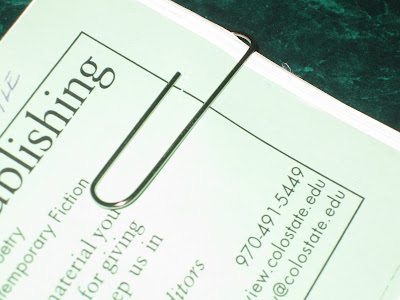
Thursday, January 17, 2008
Accept Rejection and Reject Acceptance
"You have to know how to accept rejection and reject acceptance."
- Ray Bradbury
There it is, the Bradbury quote from above printed on a strip of green paper and affixed to my bulletin board. It lives there resting on top of my series of rejection letters from a handful of literary magazines and one from a children's book publisher.
 I started pinning them up there in December 2006 as physical proof that I was doing something. They were evidence that I was trying and trying again to make it. And a part of me loves them for that. Actually, all of me loves them for that. I must be the most wacky writer out there: I love all my rejection letters. Okay the poetry contest I made an honorable mention in made me dance but when the little certificate came in the mail I showed it to my mother and then stuck it in a pile. My mother wanted to frame it but I refused as it was a cheap certificate that someone had obviously run through an inkjet and shoved into an envelope. The acceptance didn't inspire me, didn't make me feel any more like a writer than the rejection letters had. Then again, if it had come with publication not just a certificate then maybe I would have felt differently.
However it has been months since I've received a rejection letter from a literary magazine: because I've stopped submitting. Oops. This must change. Take a look at that bulletin board again:
 There's lots of room there for more pre-printed notes. And it is my intent and desire to fill the board with more notes. More proof that I am working toward my future in print.
Don't get me wrong, I love my blog, but my blog needs friends. Friends that come in hand held editions.
What you don't see in that picture are all my electronic rejection letters. I don't print emails just to tack them up there just to make me feel better as I feel it is unfair to the trees. Those electronic rejections would probably double the number of letters in the picture and there would be one from as recently as early December 2007 for poetry and a couple fiction from summer 2007. But they weren't heartfelt submissions sadly.
What you do see in that picture in the lower center area is a pre-printed note with about three handwritten sentences to me from the editor. This is my most cherished note. Handwritten comments are rare. However that note is from my poetry days and I've realized I don't really have what it takes to stick in poetry. It was a phase. My strength has always lied in fiction but I think I was simply tempted by the glitz and speed of the shorter form.
So here it is, a toast to new fiction and new literary rejection letters in the new year! They are the pebbles tossed in the river: they seem small and insignificant but if I gather enough of them I may some day walk across them to the far bank.
Subscribe to:
Posts (Atom)
Highly Recommended
