
Tuesday, May 31, 2011
Thursday, May 26, 2011
Tuesday, May 24, 2011
Adding the context of the history of romance novels to Twilight
Great little video which gives some background to the evolution of the romance novel and why Twilight is a throwback -- not something new. (We already knew it wasn't progress, but now we can see where the notion comes from.)
But being born "from a different era" still doesn't explain why it's so damn popular now.
But being born "from a different era" still doesn't explain why it's so damn popular now.

Saturday, May 21, 2011
Ad of the Week
I'm usually grossed out by anything that gets too up close and personal with an insect, but after the first few seconds, this ad made me smile.
Friday, May 20, 2011
Fantasy's contract with the finite world

 There's a great Ursala Le Guin essay that's (re)printed in The Secret History of Fantasy
 (primarily a short story collection with a couple of essays). In her essay, Le Guin points out that while fantasy fiction and surrealism differentiate themselves from realism by dealing in that which is realistically impossible, fantasy and surrealism are not interchangeable.
 Surrealism, she says, is when the rules of reality are subverted.
Fantasy is when the rules of reality are subverted, and replaced with a new set of rules.
Therefore fantasy is more like realism than surrealism. You read fantasy fiction and realism expecting a certain set of rules to shape and guide the world and your reading of it. Therefore, if something strange happens in a fantasy story, you don't ask if it was a dream. Fantasy authors aren't subverting rules, or trying to trick your mind; if they tell you something happened, then it happened. Believe the words on the page: it was real, not a dream.
(You have no idea how badly I wish I could have gotten my MFA workshop groups to read this Le Guin essay or at least listen to the above statements, but I digress.)
And so the fantasy reader enters into the novel having a contract with the finite world. The realism reader makes that contract with the author before she opens the book. The fantasy reader gives the author (roughlyt) the first 50-100 pages to set the terms of the contract. She'll believe events that are based off of that contract -- but throw any "extras" at her, and she's likely not buying.
I've been struck more than once by a situation (often near the end) which a dramatist would call deus ex machina -- essentially, a moment when a god or some other device, enters into the novel and "fixes" the narrative problem, allowing everyone a happily ever after.
Why am I writing about this specifically in the context of fantasy? Because sometimes you'll be reading a fantasy novel with, say, vampires and then the narrative problem will be solved by the appearance of, oh let's say, a ghost.
It's all gravy, right? I mean it's a fantasy novel -- we expect fantastic things, right?
Wrong.
The appearance of the ghost is a form of deus ex machina because the sudden appearance of the ghost broke the contract with the finite world. In Le Guin's terms, the fantasy broke the rules of reality that it had established for itself.
If the viability of ghosts in this vampire world was established early on as part of the rule building / world building, then the sudden interruption of a ghost at the end of the story would not warrant a cry of deus ex machina. It would warrant perhaps a subtle oh, another ghost -- clever.
Yesterday I posted about series novels, and discussed the ever-growing superpowers as a breech of contract with the finite world. If we're sticking with the contract metaphor, then every-growing superpowers (the kind that get surprisingly bigger and better with each book) would be a legal gray area. Not an outright violation, but not exactly in the spirit of the contract either. As a reader, I'd much rather see characters deal with the situation using what they have, getting cunning and clever -- after all, making a character work within the rules of her reality makes her story resonate with the human experience, and that's what all fiction, no matter the genre, should strive to do.
Thursday, May 19, 2011
Is there a trick to writing a series?
I'd often wondered about how or how not to "grow" a protagonist in a series. There are many series out there that just lose "it" -- that unidentifiable quality that makes me desperate to turn the page and know what happens and how. On the Odyssey LiveJournal, author Lane Robins discusses her take on growing a protagonist over a series of books and the considerations an author must account for as she attempts such things. She brings up something that I often feel like I see: you have an idea for two books and then your editor wants three. Or you sell the first three together -- you know how the story and the character flow -- and then they do so well that the publisher wants more. And, well, what the hell do you do now? More of the same? Why not. So often it's book four that gets episodic and breaks the camel's back -- or, in this case, my desire to read more.
 Books one through three of the Mercy Thompson
 series by Patricia Briggs were just awesome. Book four was necessary because the scene at the end of three remains unfinished until chapter one of book four! (a cheap shot ? I think it was more like Briggs realized she couldn't end it where she ended it and took book four as an opportunity to rewrite the action by altering the "ending.") But the plot of book four was abysmal. Books four and five sort of wash together in my memory because of how unspectacular they were compared to the tight, directed plots of books 1-3. Thankfully, book six got interesting because it solved some of the unsolved mysteries brought up as early as book one (why Mercy is the only coyote skin walker she's ever met). Book five sort of did the same thing with Samuel. But book four? Yeah, still don't see the redeeming value there.
Is the lesson here to plant mysteries in book one? Non-urgent mysteries, of course, that can be solved much, much later?
That might work, so long as the series keeps producing new mysteries to be solved later and doesn't give in to the temptation to become episodic jaunts.
 I haven't read enough of the Harry Dresden
 novels by Jim Butcher to know how Butcher handles the series character. But he's got at least 13 of these novels out and the popularity only seems to grow. Book one
 drew the reader into the world and left us with more than we started with, but my feeling was that Harry Dresden was roughly in the same place as he was before. That's what I mean when I say "episodic": things happen but the world returns to the way things were without permanently altering much.
Although, maybe all you need in the first novel of a series is to draw the reader into the world. And the rest of the changes can come slowly.
TV shows are often episodic -- they air in episodes, so you can even say it's a given. And perhaps it's why the season finale is the most dramatic of all the episodes: it's when something irrevocably changes in the character's world or in his world-view. So when the TV adaptation of Dresden File s
s aired on the SciFi Channel, it got even more episodic feeling and accidental feeling -- characters would accidentally run into Harry or Harry would brush up against their world without seeming to have any reason to -- so it's not all that surprising that it didn't last long on television in spite of how much fans loved the show. The Harry Dresden I watched on TV encountered a lot of creatures and characters and nothing changed him or made him grow. He was passive. And I was bored.
 A lot of paranormal romance embraces the episodic nature of the series. Writers such as Sherrilyn Kenyon
 , JR Ward
 , and Gena Showalter
 have married the idea of the series with the "completeness" the romance genre requires of its novels -- each novel shows the trials, tribulations, and eventual success of one couple's romantic journey. So they base a series of novels in the same world, and the main characters of the first novel become secondary characters in the next. Then for the third novel, other characters who've been in the background become main characters. And so on. When these novels work well, the series world has some growing tension that each novel must deal with as well as "complete" the romance. When these novels don't work so well, the "growing tension" feels more like a background game of Farmville where we're just waiting for the next Mystic Egg to be collected
 .
.

 The other was to approach paranormal romance (and these often straddle the line between paranormal romance and urban fantasy), is to have a focus cou
 ple who remain the main characters throughout the entire series like Jeaneine Frost
  did in the Cat & Bones books (technically they're called the "Night Huntress
 " series).
This is a situation where I'd almost be willing to put money on Frost being offered a contract for the first two books with no idea if she'd ever get to write a third. The first two books are brilliant. The first one plunges us into a fascinating world and ends with a wild series of events that makes us want to read more. The main character, Cat, grows tremendously. But the character arc isn't finished -- neither is the romance story line -- until book two. Then we get into book three, which is more of the same. Book four felt like the author struggled to come up with a realistic challenge to the main characters' relationship, so she created a former lover from the past which Cat can't remember because the vampires wiped it from her mind. Vampiric amnesia. Convenient. And not terribly intriguing.
This leads me to another series problem: ever growing powers.
In an attempt to up the stakes in each new book, the character discovers new super powers. The author must then explain why no one told the character (or the reader) about these powers in previous books -- a minor irritation that the author must solve. The big irritation? The new extremes the characters must go to to avoid other characters using the same super powers on them.
A few books in, Frost introduces the notion that vampires can hear conversations a half mile away. Now all of our super-secret strategy sessions must happen in whispers while a TV is blaring so other vamps can't eavesdrop. Next, vampires can fly. Next, vampires can alter memories. Next, some vampires can hear all human thoughts. Next ... next? I don't want to know what the next super power will be. The contract with the finite world has been broken (tomorrow's post), and instead of the character growing and changing, her powers are growing and changing. While it may keep some readers reading, it's not the reason I feel in love with the series back in the day. One upping ones self becomes a dangerous business.
Books one through three of the Mercy Thompson series by Patricia Briggs were just awesome. Book four was necessary because the scene at the end of three remains unfinished until chapter one of book four! (a cheap shot ? I think it was more like Briggs realized she couldn't end it where she ended it and took book four as an opportunity to rewrite the action by altering the "ending.") But the plot of book four was abysmal. Books four and five sort of wash together in my memory because of how unspectacular they were compared to the tight, directed plots of books 1-3. Thankfully, book six got interesting because it solved some of the unsolved mysteries brought up as early as book one (why Mercy is the only coyote skin walker she's ever met). Book five sort of did the same thing with Samuel. But book four? Yeah, still don't see the redeeming value there.Is the lesson here to plant mysteries in book one? Non-urgent mysteries, of course, that can be solved much, much later?
That might work, so long as the series keeps producing new mysteries to be solved later and doesn't give in to the temptation to become episodic jaunts.
novels by Jim Butcher to know how Butcher handles the series character. But he's got at least 13 of these novels out and the popularity only seems to grow. Book one drew the reader into the world and left us with more than we started with, but my feeling was that Harry Dresden was roughly in the same place as he was before. That's what I mean when I say "episodic": things happen but the world returns to the way things were without permanently altering much.Although, maybe all you need in the first novel of a series is to draw the reader into the world. And the rest of the changes can come slowly.
TV shows are often episodic -- they air in episodes, so you can even say it's a given. And perhaps it's why the season finale is the most dramatic of all the episodes: it's when something irrevocably changes in the character's world or in his world-view. So when the TV adaptation of Dresden File
s aired on the SciFi Channel, it got even more episodic feeling and accidental feeling -- characters would accidentally run into Harry or Harry would brush up against their world without seeming to have any reason to -- so it's not all that surprising that it didn't last long on television in spite of how much fans loved the show. The Harry Dresden I watched on TV encountered a lot of creatures and characters and nothing changed him or made him grow. He was passive. And I was bored. , JR Ward, and Gena Showalter have married the idea of the series with the "completeness" the romance genre requires of its novels -- each novel shows the trials, tribulations, and eventual success of one couple's romantic journey. So they base a series of novels in the same world, and the main characters of the first novel become secondary characters in the next. Then for the third novel, other characters who've been in the background become main characters. And so on. When these novels work well, the series world has some growing tension that each novel must deal with as well as "complete" the romance. When these novels don't work so well, the "growing tension" feels more like a background game of Farmville where we're just waiting for the next Mystic Egg to be collected.The other was to approach paranormal romance (and these often straddle the line between paranormal romance and urban fantasy), is to have a focus couple who remain the main characters throughout the entire series like Jeaneine Frost did in the Cat & Bones books (technically they're called the "Night Huntress" series). This is a situation where I'd almost be willing to put money on Frost being offered a contract for the first two books with no idea if she'd ever get to write a third. The first two books are brilliant. The first one plunges us into a fascinating world and ends with a wild series of events that makes us want to read more. The main character, Cat, grows tremendously. But the character arc isn't finished -- neither is the romance story line -- until book two. Then we get into book three, which is more of the same. Book four felt like the author struggled to come up with a realistic challenge to the main characters' relationship, so she created a former lover from the past which Cat can't remember because the vampires wiped it from her mind. Vampiric amnesia. Convenient. And not terribly intriguing.
This leads me to another series problem: ever growing powers.
In an attempt to up the stakes in each new book, the character discovers new super powers. The author must then explain why no one told the character (or the reader) about these powers in previous books -- a minor irritation that the author must solve. The big irritation? The new extremes the characters must go to to avoid other characters using the same super powers on them.
A few books in, Frost introduces the notion that vampires can hear conversations a half mile away. Now all of our super-secret strategy sessions must happen in whispers while a TV is blaring so other vamps can't eavesdrop. Next, vampires can fly. Next, vampires can alter memories. Next, some vampires can hear all human thoughts. Next ... next? I don't want to know what the next super power will be. The contract with the finite world has been broken (tomorrow's post), and instead of the character growing and changing, her powers are growing and changing. While it may keep some readers reading, it's not the reason I feel in love with the series back in the day. One upping ones self becomes a dangerous business.
Tuesday, May 17, 2011
The bitch in the bridal boutique
Here's a little story from this past weekend., typed as I rewatch back episodes of Covert Affairs from USA.
My friend asked me to be her maid of honor. She's the most low maintenence woman I know, so of course I agreed. We found her dress in December. My dress? I tried on a few in December. But all I remember from back then was being tired from hours at the store. Oh, and I remember feeling fat.
I decided that if I could lose weight on my own ... well six weeks and two pounds later I joined Jenny Craig. On their program I've lost 23 lbs. in three months. Thumbs up.
 So 23 lbs. ligther and almost two dress sizes smaller, we went dress shopping again. Beforehand, we'd looked at all these dresses online. Dessy group seemed to be the best. Seemed. Ooh, here's a pretty dress. But you can't buy them online. You have to go to local bridal boutiques. And even if you could buy them online you'd want to try them on right? Right? Wrong. You'd try them on and you'd realize, hey this dress could work. It is not puke-on-a-stick. I would consent to being photographed in this dress. And then you would say: Okay, friend of mine, I will conscent to wear this during your wedding in the color of your choice since you're being gracious enough to offer me a choice of cut and design. And then you will talk to the bridal boutique attendant, and she will ruin your day.
You have a list of questions and concerns. You have a specific situation that you're hoping the overpriced boutique will be specially able to cater to. You will be told to shove it, but you don't know that yet. You should know it from over hearing other people ask the attendants questions and listening to their replies.
Yet you proceed, thinking they will help you with your special situation. You explain that you are undergoing a life transformation, aka a weight loss program. That you've lost 25 lbs in three months and that you will be much smaller by your friend's October wedding and you're not certain how small. You expect the bridal boutique attendant to understand that this is not something you're undergoing for your friend's wedding, but to better your life. You expect the bridal boutique attendant to give you options, to weigh the pros and cons with you. To talk about the realities of dress ordering.
Instead the bridal boutique bitch tells you that you should have already ordered a dress if you want it for an October wedding. That if you don't order it by May 19, they will have to add on a $60 rush charge and it will take three months instead of four to get there. That four months is not nearly enough time for the tailoring she expects you to do.
Four months? A Project Runway contestant pounds out a dress in 10 hours. You're telling me your sweatshop in Asia can't? It's an already designed dress made entirely of synthetic materials. It's not like we have to wait for the worms to spin silk. Nor is the weather affecting the cotton crop--it's just a gauzy version of polyester. What kind of crack are these boutiques on?
Actually, I'm being too harsh. You don't think of the sales chick as the boutique bitch . . . yet. She's still the attendant. The fact that she believes you will want to pay $70 to tailor a dress that costs $165 off the rack makes her a capitalist, not a bitch. So far.
But if I can walk into fucking Macy's and buy an $80 dress that fits beautifully, then I see no reason to indulge in price gouging--let alone tailoring fees--just because I'm supposed to dress in the same color as two other women who'll also carry flowers.
Still, I remain calm. Until ...
Until I tell the bridal boutique attendant that I've lost 25 lbs and that I'll likely lose another 25 lbs before my friend's wedding because of my weight loss program. I don't plug Jenny Craig to her by name because I felt that would be tacky. Then the bridal boutique bitch says to me, "Well, if you feel confident in your program then we can order you the size down."
Bitch.
I've lost two dress sizes in three months. You think that I have to be fucking "confident" that I'll go down just one more size in the next five months?
See this commission? Wanna kiss it goodbye? Because it's gone.
That night while falling asleep I indulged in a bunch of mental eye rolling about how the skinny bitch has never gone up or down more than a size at a time and does not understand what it means to join the mother-f'ing-program.
You join the program. You pay the money. You get the results. Because if you don't get the results, you get to watch your money fly away on the wings you made for it. Very good motivator. And the program makes it easy to make your money work, not fly.
Anyway. At the bridal boutique, my friend also tried on veils and tiaras. The tiaras were atrocious. Giant monstrous creations. If you've always been a flowers and crowns kinda girl then maybe these would not be so bad. But this would be my friend's first tiara. And since she's not marrying Prince William, she really shouldn't wear the things in the case. (Although I'm certain Kate Middleton would have found the things in the case tacky even if she was marrying a commoner.) Anyway. My friend found a veil she loved which cost as much as her dress. And we decided that she could not buy a veil for that price because you can't even wear a veil out in public on its own without being arrested and therefore you should not spend that much money on it.
"Hey," my friend said. "What if we go to David's Bridal and see what tiaras and veils they have there?"
 Long story shortened: we found a veil, a tiara and a brides maid's dress that we liked. The people were also much more reasonable and much less bitchy. And they'll get us our dress in (most likely) six weeks, not four fucking months. So I've got more time to figure things out before I order. And no boutique bitch to impede the process.
My friend asked me to be her maid of honor. She's the most low maintenence woman I know, so of course I agreed. We found her dress in December. My dress? I tried on a few in December. But all I remember from back then was being tired from hours at the store. Oh, and I remember feeling fat.
I decided that if I could lose weight on my own ... well six weeks and two pounds later I joined Jenny Craig. On their program I've lost 23 lbs. in three months. Thumbs up.
You have a list of questions and concerns. You have a specific situation that you're hoping the overpriced boutique will be specially able to cater to. You will be told to shove it, but you don't know that yet. You should know it from over hearing other people ask the attendants questions and listening to their replies.
Question: Have you had lots of requests for long sleeves because of Kate Middleton's dress?How is that answer even related to the question? It isn't, and it's just a conversational question. It's not like they're challenging the stock the boutique carries or the attendant's taste. And yet, the response is a non-response. WTF is up with that? Can't they answer the question? Are people or aren't people asking about sleeves since Kate Middleton married Prince William?
Answer: Most wedding dresses are sleeveless, strapless gowns.
Yet you proceed, thinking they will help you with your special situation. You explain that you are undergoing a life transformation, aka a weight loss program. That you've lost 25 lbs in three months and that you will be much smaller by your friend's October wedding and you're not certain how small. You expect the bridal boutique attendant to understand that this is not something you're undergoing for your friend's wedding, but to better your life. You expect the bridal boutique attendant to give you options, to weigh the pros and cons with you. To talk about the realities of dress ordering.
Instead the bridal boutique bitch tells you that you should have already ordered a dress if you want it for an October wedding. That if you don't order it by May 19, they will have to add on a $60 rush charge and it will take three months instead of four to get there. That four months is not nearly enough time for the tailoring she expects you to do.
Four months? A Project Runway contestant pounds out a dress in 10 hours. You're telling me your sweatshop in Asia can't? It's an already designed dress made entirely of synthetic materials. It's not like we have to wait for the worms to spin silk. Nor is the weather affecting the cotton crop--it's just a gauzy version of polyester. What kind of crack are these boutiques on?
Actually, I'm being too harsh. You don't think of the sales chick as the boutique bitch . . . yet. She's still the attendant. The fact that she believes you will want to pay $70 to tailor a dress that costs $165 off the rack makes her a capitalist, not a bitch. So far.
But if I can walk into fucking Macy's and buy an $80 dress that fits beautifully, then I see no reason to indulge in price gouging--let alone tailoring fees--just because I'm supposed to dress in the same color as two other women who'll also carry flowers.
Still, I remain calm. Until ...
Until I tell the bridal boutique attendant that I've lost 25 lbs and that I'll likely lose another 25 lbs before my friend's wedding because of my weight loss program. I don't plug Jenny Craig to her by name because I felt that would be tacky. Then the bridal boutique bitch says to me, "Well, if you feel confident in your program then we can order you the size down."
Bitch.
I've lost two dress sizes in three months. You think that I have to be fucking "confident" that I'll go down just one more size in the next five months?
See this commission? Wanna kiss it goodbye? Because it's gone.
That night while falling asleep I indulged in a bunch of mental eye rolling about how the skinny bitch has never gone up or down more than a size at a time and does not understand what it means to join the mother-f'ing-program.
You join the program. You pay the money. You get the results. Because if you don't get the results, you get to watch your money fly away on the wings you made for it. Very good motivator. And the program makes it easy to make your money work, not fly.
Anyway. At the bridal boutique, my friend also tried on veils and tiaras. The tiaras were atrocious. Giant monstrous creations. If you've always been a flowers and crowns kinda girl then maybe these would not be so bad. But this would be my friend's first tiara. And since she's not marrying Prince William, she really shouldn't wear the things in the case. (Although I'm certain Kate Middleton would have found the things in the case tacky even if she was marrying a commoner.) Anyway. My friend found a veil she loved which cost as much as her dress. And we decided that she could not buy a veil for that price because you can't even wear a veil out in public on its own without being arrested and therefore you should not spend that much money on it.
"Hey," my friend said. "What if we go to David's Bridal and see what tiaras and veils they have there?"
Monday, May 16, 2011
Four ways to amuse yourself on Monday
I found a kindred spirit over at Ass Over Tea Cup: someone else who fell in love with Anne McCaffery books as a teen/pre-teen and consumed them relentlessly. Our favorite? It was and remains Dragonsinger . Erin posts about Dragonsinger illustrator Elizabeth Littman, whom you will instantly love for her heart and care.
10 simple ways to write faster started off really nice. Maybe I found it nice because I'd already converted to the Church of the Outline and the article writer was preaching to the choir. Then as it went on, I sorta wanted to deck the preacher. Probably feeling pugnacious because I've been sitting too long at my desk.
Your life in photos: your life, that is, if you lived at IKEA.
From xkcd -- read it on its original page
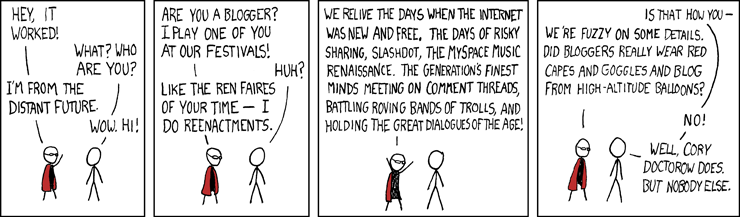
. Erin posts about Dragonsinger illustrator Elizabeth Littman, whom you will instantly love for her heart and care.10 simple ways to write faster started off really nice. Maybe I found it nice because I'd already converted to the Church of the Outline and the article writer was preaching to the choir. Then as it went on, I sorta wanted to deck the preacher. Probably feeling pugnacious because I've been sitting too long at my desk.
Your life in photos: your life, that is, if you lived at IKEA.
From xkcd -- read it on its original page
Friday, May 13, 2011
Adolescent me does a happy dance
 So I don't normally post about when I make a submission to a journal or anthology -- there's all sorts of reasons why. Everything from the superstitious don't wanna jinx it to the vanity based don't wanna look stupid if I don't make it comes to mind. And I especially don't blog when a submission isn't picked up. However, this post isn't about making a submission to a market or the market's reply, it's about how damn, amazingly geeked my thirteen-year-old self is right now.
When I was about thirteen, somewhere in that seventh to ninth grade range, I read a lot of Sword and Sorceress

 anthologies. They were all short fantasy stories focused on heroines -- right up my alley. I particularly remember the S&S anthology with the cover at left. I'm absolutely certain that was one I owned not I borrowed from the library or theLiz.
Back then, Marion Zimmer Bradley was still editing these anthologies. After she died, the series went on a little hiatus and I lost track of it.

The month-long submission period came. And went.
I changed my promise to I'll submit ... someday.
I'm here to report that someday is today. My thirteen-year-old self would be reporting to you, except she's too busy doing a happy dance.
Of course I would love to be published in this anthology, but for the moment, the act of sending in a story is far more important. Sending in the story means that I'm now engaging a world that brought me joy as a reader.
I think I lose track of that sometimes -- we all probably lose track of that sometimes. In the race to get published, then the race to get more -- more readers, more prestigious markets, more publication credits -- it's easy to submit to markets that we've never read. Some would even claim it's necessary. But there's undoubtedly something warm and fuzzy about submitting work to a market that has, at any point in your life, brought you joy.
Tuesday, May 10, 2011
Recovery: an addendum to the Odyssey workshop experience

I've heard it described as a "boot camp." I've never been to boot camp, but I have played varsity sports. Odyssey is like pre-season. You're learning the skills and building muscle memory and creating endurance. It's rigorous. You push yourself to the limit and you fall asleep exhausted each night. Before regular season starts, coach gives you a long weekend off and you tell all your friends you'll meet up with them and then never see them because you fell asleep on the couch in the middle of the day. But making varsity doesn't mean you feel like you're good enough for varsity yet. You screw up. Other players are smother, quicker, already know how to work with teammates you've just met. The first time you touch the ball in a real game isn't to make a pass, it's when you foot foul and lose the ball to the other team.
When I got home from Odyssey I slept. I woke up the next day, made coffee, sat down on the couch and fell asleep before the pot had finished brewing. Four hours later I woke up. My incessant need for sleep lasted about three days. I thought that was the "recovery" period which was discussed while I was at Odyssey. But then I couldn't write. This was something I was prepared for because so many people had told me about it. So I made myself write--I felt very righteous about this, btw--even if I knew it was drivel, at least I was maintaining momentum. I thought I'd beaten the "post-Odyssey low," the one that people talked about with sad, compassionate faces in low, reverent tones.
I read 15 books in under three weeks--a pace that, for me, meant I was spending almost every waking moment reading. It turns out this was my withdraw. I wanted to write but couldn't, so I self-medicated with books. It was painful. The books that didn't live up to my Odyssey education nearly got flung into walls in my disgust. But then I ended up reading some extremely well written books. They were doing all the things I'd been taught at Odyssey and avoiding all the pitfalls I now recognized in lesser books. I despaired. I was certain I'd never be as good as those writers, so what was the point?
These were symptoms of the "post-Odyssey low" which I wasn't prepared for.
Just like everything else, I was sure it wouldn't happen to me--I was still writing after all. But sometimes the low takes the form of not writing, and sometimes it takes the form of not believing in yourself. But eventually you get yourself back together--or you give up on writing altogether.
Thankfully, I read some novels that were neither amazing nor crap. They made me feel neither sad nor angry. They made me feel like I, too, was a storyteller who could succeed. But I still wasn't able to write anything I was proud of, even if I was out of my death-spiral of self-loathing.
It was December, five months later, before I was ready to tackle a rewrite of a story I'd workshopped at Odyssey. And it wasn't until January or February that I'd finished a rewrite I wanted to show someone. (The rewrites of the rewrites are almost done as I write this in May). I wrote during those five months. Came up with a couple short stories (one of whichI threw out) and plotted a novel which I partially wrote and then restarted from scratch.
I kept working with my Odyssey classmates (online, now that we'd scattered across the world once again), worked with a new mentor, and finished my MFA. Being able to talk with others about what you've learned and how to implement it is an important part of Odyssey recovery.
I kept working with my Odyssey classmates (online, now that we'd scattered across the world once again), worked with a new mentor, and finished my MFA. Being able to talk with others about what you've learned and how to implement it is an important part of Odyssey recovery.
Photo credit: gorjan123
Sunday, May 08, 2011
Saturday, May 07, 2011
Tuesday, May 03, 2011
Last act of the semester: grading
One more thing to do before I'm done with this semester: submit final grades for my students. After which, this blog will return to some semblance of normalcy which it lacked the past two weeks while semester wound up and I got uber-busy. So Rosie and I are chained to the desk for the day reading final essays.

Yep. Chained to the desk. Or, erm, cat pillow that sits on the desk. Hard at work. Grading away.

And grading ...


Yep. Chained to the desk. Or, erm, cat pillow that sits on the desk. Hard at work. Grading away.

And grading ...

And grading ...

Oof, hard work.
Subscribe to:
Posts (Atom)
Highly Recommended
